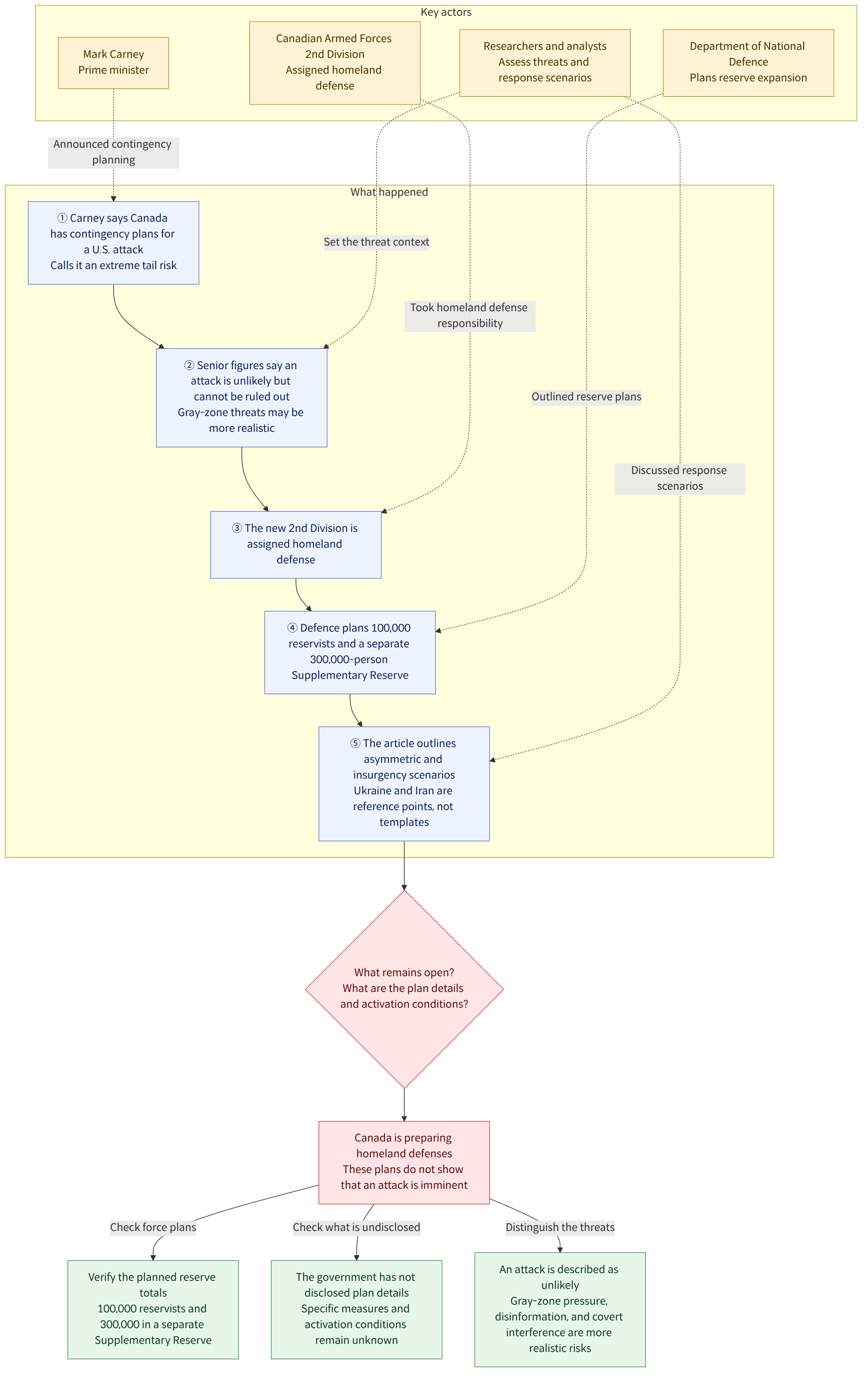
Canadian Prime Minister Mark Carney recently said Canada has contingency plans for the possibility of a U.S. military attack. He described it as an “extreme tail risk” that should not be ignored, even though it is highly unlikely. The article reports that several senior political and military figures have also said the threat is unlikely to materialize but cannot be ruled out entirely.
Background and context
The article presents researchers’ argument that public statements by U.S. President Donald Trump alone do not fully explain the seriousness of the threat to Canadian sovereignty. At the same time, it suggests that the main risks facing Canada may be gray-zone attacks (pressure that blurs the line between war and peacetime), disinformation campaigns, and covert political interference rather than all-out war.
This distinction matters. Including the possibility of a military attack in contingency planning is not the same as concluding that an attack is imminent. The article says the Canadian government has not disclosed the details of its contingency plans, and it does not provide the government’s specific assessment of the likelihood of an attack.
The Canadian Armed Forces’ new 2nd Division (제2사단) has been assigned responsibility for homeland defense. The article also reports that the Department of National Defence (국방부) plans to expand the reserves to 100,000 personnel and create a separate Supplementary Reserve (보충예비군) of 300,000. The article’s authors draw attention to the significant number of personnel being prepared for homeland defense, but the plans themselves are not evidence that a U.S. attack is imminent.
What this news means
The article divides Canada’s military response scenarios, in the absence of nuclear weapons, into conventional asymmetric warfare and insurgency warfare. Conventional war means a conflict between the regular armed forces of states. The article reports that, given the disparity in military power, most analysts believe the United States would easily defeat Canada in a conventional war.
But discussions of a response are not limited to the outcome of an all-out war. Asymmetric warfare involves weakening an adversary’s advantages and raising the cost to them rather than confronting a stronger opponent head-on. The article cites Ukraine’s use of drones, commercial satellites, mobile surface-to-air missiles, electronic warfare, and networked intelligence systems to impose heavy costs on Russian forces. It also notes, however, Ukraine’s significant reliance on foreign resources and technology transfers.
Iran’s “strategic denial” is also presented as a comparison. This is an approach that makes it costly for an adversary to achieve its objectives and makes those objectives difficult to attain. The article explains that Iran has a structure in which regular military units and networks of proxy forces are dispersed so that they can continue fighting even if command centers, communications networks, or key bases are attacked. These cases are cited as points of reference for a country with a significant military disadvantage considering how to defend itself, rather than as plans Canada should simply copy.
If a country cannot sustain a defense like Ukraine’s or Iran’s, the article presents guerrilla warfare as an alternative. In this scenario, military personnel shed their uniforms, blend into society, and fight the occupying force. This is an extreme stage based on the assumption that a country’s regular defense has failed and it has been occupied.
For example, if Canada is reviewing contingency plans, readers should distinguish between plans for deterrence and homeland defense and plans that include responses to actual combat. The information currently available to the public does not reveal the specific measures in the contingency plans or the conditions for putting them into effect.
What is known and what remains unknown
What is known
- Prime Minister Carney said Canada has contingency plans for the possibility of a U.S. military attack and described that possibility as an “extreme tail risk.”
- The article reports that senior political and military figures consider the threat unlikely but say it cannot be ruled out entirely.
- The Canadian Armed Forces’ new 2nd Division (제2사단) has been assigned responsibility for homeland defense.
- The article reports that the Department of National Defence (국방부) plans to have 100,000 reservists and a separate Supplementary Reserve (보충예비군) of 300,000.
- The article describes conventional asymmetric warfare and insurgency warfare as two scenarios for responding to military threats.
What remains unknown
- What specific military measures are included in Canada’s contingency plans?
- When and how will plans to expand the reserves and the Supplementary Reserve be implemented?
- How likely does the Canadian government consider a U.S. military attack to be?
What readers should look for
- Distinguish plans to expand the reserves from actual changes in how forces are deployed or organized. The article does not provide detailed timelines or implementation methods.
- Future explanations of contingency plans may help clarify the nature of the threat if they specify whether the plans address all-out war or gray-zone attacks, disinformation, and political interference.
- When Ukraine and Iran are mentioned as comparisons, avoid treating their situations and Canada’s plans as identical. Read the examples cited in the article separately from measures confirmed in Canada.