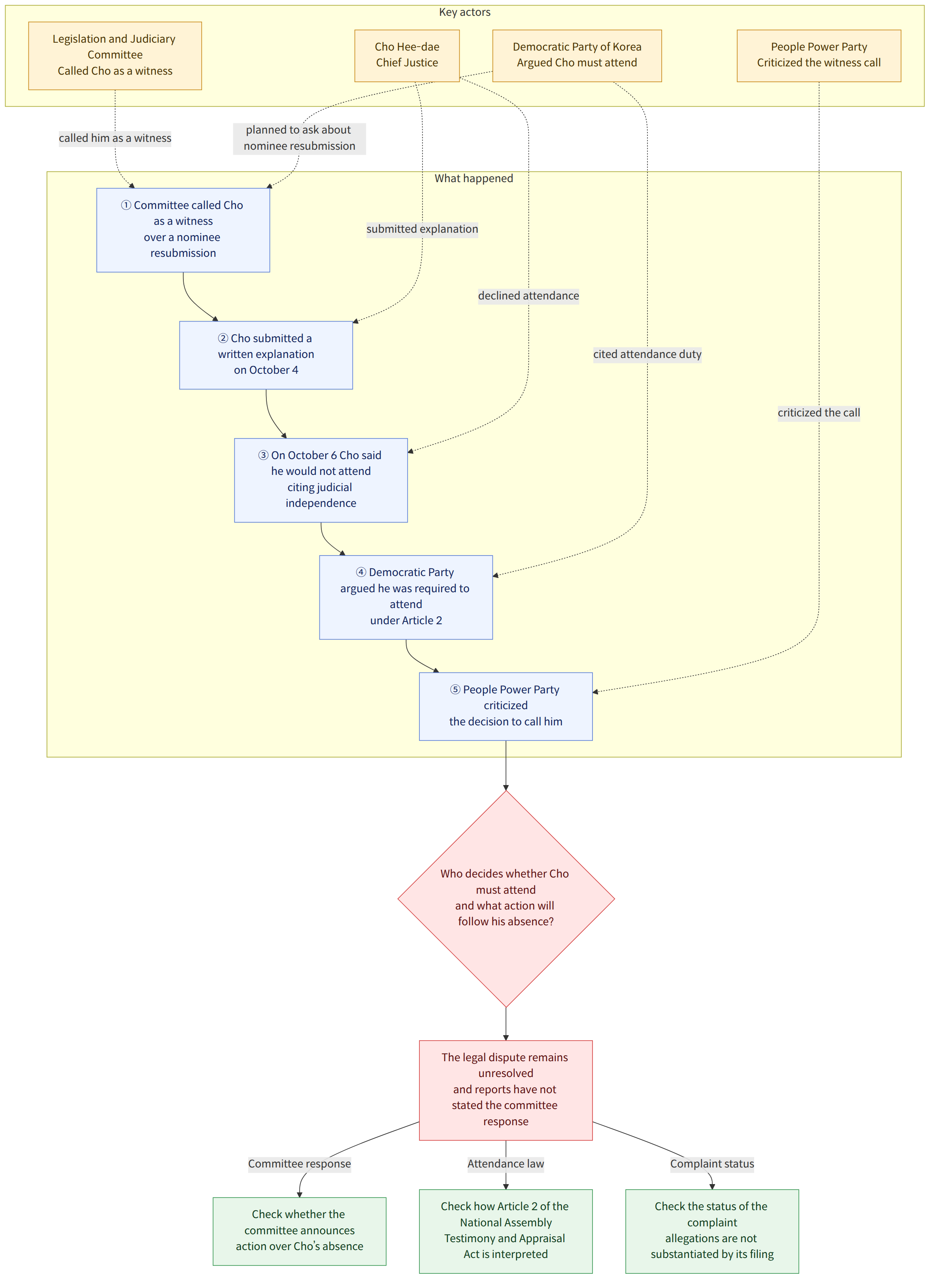
On October 6, Chief Justice of the Supreme Court (대법원) Cho Hee-dae said he would not attend the National Assembly Legislation and Judiciary Committee (국회 법제사법위원회)’s audit of the Supreme Court as a witness. The Democratic Party of Korea (더불어민주당) said that Chief Justice Cho had submitted a written explanation for his absence on October 4. He cited the view that testifying about his authority to recommend Supreme Court justice nominees would conflict with the separation of powers and judicial independence, and said it would be difficult to disclose sensitive matters such as information about the candidates and discussions with the president.
The central issue surrounding his absence is where the line falls between the National Assembly’s demand that a witness attend and the judicial independence invoked by the chief justice. Reports have not said what action the committee will take over his absence.
Background and context
The decision to call him as a witness is tied to the issue of resubmitting a Supreme Court justice nominee. According to reports, the Democratic Party intends to ask during the audit about the circumstances in which Chief Justice Cho rejected the Blue House (청와대)’s request to resubmit a nominee. In his written statement, Chief Justice Cho argued that his authority to recommend nominees is an independent constitutional power of the chief justice, and that requiring him to testify before the National Assembly about how he exercises that power would run counter to the principles of separation of powers and judicial independence.
Chief Justice Cho also said it would be inappropriate to disclose in detail information about the candidates, sensitive matters related to ongoing personnel decisions, or discussions with the president. He wrote that, given that a complaint had been filed over his exercise of the recommendation authority and that investigative proceedings could follow, it would be difficult for him to appear as a witness and answer questions. The article reports that a civic group filed a complaint with the Corruption Investigation Office for High-ranking Officials (고위공직자범죄수사처) against Chief Justice Cho and Noh Kyung-pil, head of the Court Administration Office, alleging abuse of authority and dereliction of duty. This is a report that a complaint was filed; it does not mean the allegations have been substantiated.
The two sides also disagree on how to interpret the obligation to attend. Democratic Party spokesperson Lee Yong-woo cited Article 2 of the National Assembly Testimony and Appraisal Act (국회증언감정법), arguing that anyone who receives a demand to appear as a witness must comply. In his written statement, Chief Justice Cho took the position that provisions of the National Assembly Act did not impose an obligation to attend and answer questions. The legal arguments over the National Assembly’s authority to demand testimony and the independence of the head of the judiciary are in conflict, but the reports provided do not establish a final legal determination on the issue.
The political dispute has continued. Seo Young-kyo, a Democratic Party lawmaker who chairs the Legislation and Judiciary Committee, repeatedly called on Chief Justice Cho to attend and said he should step down if he had no intention of explaining himself to the public. By contrast, People Power Party (국민의힘) senior deputy floor leader and spokesperson Choi Eun-seok criticized the Democratic Party, saying it should bring before the public the witnesses it had blocked from appearing before pressuring Chief Justice Cho. Reports say the People Power Party is seeking to have Kim Hyun-ji, head of the Blue House’s First Secretariat, and Kim Yong-beom, former head of the Blue House Policy Office, among others, called as witnesses.
What this news means
A parliamentary audit is a process through which the National Assembly examines the work of the government and public institutions, while the chief justice is the head of a constitutional body that leads the judiciary. This case raises both the question of how far the National Assembly can go in asking about judicial administration and the process for recommending Supreme Court justice nominees, and whether answering those questions could compromise judicial independence or sensitive personnel information. The fact that the two sides’ arguments conflict does not, by itself, establish that either side’s legal interpretation is definitive.
For the public, a key concern may be how judicial appointments and the National Assembly’s oversight are explained and held accountable. The effectiveness of demands to attend is worth watching because the public can examine the circumstances behind public decisions only if the process of the National Assembly asking questions and the judiciary answering them works. At the same time, it is necessary to consider how detailed testimony about the chief justice’s exercise of his recommendation authority could affect sensitive personnel information or judicial independence. Rather than reaching a conclusion based solely on the concerns of either side, the scope of the questions asked by the National Assembly and the specific reasons why answers might need to be limited could serve as criteria for judgment.
For example, if voters want to know how a Supreme Court justice nominee came to be recommended, they can look at what the National Assembly asked, why Chief Justice Cho declined to answer, and what steps the Legislation and Judiciary Committee takes afterward. However, current reports do not say how the issue of his absence or the resubmission of a nominee was addressed at the October 6 audit, or what action the committee took over his absence.
Relevant procedures and legal information
The general standards for the complaint procedure and the alleged offenses connected to this case can be reviewed. According to a guide based on consultation cases from the Korea Legal Aid Corporation (법률구조공단), a person who is not entitled to file a criminal complaint may still file a report of an offense, and complaints or reports may be made verbally or in writing to a prosecutor or judicial police officer. If made verbally, a written record must be prepared. This is general procedural information and does not explain what stage the civic group’s complaint reported in the article has reached.
Dereliction of duty is not established merely because someone neglected or improperly handled their duties; it is important whether they consciously abandoned or relinquished those duties. Abuse of authority requires consideration of whether a public official unlawfully exercised their general official powers, among other factors. Therefore, the fact that complaints have been filed against Chief Justice Cho and Court Administration Office head Noh Kyung-pil is not enough to determine whether either offense has been committed. An actual determination requires specific facts, including the circumstances of the conduct and the authority and roles of the people involved.
Handling a complaint requires an examination of the facts and applicable laws in each case. A legal guide explains that even when a time limit for handling a case is set, the fact that the deadline has passed does not, by itself, invalidate a later decision. It also says that in a case in which prosecution is declined, a complainant may request access to or copies of documents containing their own statements or documents they submitted, but access may be restricted to protect privacy or avoid hindering an investigation. This is general guidance and does not establish the outcome of the complaint reported in the article or the rights of the parties involved.
Points reported differently
Reports consistently said that Chief Justice Cho intended not to attend, had submitted a written explanation, and faced calls to attend from the Democratic Party as well as criticism from the People Power Party. However, one report anticipated that, as had been customary before the audit, Chief Justice Cho would deliver only opening remarks. Other reports did not confirm that expectation or describe what actually happened on October 6, so his attendance or remarks at the audit cannot be treated as established facts.
What is confirmed and what remains unknown
Confirmed facts
- Chief Justice Cho Hee-dae said he would not attend the National Assembly Legislation and Judiciary Committee’s audit of the Supreme Court on October 6 as a witness.
- The Democratic Party said that Chief Justice Cho submitted a written explanation for his absence on October 4.
- Chief Justice Cho cited concerns about the separation of powers and judicial independence related to testimony on his recommendation authority, sensitive personnel information, and the possibility of an investigation as reasons for his absence.
- The Democratic Party called on him to attend, while the People Power Party criticized the Democratic Party’s decision to call him as a witness. Reports say the People Power Party is seeking to have Chief Kim Hyun-ji and former chief Kim Yong-beom, among others, called as witnesses.
What remains unknown
- Reports have not said what action the Legislation and Judiciary Committee will take over Chief Justice Cho’s absence.
- It has not been confirmed how the issue of his absence or the resubmission of a Supreme Court justice nominee was actually addressed at the October 6 audit.
- The reports provided do not give the status of the investigation into the complaints against Chief Justice Cho and Noh Kyung-pil, or the outcome of those cases.
- It is not known how the legal arguments between the National Assembly and the Supreme Court over the obligation to attend and the scope of testimony will be resolved.
What readers should check
- Check what procedures or actions the Legislation and Judiciary Committee later decides on regarding the absence.
- If the audit proceedings are made public, review how the circumstances of the nominee’s resubmission and questions and answers about the recommendation authority were handled.
- The complaint procedure and whether the offenses of abuse of authority or dereliction of duty have been committed are separate issues. When checking legal information about similar cases, do not reach a conclusion based only on the name of an alleged offense; also consider the specific facts and the laws applicable at the relevant time.
References
- Guide to Criminal Complaints and Accusations, Withdrawal, and Procedures
- How far does criminal liability extend for offenses related to public officials’ duties?
- Other coverage consulted: hani.co.kr
- Other coverage consulted: chosun.com