

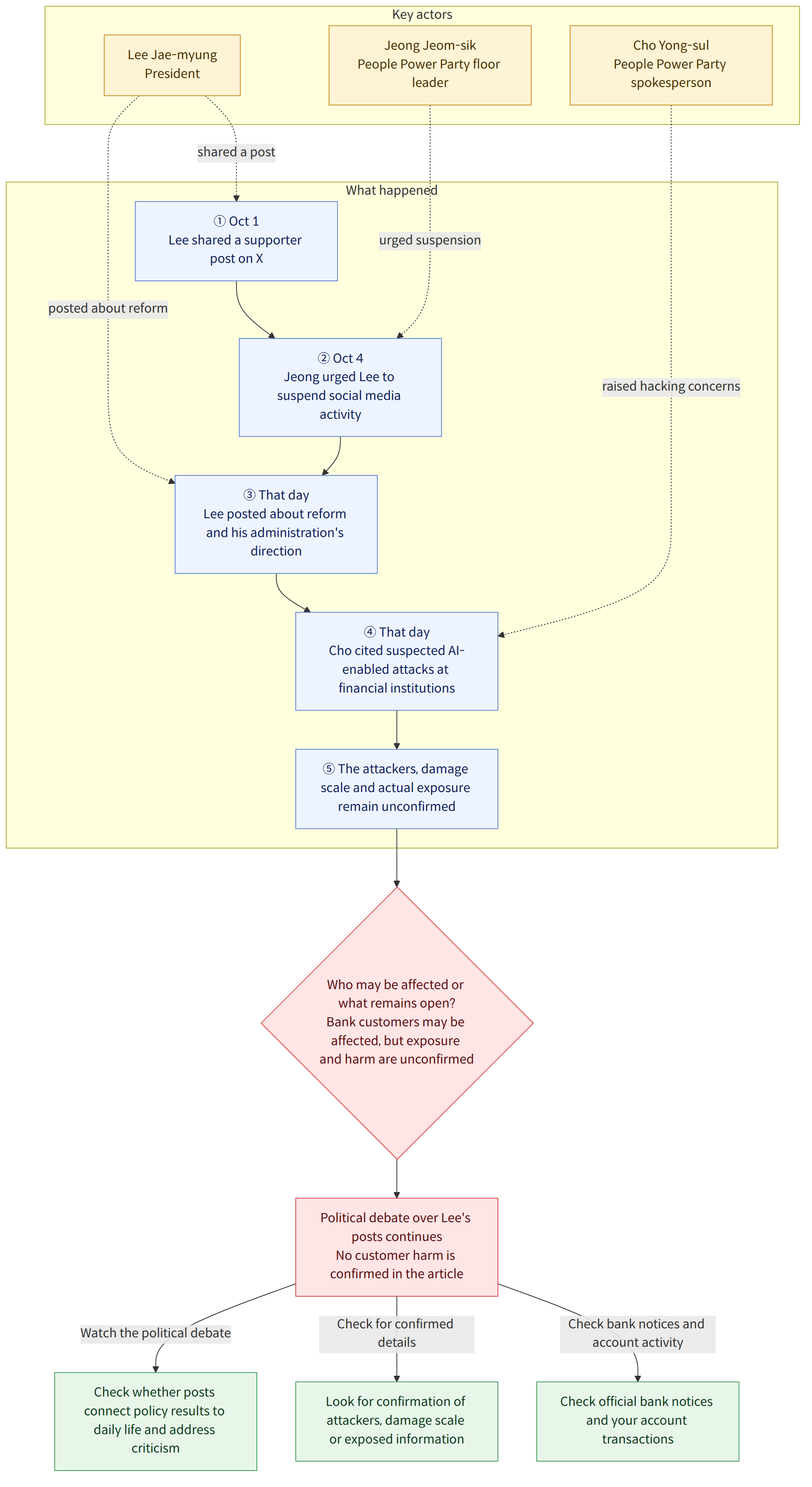
On October 4, People Power Party floor leader Jeong Jeom-sik urged President Lee Jae-myung to suspend his social media activity for the time being. He said the president’s posts were concerning because they were detached from the reality people experience. That same day, Lee posted about reform and the direction of his administration, while the People Power Party also raised concerns about suspected AI (artificial intelligence)-enabled hacking targeting the financial sector and the possible exposure of personal information. However, the article does not establish who was behind the attacks on the banks, the scale of any damage, or whether personal information was actually exposed.
Background and context
Jeong’s criticism targeted a post Lee shared on X on October 1, in which he reposted a supporter’s post and wrote, “Many of you, please join us—‘jwa-ah-hage,’ as it were.” According to the report, “jwa-ah-hage” is an expression used among New Lee Jae-myung (뉴이재명), Lee’s hard-line supporters. It is a play on “u-ah-hage,” meaning “gracefully,” replacing “u” (right) with “jwa” (left), a reference to the progressive camp. Jeong criticized the president’s social media politics with the punning term “jwa-mae-han.”
Jeong also claimed that Lee told an online commenter who criticized his dinner with former leader Jeong Cheong-rae to “take things in the right perspective.” He criticized as self-congratulation Lee’s statement that the country and economy were returning to normal, made while sharing a post by Minister of Planning and Budget Park Hong-geun (기획예산처). These are Jeong’s assessments and should be understood as part of the political debate over how often the president uses social media and whether his remarks are appropriate.
Lee’s posts, as described in another report, carried a different message about governing from Jeong’s criticism. Lee said reform should lead to results that improve people’s lives, rather than serve as a way to gain political credit or attention, and said he would pursue “pragmatic reform.” In response to speculation about a rift with former leader Jeong Cheong-rae, he said the two were comrades and asked people not to misunderstand. The report also said Lee pressed the Ukrainian government over the repatriation of North Korean soldiers held as prisoners of war, warning that he would take further action if it refused to acknowledge the facts and issue a public apology.
The dispute over economic performance continued as well. People Power Party spokesperson Cho Yong-sul criticized Lee’s description of an economic recovery, based on factors including growth forecasts, as self-congratulation. Cho also claimed that a poll released on September 23 found that 65.7% of respondents rated the current economic situation as bad. Democratic Party of Korea (더불어민주당) spokesperson Lee Yong-woo countered by citing periods of negative growth under the Yoon Suk Yeol administration and the policies of the Lee administration, arguing that the economy was recovering. These figures and assessments should be understood as claims made by the parties’ respective spokespeople.
What this news means
The president’s social media accounts are a way to deliver messages about the administration quickly, but the wording and reactions to those posts can also become the focus of political debate. The issue, therefore, is not only whether the president uses social media. It is also worth watching whether his messages connect to explanations of policy results and people’s daily lives, and how he responds to criticism or opposing views.
Concerns about hacking in the financial sector require fact-checking separately from political rhetoric. Spokesperson Cho said that suspected attacks using AI tools had occurred simultaneously at a minimum of six institutions, including Shinhan Bank, KB Kookmin Bank, Hana Bank, Woori Bank, NH NongHyup Bank, and BNK Busan Bank. However, this information alone does not confirm that personal information was exposed or that customers suffered harm. The phrase “suspected attacks” and “concerns about exposure” should be distinguished from confirmed damage.
For example, if someone who uses one of the banks sees news about the attacks, it would be reasonable to check the bank’s official notices and their own account transactions rather than assume, based on the report alone, that their information has been exposed. This is general advice for distinguishing unconfirmed concerns from events that have actually affected an individual; it is not a procedure for confirming damage described in the article.
The fact that a possible attack has been reported is different from confirmation that personal information was actually exposed. The article does not confirm whether information was exposed or the scale of any damage.
What is confirmed and what is still unknown
Confirmed facts
- In a Facebook post on October 4, floor leader Jeong Jeom-sik urged President Lee to suspend his social media activity for the time being.
- On October 1, Lee shared a supporter’s post on X and used the expression “jwa-ah-hage.”
- Lee was reported to have posted his positions on reform and improving people’s livelihoods on social media on October 4.
What is still unknown
- The article does not say whether Lee responded to Jeong’s recommendation or will actually suspend his social media activity.
- The attackers behind the incidents targeting the banks, the scale of any damage, and whether personal information was actually exposed have not been confirmed.
- This article alone does not make clear what responses were taken by each bank or what measures the government announced.
What readers can check
- Distinguish politicians’ assessments of the president’s social media remarks from what the president actually posted.
- For reports of attacks on the financial sector, check whether the attacks are only suspected or confirmed, and separately whether exposure of personal information has been confirmed.
- If you use one of the banks involved, check its official notices and your account transactions, and contact the bank if you see any unusual activity.
References
- Other coverage consulted: hani.co.kr
- Other coverage consulted: chosun.com

















