

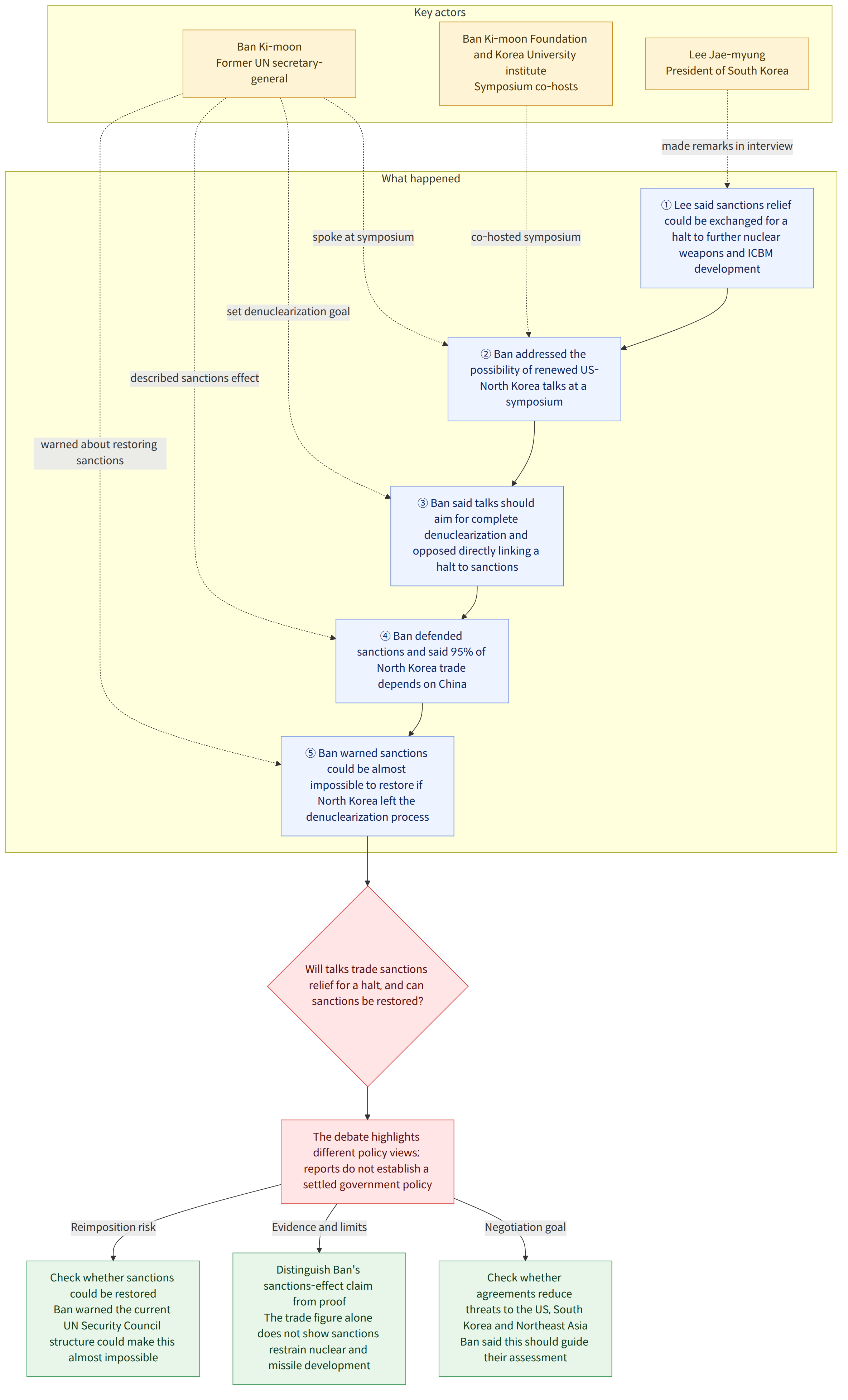
Former UN Secretary-General Ban Ki-moon said that even if US-North Korea talks resume, their goal should be North Korea’s complete denuclearization. He said it would be dangerous to directly link a halt to North Korea’s nuclear and missile development with sanctions, and argued that sanctions and pressure should continue and that North Korea’s human rights should also be addressed. He made the remarks in a keynote speech at a symposium held at Korea University (고려대학교) on the 29th of last month.
The background to the debate is an interview with President Lee Jae-myung by The New York Times. According to the article, Lee said there was value in trading sanctions against North Korea, which have had limited effectiveness, for a halt to the development of additional nuclear weapons and intercontinental ballistic missile (ICBM, a ballistic missile that flies across continents) technology. Ban opposed this proposal, saying it would be dangerous to directly link sanctions with a halt to nuclear and missile development.
Background and context
The symposium was co-hosted by the Ban Ki-moon Foundation for a Better Future (보다 나은 미래를 위한 반기문재단) and Korea University’s Institute for Unification and Convergence Studies (고려대 통일융합연구원). Its theme was “Order After Order: The Reshaping of International Security and Peace on the Korean Peninsula.” Speaking about issues on the Korean Peninsula, Ban addressed the possibility of renewed US-North Korea talks and the goals that should be set for them.
The goal he put forward was North Korea’s complete denuclearization (CVID). After saying that agreements reached during the denuclearization process should be assessed to determine whether they substantially reduce threats to not only the United States but also South Korea and all of Northeast Asia, Ban voiced concern about directly tying a halt to nuclear and missile development to sanctions.
Ban also disagreed with the assessment that sanctions against North Korea are ineffective. He said their effect was clear, and that 95% of North Korea’s trade depends on China because of international sanctions. This is Ban’s explanation of the effect of sanctions; the remarks alone do not establish a causal link showing that sanctions restrain nuclear and missile development.
What particularly concerned him was whether sanctions could be reimposed after being lifted. Ban said that if North Korea departed from the denuclearization process, it could be almost impossible to restore sanctions under the current structure of the UN Security Council. His argument can therefore be read as a warning that policymakers should consider not only whether sanctions should be used as a bargaining chip, but also whether sanctions can be reversed once lifted.
What this news means
The remarks highlight two interrelated issues in North Korea policy. One is whether to maintain complete denuclearization as the goal of negotiations; the other is whether a halt to the development of additional nuclear weapons and ICBM technology can be exchanged for sanctions relief. President Lee’s interview remarks referred to the value of such an exchange, while Ban considered the linkage dangerous. However, the reports provided do not establish which proposal, if either, is the government’s settled policy.
For example, suppose US-North Korea talks resume and a proposal to exchange sanctions relief for a halt to the development of additional nuclear weapons and ICBM technology is put on the negotiating table. In that case, the debate could focus on the significance of the halt that sanctions relief might secure and on how to maintain the ultimate goal of denuclearization. In light of Ban’s concern, the difficulty of reimposing sanctions if North Korea departs from the denuclearization process after sanctions are lifted would also be part of the assessment.
This issue also matters to citizens following the government’s direction on North Korea policy. Assessing whether sanctions are effective and deciding under what conditions to adjust them are related questions, but they are not the same. A low assessment of sanctions’ effectiveness does not automatically mean that a particular exchange proposal has been adopted, and the president’s interview remarks alone are not enough to conclude that the government will pursue it in practice.
Points reported differently in different coverage
There is only one original report, so there is no basis for comparing different accounts of the same issue. However, the article includes both President Lee’s interview remarks and Ban’s rebuttal. Ban emphasized the effectiveness of sanctions and the possibility that they could not be restored, while Lee was reported to have said there was value in trading sanctions for a halt to the development of additional nuclear weapons and ICBM technology.
Confirmed facts and what remains unknown
Confirmed facts
- Ban delivered a keynote speech at the fourth symposium, held on the 29th of last month at Korea University Centennial Samsung Hall (고려대학교 백주년기념삼성관).
- The symposium was co-hosted by the Ban Ki-moon Foundation for a Better Future and Korea University’s Institute for Unification and Convergence Studies, and its theme was the reshaping of international security and peace on the Korean Peninsula.
- Ban said that even if US-North Korea talks resume, their goal should be North Korea’s complete denuclearization.
- He opposed directly linking a halt to nuclear and missile development with sanctions, and spoke of continuing sanctions and pressure and addressing North Korea’s human rights.
- According to the article, former UN Ambassador Kim Sook criticized President Lee’s approach to North Korea in a commentary on the 1st.
What remains unknown
- The original report does not say what position President Lee Jae-myung or the government took in response to criticism from Ban and former UN Ambassador Kim Sook.
- It is also unclear whether the government plans to pursue as actual policy a proposal linking sanctions with a halt to nuclear and missile development.
- It is not known whether sanctions relief and a halt to development will be discussed as specific negotiating terms in future talks.
What readers should look for
- In following future announcements, readers should distinguish the president’s interview remarks from policies formally adopted by the government.
- Readers can check whether the government says it will pursue a link between sanctions and a halt to development and, if so, what conditions and goals it sets out.
- It may also be worth comparing how expressions of the goals, such as “complete denuclearization” and “a nuclear-free Korean Peninsula,” are used in future announcements about talks with North Korea.

















