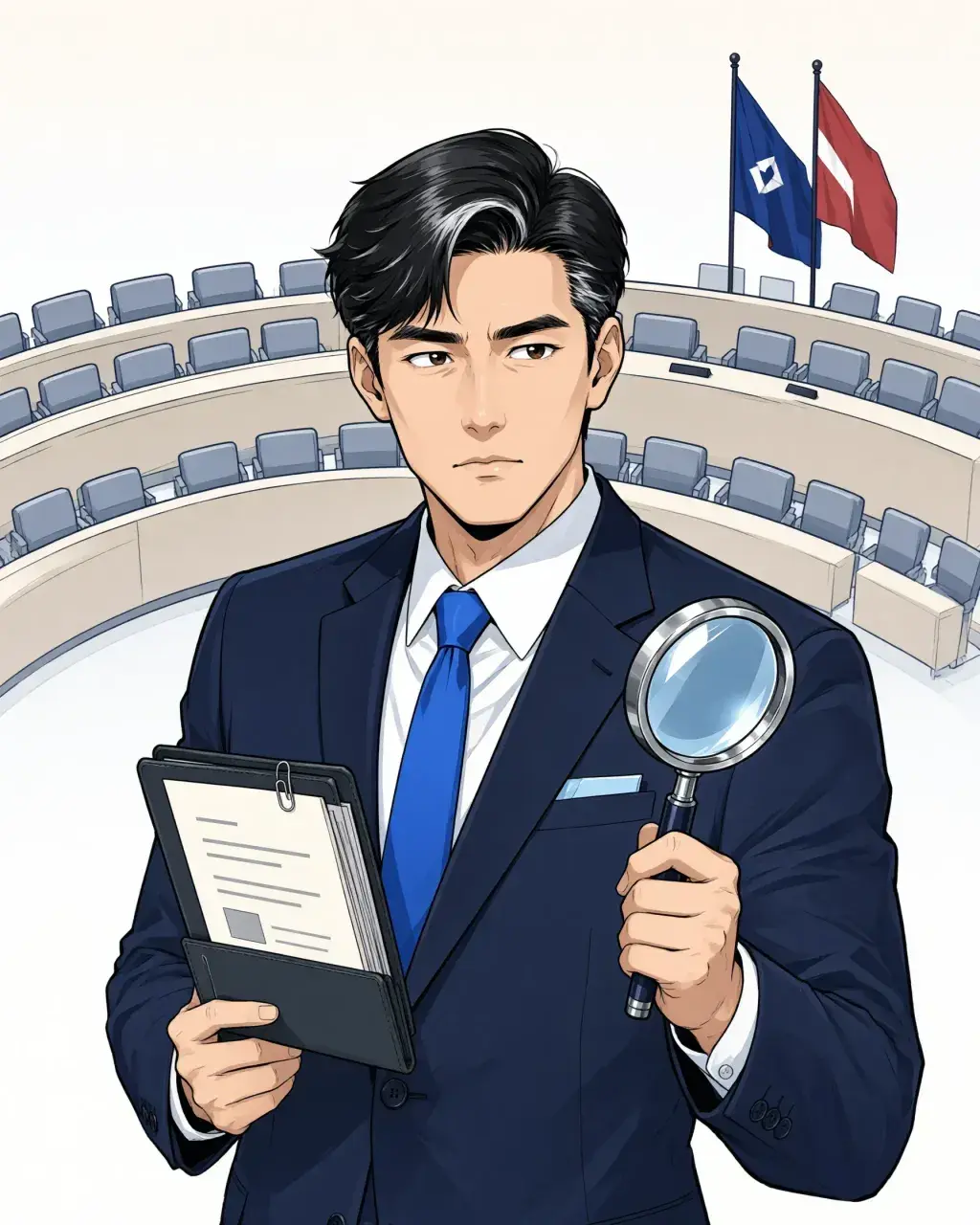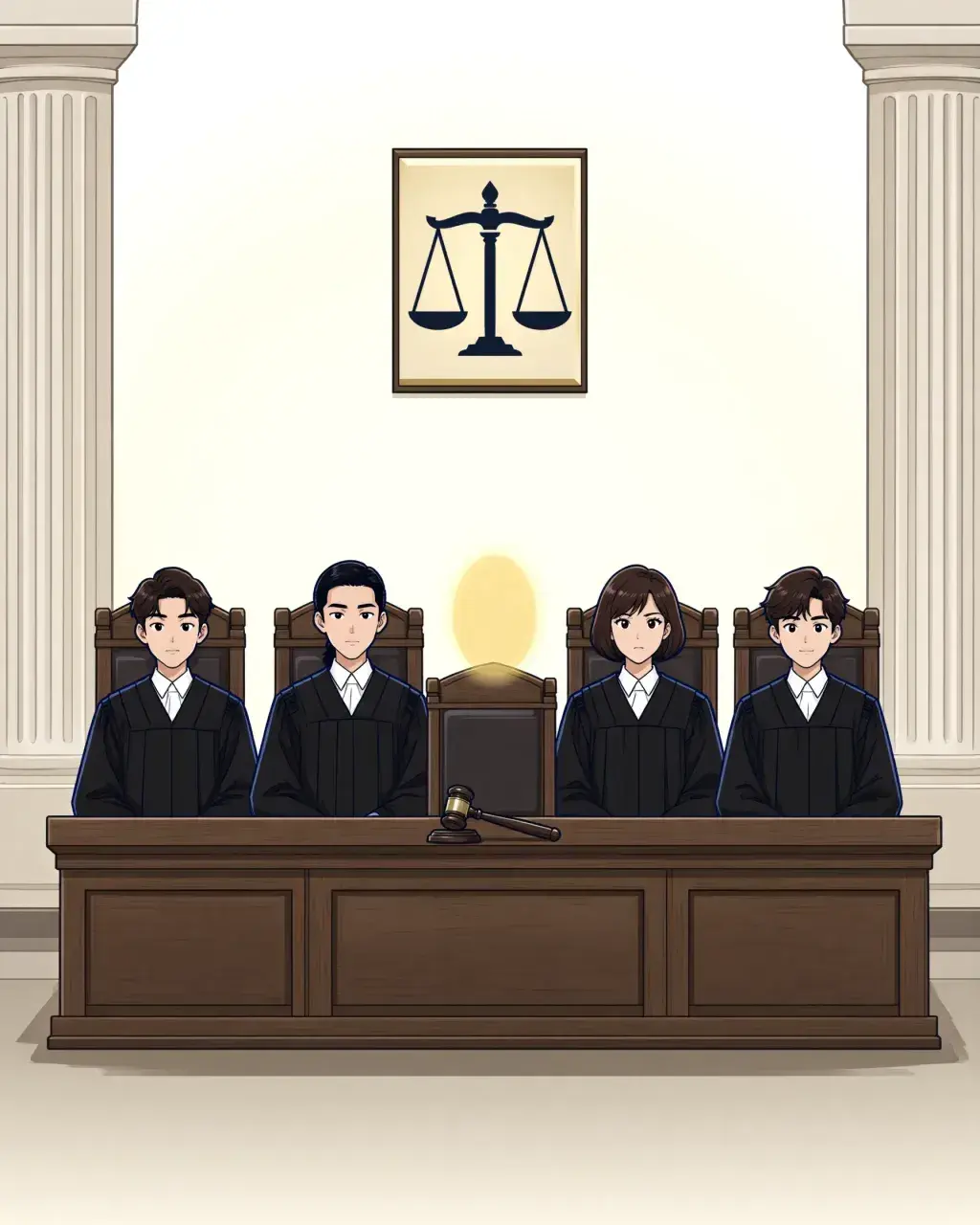
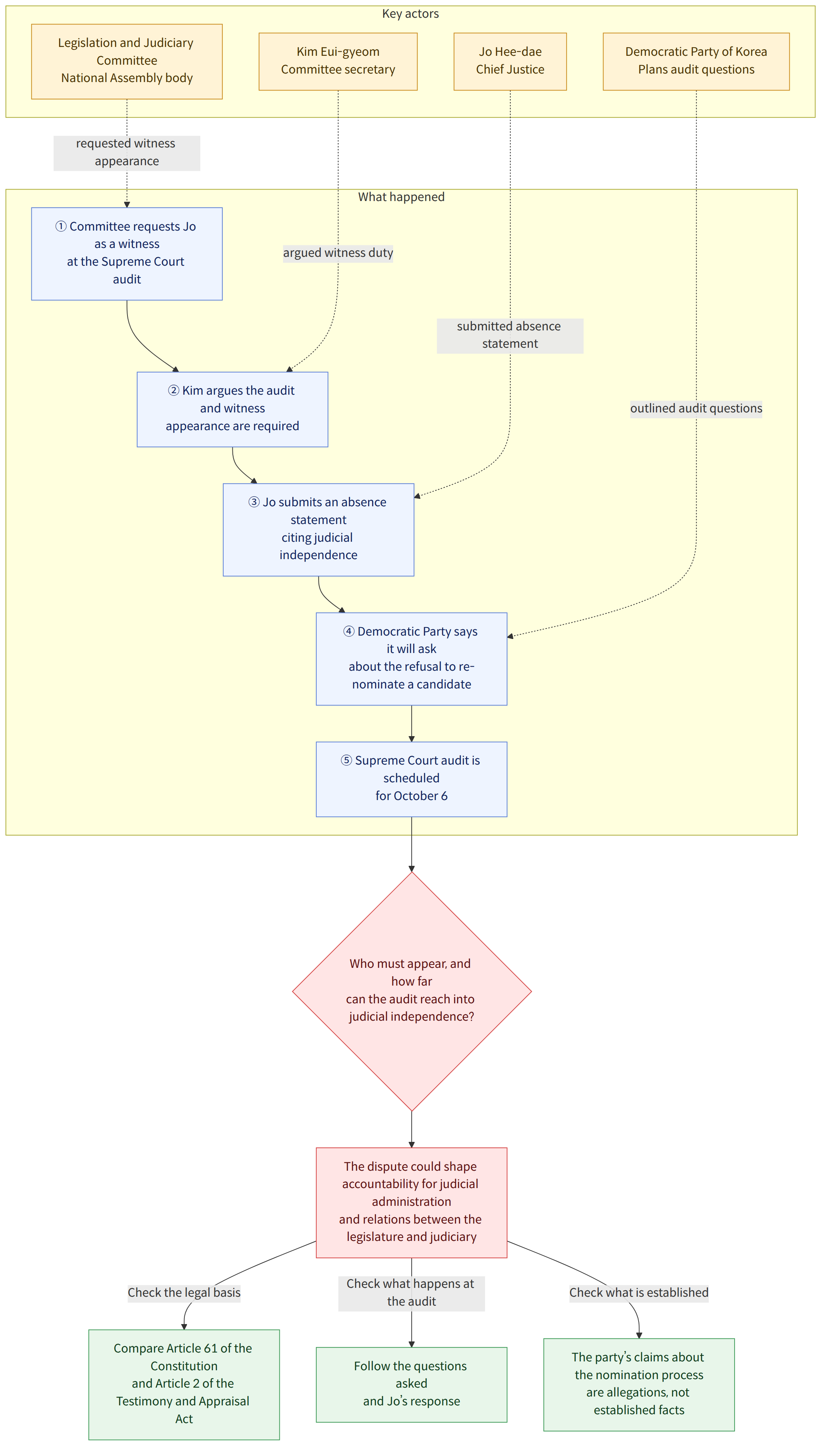
Chief Justice Jo Hee-dae submitted a statement explaining his absence in response to a request from the National Assembly Legislation and Judiciary Committee (국회 법제사법위원회) that he appear as an ordinary witness at its audit of the Supreme Court. The audit is scheduled for October 6, and the Democratic Party of Korea (더불어민주당) says it will focus its questions on the circumstances surrounding the refusal to re-nominate a candidate for Supreme Court justice. The issues are whether the Chief Justice must appear as a witness and how far the National Assembly’s audit authority can extend into the judiciary’s independent exercise of its powers.
Background and context
Kim Eui-gyeom, the Democratic Party’s Legislation and Judiciary Committee secretary, argued in a statement on October 4 that the audit is an authority of the National Assembly guaranteed by Article 61 of the Constitution (헌법 제61조), and that judicial administration is also subject to audit. Citing Article 2 of the National Assembly Testimony and Appraisal Act (국회증언감정법), Kim said that, absent a specific provision to the contrary, anyone asked to appear as a witness must comply, and that this duty also applies to the Chief Justice. He argued that the circumstances surrounding the refusal to re-nominate a candidate for Supreme Court justice do not constitute grounds for refusing to take an oath or testify.
By contrast, the statement explaining his absence submitted by Chief Justice Jo focuses on concerns about judicial independence and his authority to recommend judicial nominees. According to reports, he said that requiring him to testify in the National Assembly about his exercise of his constitutionally independent authority to recommend nominees would run counter to the purpose of the separation of powers and judicial independence, and exceed the limits of an audit under the separation of powers. He also said it would be inappropriate to disclose in detail sensitive information about candidates and ongoing appointments, as well as the contents of consultations with the president, and that the possibility of an investigation related to a complaint over his exercise of the recommendation authority could not be ruled out.
Legislation and Judiciary Committee Chair Seo Young-kyo said the request for the Chief Justice to appear as a witness cited Article 129 of the National Assembly Act (국회법), Article 10 of the Act on the Inspection and Investigation of State Administration (국정감사 및 조사에 관한 법률), and Article 5 of the National Assembly Testimony and Appraisal Act. She said Chief Justice Jo’s side had argued in its written opinion that he had no duty to appear, take an oath, or testify, while Seo maintained that a witness must take an oath and testify if they appear. The two sides interpret the application of the legal provisions and the boundaries between the powers of constitutional institutions differently. The information reported does not make it possible to conclude which interpretation is legally correct.
The central issue behind the witness request is the refusal to re-nominate a candidate for Supreme Court justice. According to reports, the Democratic Party says it will question the Chief Justice at the audit about the process behind his refusal to make a new nomination. The party also argues that questions should be asked about whether the Court Administration Office gave instructions to settle on refusing the nomination despite having expressed an opinion in favor of it. These are allegations raised by a political party; the reports do not establish that they are true.
What this news means
This issue could lead to a debate over how to protect both the National Assembly’s oversight of the executive branch and judicial administration, and the judiciary’s independence. If the National Assembly emphasizes its authority to require witnesses to appear, accountability for judicial administration and appointment processes comes to the fore. Conversely, if the argument that details of the recommendation process and appointment consultations are subject to limits on disclosure is accepted, the scope of matters that can be addressed in an audit could become contentious. Either way, the controversy will not necessarily end with the request for the Chief Justice to appear as a witness; the questions the National Assembly asks and the way the Chief Justice responds could affect relations between the legislature and the judiciary.
For example, if the Chief Justice appears as a witness and explains the circumstances surrounding the re-nomination, the National Assembly could use that explanation to examine the appointment process and accountability for judicial administration. How to handle matters said to require caution in public disclosure, such as information about candidates and the contents of consultations with the president, would nevertheless remain a separate issue. This example describes a possible scenario; it does not mean that an appearance or a particular form of response has been decided.
Seo said that if the Chief Justice failed to appear without a valid reason, legal action could be taken under Articles 12 and 15 of the National Assembly Testimony and Appraisal Act. She also said that subsequent steps, including filing a complaint, would depend on what Chief Justice Jo did regarding the request to appear. It is therefore important to distinguish the possibility raised by the Legislation and Judiciary Committee from any actual decision to take legal action, rather than interpreting the latter as already decided.
The audit will address issues beyond the re-nomination controversy. Seo said she would also scrutinize the Chief Justice’s office expenses and the budget for renovating the official residence, claiming that 2.3 billion won was requested for the renovation and 33 million won allocated for repairs to a wooden handrail. These budget figures are also issues Seo has raised for the audit; the amounts reported do not, on their own, establish whether the spending was justified.
Confirmed facts and what remains unknown
Confirmed facts
- Chief Justice Jo Hee-dae submitted a statement explaining his absence in response to the Legislation and Judiciary Committee’s request that he appear as an ordinary witness at its audit of the Supreme Court.
- Kim Eui-gyeom argued that the Chief Justice should appear, citing the National Assembly’s audit authority and the duty to appear as a witness.
- Reports say Chief Justice Jo cited his authority to recommend nominees, the separation of powers, judicial independence, the disclosure of sensitive appointment information, and the possibility of an investigation as reasons for his absence.
- Seo Young-kyo said legal action was possible if the Chief Justice did not appear and said the audit would also address his office expenses and the budget for renovating the official residence.
What remains unknown
- Reports do not confirm whether Chief Justice Jo will actually appear as an ordinary witness at the audit on October 6.
- It is not known what follow-up action the Legislation and Judiciary Committee will take if he does not appear, or whether any action will be taken after an appearance.
What readers should check
- Check whether Chief Justice Jo actually appears on the day of the audit and, if he does, how the witness oath and testimony proceed.
- Considering separately the legal grounds for the appearance request cited by the Legislation and Judiciary Committee and the reasons for absence given by Chief Justice Jo’s side can help distinguish political arguments from procedural issues.
- Check what questions and answers there are about not only the circumstances surrounding the re-nomination, but also the office expenses and the official residence renovation budget. The allegations raised and the budget figures alone do not establish illegality or impropriety.
References
- Other coverage consulted: hani.co.kr
- Other coverage consulted: chosun.com