

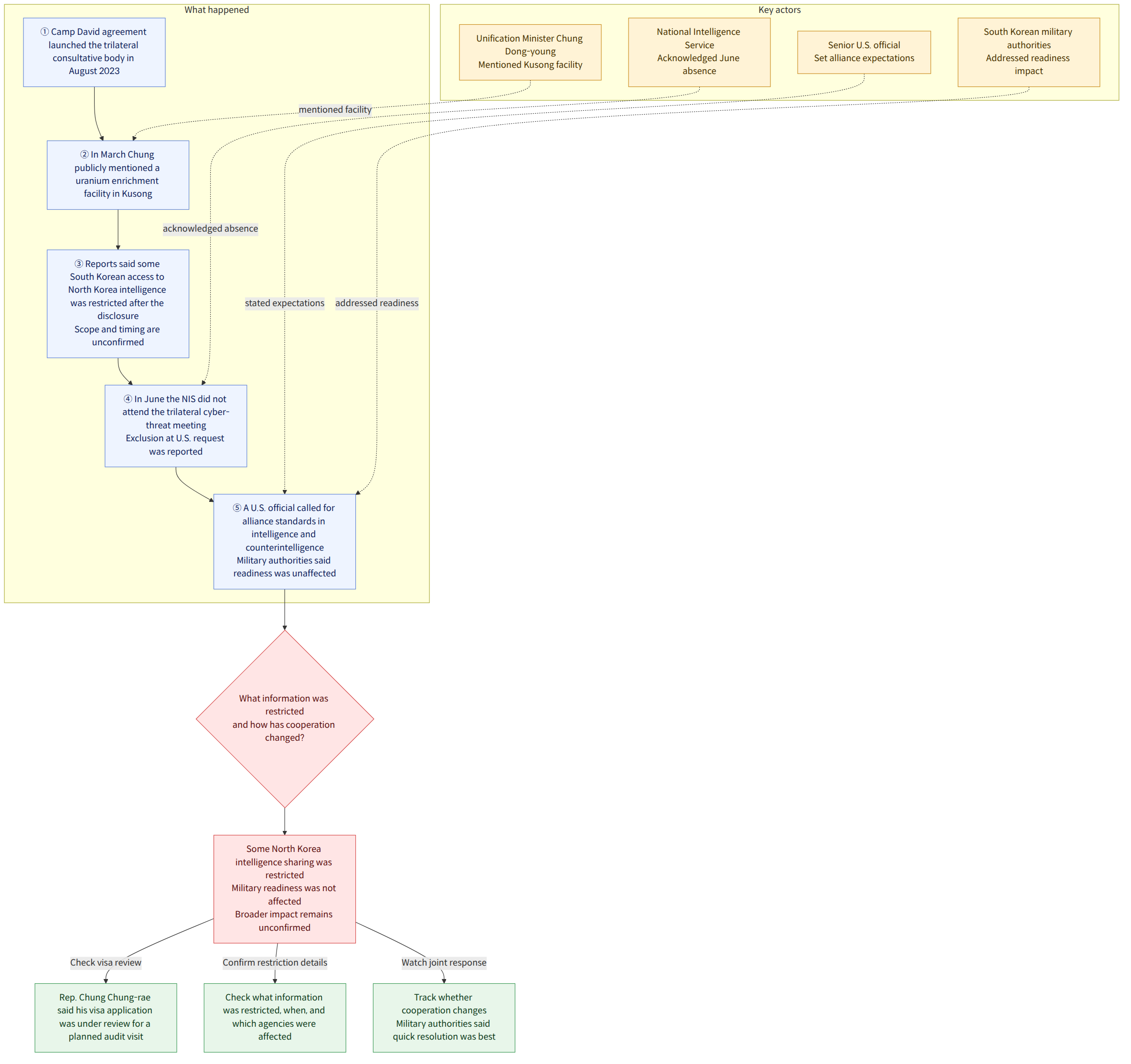
A senior U.S. official said Washington expects South Korea to uphold the standards of a decades-old alliance, as concerns about intelligence cooperation between the two countries grow. The official specifically mentioned intelligence and counterintelligence (activities to thwart intelligence operations and protect classified information). The remarks were conveyed in a written response to a question about the state of intelligence cooperation between the two countries.
Tensions have recently centered on the exclusion of South Korea’s National Intelligence Service (국가정보원) from a U.S.-South Korea-Japan meeting on responding to North Korean cyber threats in June. The National Intelligence Service acknowledged that it did not attend the meeting, and local media reported that it had been excluded at the request of the United States. Earlier, reports said friction had arisen over intelligence sharing on North Korea after Unification Minister Chung Dong-young publicly mentioned a uranium enrichment facility in Kusong, North Korea, in March.
Background and context
The remarks drew attention not simply because they reiterated the importance of the alliance, but because they specifically identified intelligence and counterintelligence. However, the public response does not reveal what problems, if any, the United States identified in South Korea’s handling of intelligence or what standards it is asking South Korea to meet. The senior U.S. official said Washington expects South Korea to uphold the alliance’s standards in intelligence and counterintelligence, but did not give specific examples or an assessment.
The National Intelligence Service, which was excluded from the meeting, reportedly attended the previous four meetings but was unable to attend the June meeting. The consultative body was launched under an agreement reached at the U.S.-South Korea-Japan summit at Camp David in August 2023, and was described as a forum for discussing intelligence sharing and joint responses to North Korea’s illicit cyber activities. The agency’s absence could therefore prompt questions not only about attendance at one particular meeting, but also about how intelligence is shared as the three countries work together to counter North Korean cyber threats.
The dispute over restricted access to intelligence is linked to Minister Chung’s remarks. Chung said he had merely shared information about the facility in Kusong that had already been made public. By contrast, media reports said the United States appeared to have restricted some South Korean access to intelligence on North Korea in protest after the disclosure. What information was restricted, and when the restrictions began and ended, have not been confirmed.
What this news means
Because intelligence cooperation involves allies sharing information and responding together, trust and the handling of information can matter. When the United States expresses expectations and reports emerge of an agency’s exclusion from a meeting and restrictions on intelligence, it is worth watching closely for changes in the scope of information South Korea receives or in how the two countries respond jointly. However, the information currently available does not establish the specific scope of the restrictions, their military impact, or the extent to which cooperation between the two countries as a whole has changed.
Military authorities acknowledged that some intelligence sharing on North Korea had been restricted, while saying that this had not affected military readiness. They also said that resolving the situation quickly would be best and that efforts were being made to do so. This indicates that restrictions on intelligence sharing have been raised, but that their existence alone does not mean readiness has been affected.
For example, if relevant South Korean agencies were receiving less information than before about a particular development in North Korea, it could be operationally important to know how any intelligence gap is being addressed and whether the joint response is changing. This is a hypothetical scenario; it has not been confirmed what information was restricted or which agencies were affected.
Rep. Chung Chung-rae’s delayed U.S. visa review was also cited as a possible sign of alliance tensions. Chung planned to visit the United States for a National Assembly audit (국정감사) of diplomatic missions in Seoul, and said on Facebook that his visa application was under review. However, an official at the Ministry of Foreign Affairs (외교부) said it was not appropriate to link an individual visa issue to the broader U.S.-South Korea relationship. The official also explained that individual applications and review outcomes are confidential under U.S. law and procedures, making it difficult to confirm details. It has not been confirmed that the visa review delay resulted from the dispute over intelligence cooperation.
Differences in how reports presented the issue
Reports on the National Intelligence Service’s exclusion and restrictions on intelligence emphasized the possibility of tensions, while also conveying the parties’ accounts of the current situation. One report said the National Intelligence Service had stated that there had been “some misunderstandings a few months ago, but that is in the past,” and that there are no misunderstandings between U.S. and South Korean intelligence authorities at present. Another report also said the agency had played down the incident. Military authorities, however, acknowledged that some intelligence sharing on North Korea was restricted. It is therefore important to distinguish between the explanation that earlier misunderstandings have been resolved and the continued reports of some restrictions on intelligence sharing.
Views also differed on whether to link the visa issue to U.S.-South Korea relations. The ruling party expressed regret over the delay, while the opposition argued that it was necessary to watch for a continuing series of warning signs in diplomacy, intelligence, and security. An official at the Ministry of Foreign Affairs said it was not appropriate to link an individual visa issue to the broader relationship between the two countries. What has been made public so far is that the visa application is under review; it has not been confirmed that the delay stems from an intelligence dispute between the two countries.
What is confirmed and what remains unknown
Confirmed facts
- A senior U.S. official said Washington expects South Korea to uphold the U.S.-South Korea alliance’s standards in intelligence and counterintelligence.
- The National Intelligence Service acknowledged that it did not attend the June U.S.-South Korea-Japan meeting on responding to North Korean cyber threats.
- Unification Minister Chung Dong-young said he had merely shared information about the uranium enrichment facility in Kusong that had already been made public.
- Military authorities said some intelligence sharing on North Korea had been restricted, but that military readiness had not been affected.
- Rep. Chung Chung-rae said his U.S. visa application was under review, and an official at the Ministry of Foreign Affairs said caution was warranted in linking an individual visa issue to the broader U.S.-South Korea relationship.
What remains unknown
- The specific scope of the North Korea-related intelligence to which the United States restricted South Korea’s access, and the duration of the restrictions, have not been made public.
- The specific intelligence and counterintelligence standards the United States is asking South Korea to meet have not been confirmed.
- It is not known when Rep. Chung Chung-rae’s visa review will be completed or what the outcome will be.
What readers should watch for
- In follow-up explanations, watch for specific details about what intelligence was restricted and for how long, as well as the basis for military authorities’ assessment of readiness.
- Check whether the National Intelligence Service participates in future U.S.-South Korea-Japan meetings, and whether intelligence sharing and joint responses to North Korean cyber threats change.
- Even if the outcome of Rep. Chung Chung-rae’s visa review is made public, it is important not to conclude, without an official explanation, that it resulted from a dispute over U.S.-South Korea intelligence cooperation.
References
- Other coverage consulted: hani.co.kr
- Other coverage consulted: en.yna.co.kr
















