
In Kansas, where Republicans have long maintained an advantage, the cost burden on farmers and dissatisfaction with Trump administration policies are turning the Senate race into a close contest. It is not yet clear, however, whether this shift will lead to a Democratic victory.
Background and context
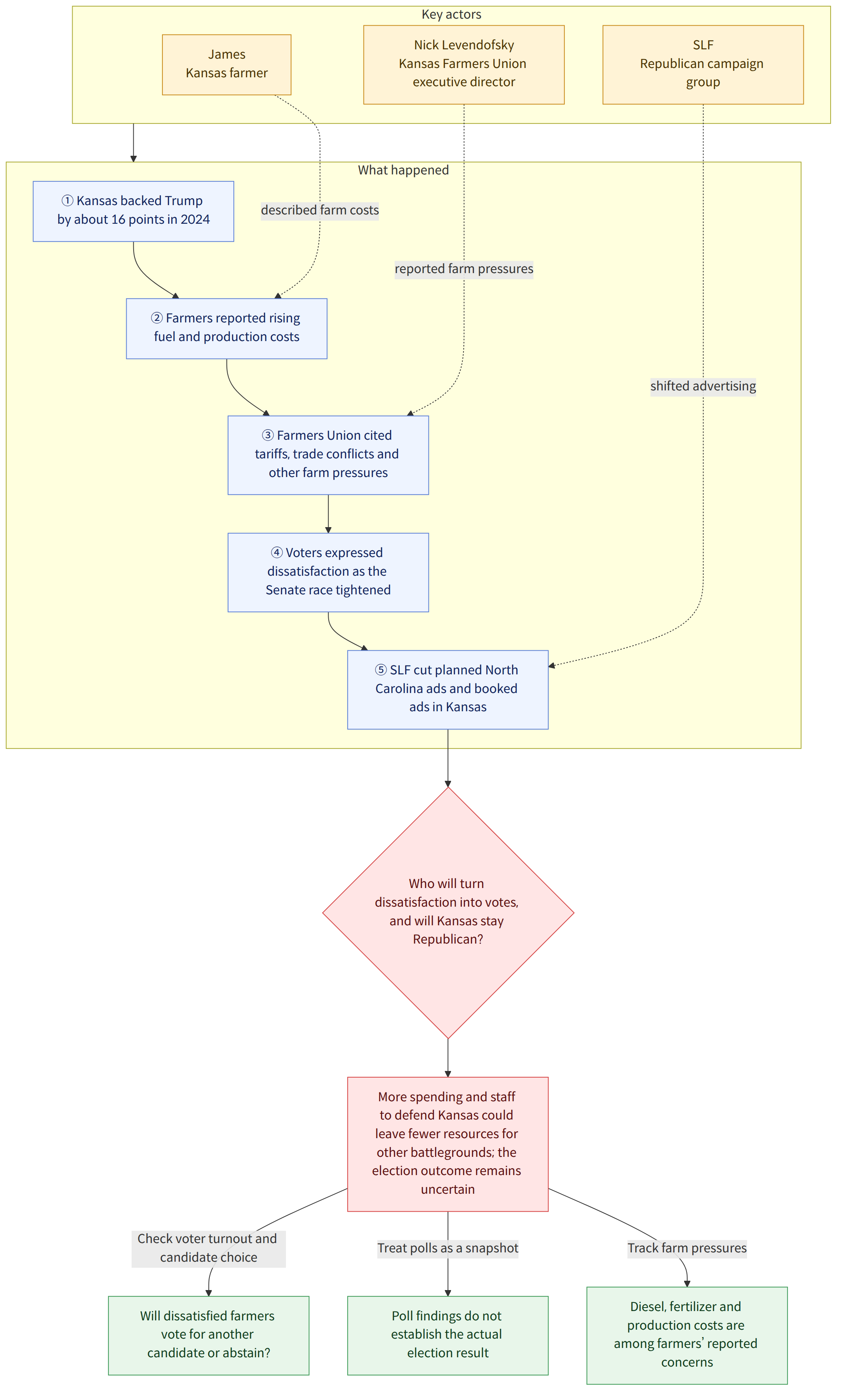
Kansas is an agricultural state with a population of about 2.98 million. In the 2024 presidential election, it gave Donald Trump a victory by about 16 percentage points. According to the article, the state has not elected a Democratic senator in 94 years, since 1932. Given this long-standing Republican advantage, that an incumbent Republican is facing a close race is itself noteworthy.
Farm costs are among the factors shaking up the race. James (a pseudonym, 45), who grows corn and soybeans on about 5,000 acres near Lawrence, said he voted for Trump in the 2024 presidential election but is now weighing his options in this year’s Senate race. He said on-road diesel costs $6.50 a gallon; according to the article, the price was around $3.50 a gallon in January 2026, before the U.S.-Iran war.
Scott Sellman (36), who operates a farm in Lawrence, said production costs for this year’s crops are up 20% to 35% from last year. He expects fuel costs to rise by more than 40% from last year. These examples of actual pressure on farm operating costs show that voters’ evaluations of policy may not be based solely on abstract party preferences. It is possible that the cost burden could shape voters’ assessments of the party in power, but individual cases alone cannot establish the views of voters across the state.
Farmers’ complaints are not limited to fuel prices. Nick Levendofsky, executive director of the Kansas Farmers Union (캔자스농민연합), cited tariffs and trade conflicts, cuts to USAID programs, expanded beef imports, and higher diesel and fertilizer prices following the war with Iran as difficulties facing farmers. He said that trade conflicts had affected markets for soybeans and that cuts to foreign aid had affected demand for sorghum. This illustrates how changes in agricultural and international policies can affect local farmers’ income and costs.
What this news means
The shift in this election does not necessarily mean that all Republican voters have moved to the Democratic Party. Rather, it may signal that some voters are reassessing candidates and policies. Bruce Bratman (65), a registered Republican who voted for Trump in 2024, said he plans to vote for Hamilton this time. Kathy Bowe (68), a retired nurse and longtime Republican, also voiced dissatisfaction with the war, tariffs and immigration policy, and said she was leaning toward the Democratic side in the general election.
In a second report, Alexandra Middlewood, a political science professor at Wichita State University, cited an Emerson College poll showing that 62% of Kansas independents and 23% of Republicans viewed the president’s job performance negatively. She also cited poll results showing that 42% of independents and 15% of Republicans said they would vote for Hamilton. These were presented as results from a poll conducted at a particular point in time; they should not be treated as equivalent to the actual election outcome.
The election results could affect not only Kansas voters but also the Republican Party’s nationwide allocation of resources. SLF cut back $18 million in advertising it had planned to run over one month in North Carolina and newly booked about $9.8 million in advertising in Kansas to support Marshall. This is why analysts say that spending more money and deploying more staff to defend Kansas could leave fewer resources for other battlegrounds. However, advertising spending alone cannot predict the election result or the balance of power in Congress nationwide.
For example, a voter dissatisfied with farm costs might support Hamilton, or that dissatisfaction might lead the voter not to vote at all. Levendofsky also said it remains to be seen whether farmers’ dissatisfaction will lead them to vote for another candidate or to abstain. The key point to watch, then, is not just whether dissatisfaction exists, but how it translates into voter turnout and candidate choice.
What is confirmed and what remains unknown
Confirmed facts
- Kansas is a Republican stronghold that gave Trump a victory by about 16 percentage points in the 2024 presidential election and, according to the article, has not elected a Democratic senator since 1932.
- Farmers have complained about diesel and fertilizer prices and production costs, while a representative of a farmers’ group also cited tariffs and trade conflicts as difficulties for farms.
- Reports say Democrat Hamilton and incumbent Republican Marshall are in a close race within the margin of error.
- SLF cut back its advertising in North Carolina while newly booking about $9.8 million in advertising in Kansas.
- Former Republican Kansas governors Bill Graves and Mike Hayden have endorsed Hamilton.
What remains unknown
- It is not known who will win the Senate election in November.
- It has not been established whether farmers and Republican voters dissatisfied with the Trump administration will vote for the Democratic candidate or stay home.
- It is not yet known how the resources Republicans devote to the Kansas race will affect election outcomes in other battlegrounds.
What readers should watch
- For polls released ahead of the election, readers should check when they were conducted, how the questions were worded and who was surveyed. Stated support in a poll should be distinguished from actual voting.
- Readers can watch whether dissatisfaction with farm costs affects not only candidate choice but also voter turnout. The farmers’ group representative quoted in the article also left both possibilities open.
- Tracking whether SLF’s advertising spending actually increases in Kansas and what changes occur in other battlegrounds can help clarify how this close race affects the allocation of campaign resources nationwide.
References
- Other coverage consulted: hani.co.kr

















