At a closed Cabinet meeting (국무회의) on the 6th, President Lee Jae-myung instructed officials to review from the beginning the question of joining the Comprehensive and Progressive Agreement for Trans-Pacific Partnership (CPTPP; 포괄적·점진적 환태평양경제동반자협정), a trade agreement in the Asia-Pacific region. The move came as farmers, opposing the government’s full-scale farmland survey, also opposed CPTPP accession over concerns about the harm that opening agricultural markets could cause. Reports said farmers’ protests and opposition to accession led to a change in the president’s position.
Background and context
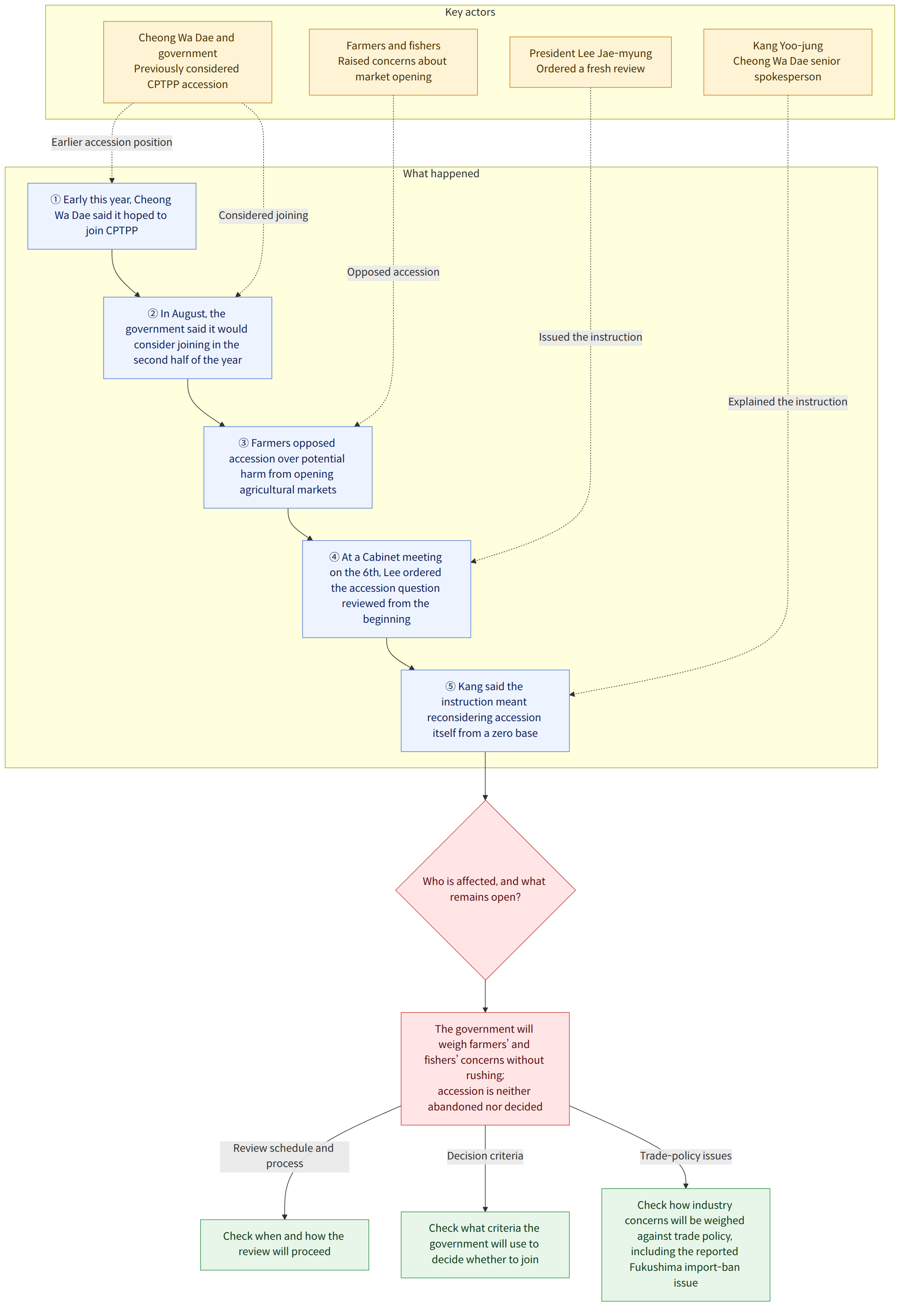
Cheong Wa Dae (청와대) has said since early this year that it hopes to join the CPTPP, which has been led by Japan. The government said as recently as August that it would consider whether to join in the second half of the year. The latest instruction was described not as a review premised on pursuing accession, but as a direction to reconsider whether to join at all.
Kang Yoo-jung, Cheong Wa Dae’s senior spokesperson, said President Lee had noted that concerns were being raised about the scale of the worries in the agriculture and fisheries sectors. The president emphasized that the government should not rush ahead with a predetermined conclusion, but should start the discussion from the beginning and pursue policy in the national interest, based on the trust and broad agreement of farmers and fishers. Kang explained that “zero base” meant reconsidering accession itself from the beginning.
The accession debate involves not only farmers’ and fishers’ concerns but also external trade policy. According to related reports, Japan’s position was that South Korea should ease its ban on imports of agricultural and fishery products from Fukushima in order to join the CPTPP. This shows that concerns in the agriculture and fisheries sectors and trade-policy considerations could both be addressed when weighing whether to join.
What this news means
The key point of the instruction is that the government intends to reflect farmers’ and fishers’ concerns in the discussion rather than rush to pursue accession. The fact that concerns about opening agricultural and fisheries markets have been raised as an important condition for policy review could also affect future discussions on accession and market opening. However, reviewing the issue from scratch does not mean that accession has been abandoned or that any particular outcome has been decided.
For example, farms worried that opening agricultural markets could cause harm may consider it important to see how the government addresses those concerns in future discussions and what criteria it applies when deciding whether to join. What is currently confirmed is the instruction to review the issue and its purpose; no specific response measures or final decision have been announced.
Points reported differently by different outlets
One report focused on the president’s instruction to review the issue from scratch, citing concerns in the agriculture and fisheries sectors. Another reported that some also highlighted the CPTPP’s strategic value amid changes in the international trade order. Reports therefore described the review as involving both industry concerns and trade-policy considerations.
English-language reports explained that the CPTPP is an agreement among 12 countries, including Japan, Mexico, Australia, Canada and Vietnam, and that its member countries accounted for about 15.2% of global trade in 2019. This is background information about the scale of the agreement; it does not indicate whether South Korea will join or what the review will conclude.
What is confirmed and what remains unknown
Confirmed facts
- At a closed Cabinet meeting on the 6th, President Lee instructed officials to review the question of CPTPP accession from the beginning.
- Farmers opposed the full-scale farmland survey and also opposed CPTPP accession over concerns about harm to farms from market opening.
- The president was reported to have said that the government should not rush ahead with a predetermined conclusion and should weigh the national interest based on the trust and broad agreement of farmers and fishers.
- Kang Yoo-jung, Cheong Wa Dae’s senior spokesperson, explained that the instruction meant reconsidering accession itself from a zero base.
What remains unknown
- What will the specific timetable and process for the review be?
- What criteria will the government use to decide whether to join?
- How will the government reconcile farmers’ and fishers’ concerns with trade-policy considerations during the actual discussions?
What readers should watch for
- Check whether subsequent announcements provide a timetable and process for the review.
- Watch for details on the criteria the government will use to decide whether to join and how it will incorporate farmers’ and fishers’ concerns.
- Another point to follow is how discussions related to the ban on imports of agricultural and fishery products from Fukushima will be handled in relation to the accession review.
References
- Other coverage consulted: koreatimes.co.kr