Conservative U.S. Supreme Court Justice Samuel Alito expressed concern about the increasingly harsh public remarks directed at the Supreme Court (대법원) and its justices. In a Fox News interview on the 4th (local time), Alito said he was worried about the long-term effect of such remarks on the Court’s standing. His comments came as he responded to criticism over Supreme Court rulings that blocked major Trump administration policies and over the fact that justices appointed by President Trump joined the majority opinions in those cases.
Background and context
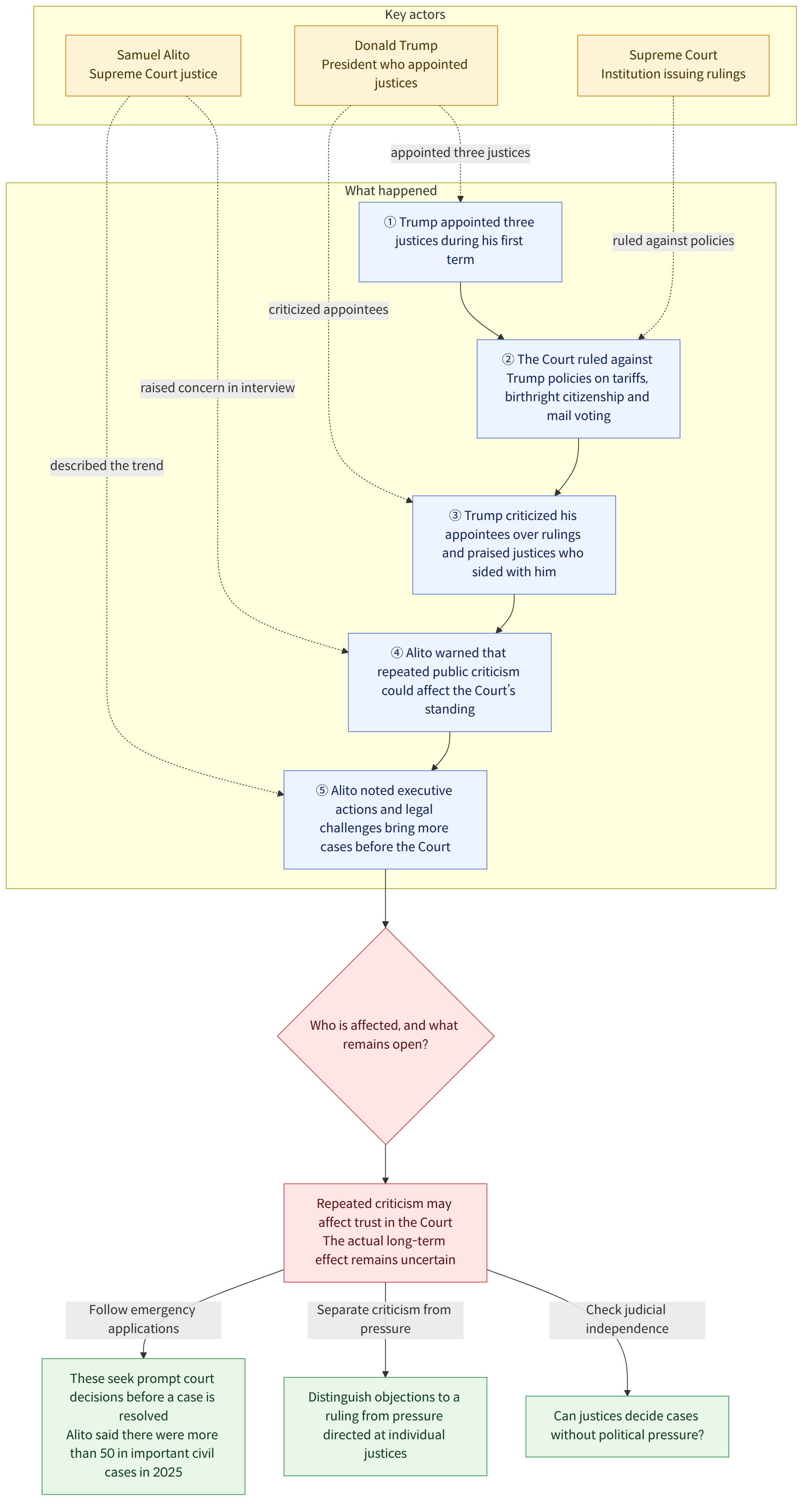
During his first term, President Trump appointed three justices to the Supreme Court: Neil Gorsuch, Brett Kavanaugh and Amy Coney Barrett. According to reports, six of the Court’s nine justices are classified as conservative, including Chief Justice John Roberts, Alito and Clarence Thomas. However, reports said that this year the Supreme Court ruled against President Trump’s wishes in a February ruling that his reciprocal tariffs were unlawful, a June ruling recognizing birthright citizenship, and a September ruling that restrictions on mail voting were impermissible.
President Trump publicly criticized justices he had appointed over these rulings. Last month, he targeted the three justices he appointed on Truth Social, and in a recent interview with Time magazine, he said he regretted appointing them. However, he called Thomas and Alito, who sided with him in the mail-voting restrictions lawsuit, “both legends.” The fact that the same justices are criticized or praised depending on the outcome of a ruling illustrates the clash between the Court’s decisions and political expectations.
Alito said he pushes such remarks out of his mind and believes his fellow justices do the same. But his concern is that whether individuals can ignore criticism is a separate question from whether such criticism has a cumulative effect on the Supreme Court’s standing in society. The issue has drawn attention because the Court’s authority is connected not only to its power to issue rulings but also to whether those decisions are accepted as coming from a public institution.
Alito also pointed to a trend in which presidents, unable to persuade Congress to advance their legislative agendas, pursue policies by issuing executive orders or reinterpreting laws and rules, leading to more lawsuits and emergency applications in response. He said that in 2025 there were more than 50 emergency applications in important civil cases, and that the number of cases heard on the merits over a comparable period was similar. An emergency application is a request for a court to make a prompt decision before a case’s final resolution. This shows that as policymaking and legal challenges follow one another rapidly, the Supreme Court may be called on more often to address political issues.
What this news means
The debate is connected not only to the relationship between the president and the Supreme Court but also to questions about whether justices can decide cases independently amid political criticism. Judicial independence (사법부 독립) is the principle that courts must be able to decide cases without being swayed by political pressure. Alito’s remarks can be understood to mean that even if individual justices can put such remarks out of their minds, the effect of repeated public pressure on the Court’s overall trust and standing is still a concern.
The people affected are not only justices or the president. For people whose rights or the application of policies may change as a result of Supreme Court rulings, both the substance of a ruling and whether the institution issuing it is free from political pressure may matter. For people who support the president’s policies, by contrast, the question may be whether the momentum of an elected administration is being limited by court decisions. This does not confirm the actual reactions of any particular group; it explains the interests that may come into play when rulings and political conflict intersect.
For example, if a president’s policy is blocked by the Supreme Court and public criticism of justices follows, readers may consider not only whether the policy is lawful but also whether the Court can rule consistently despite political pressure. This hypothetical alone cannot establish that any particular ruling is right or wrong. The key is to distinguish criticism of a ruling from pressure directed at individual justices.
Alito also expressed concern about calls for reforms such as expanding the number of justices and imposing term or age limits. He characterized these as organized efforts to influence the Supreme Court and its justices, and said he was worried about the Court’s future. However, this does not mean it has been established that calls for reform are, in fact, pressure intended to change the Court’s decisions; it reports how Alito assessed those proposals.
What is confirmed and what remains unknown
Confirmed facts
- In a Fox News interview on the 4th (local time), Alito expressed concern about the increasingly harsh public remarks directed at the Supreme Court and its justices.
- He said he was worried about the long-term effect of those remarks on the Court’s standing.
- During his first term, President Trump appointed three Supreme Court justices: Gorsuch, Kavanaugh and Barrett.
- Reports said the Supreme Court ruled against President Trump’s wishes this year in cases involving reciprocal tariffs, birthright citizenship and restrictions on mail voting.
- Alito pointed to a trend of increasing lawsuits and emergency applications challenging presidents’ unilateral pursuit of policies.
What remains unknown
- The original report does not say how President Trump responded to Alito’s interview remarks.
- The original report does not specify which particular remarks were included in the public statements Alito was concerned about.
- The information provided does not establish whether public criticism has actually changed justices’ decisions or public trust in the Supreme Court.
What readers should check
- When reviewing Supreme Court rulings, readers can distinguish the outcome of a ruling from the justices who joined the majority opinion.
- When encountering criticism from the president or political figures, readers should distinguish criticism of a ruling’s reasoning from pressure directed at individual justices.
- Discussions of the number of justices and term or age limits should be considered separately from Alito’s assessment and the content of actual reform proposals.