
Supreme Court Chief Justice Cho Hee-dae appeared on October 6, 2026, at the National Assembly’s (국회) audit of the Supreme Court before the Legislation and Judiciary Committee (법제사법위원회), stating his position on demands to renominate a Supreme Court justice candidate and his refusal to take an oath as a witness or testify. Democratic Party of Korea (더불어민주당) lawmakers pressed him to comply with President Lee Jae-myung’s demand for a new nomination, arguing that the chief justice’s nomination authority was procedural and ancillary. Chief Justice Cho countered that neither the National Assembly nor the president could take part in the nomination, and that requiring him to take an oath and testify at the audit could undermine the separation of powers and judicial independence.
Background and context
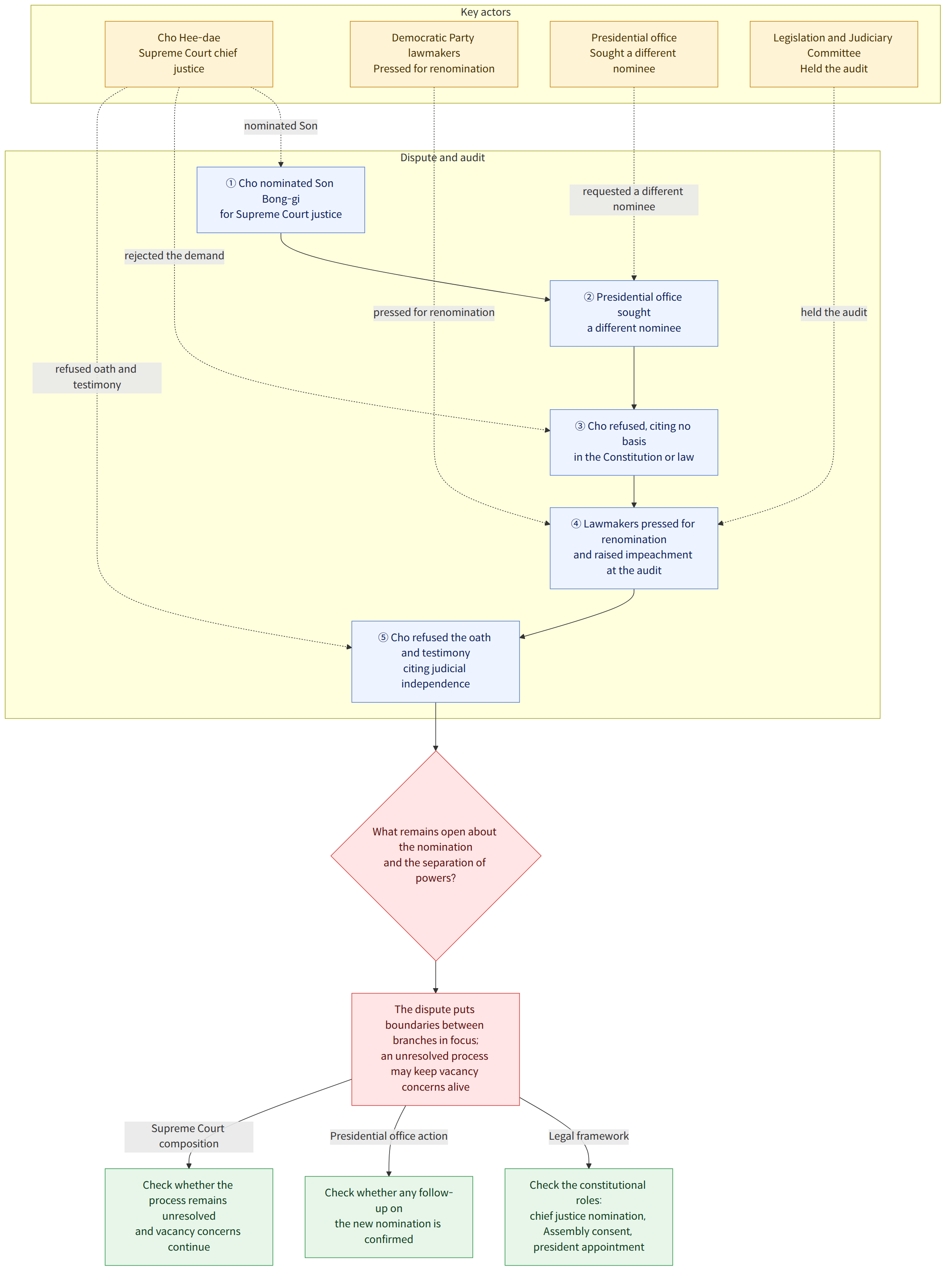
The dispute began with the procedure for nominating a Supreme Court justice candidate. According to news reports, after Chief Justice Cho nominated Son Bong-gi, a presiding judge at the Daegu District Court, the presidential office (청와대) demanded that he nominate a different candidate. Chief Justice Cho refused, saying there was no basis for the demand in the Constitution (헌법) or the law. The presidential office took issue with the nomination having been made without prior consultation, while Chief Justice Cho explained that past prior consultations had been voluntary cooperation intended to ensure a swift and smooth appointment.
The Constitution divides the roles in appointing Supreme Court justices among the chief justice’s nomination, the National Assembly’s consent, and the president’s appointment. The central dispute is how far those roles can influence one another. Democratic Party lawmakers argued, in effect, that the president’s appointment authority includes the right not to appoint, and viewed the nomination authority as a procedural power to cooperate with the president’s selection. Chief Justice Cho, by contrast, argued that neither the National Assembly nor the president could take part in the nomination, and that the Legislation and Judiciary Committee’s interference in it was unconstitutional because it violated the division of powers and judicial independence. These are the positions of the parties involved; the reported remarks at the audit do not establish which interpretation is ultimately correct.
At the audit, the nomination dispute overlapped with the issue of taking an oath as a witness. Chief Justice Cho said he could not take the oath or testify because of the separation of powers and judicial independence. However, Legislation and Judiciary Committee Chair Seo Young-kyo proceeded with the witness oath alongside those of other agency heads without having granted Chief Justice Cho permission to leave. Chief Justice Cho initially avoided answering or gave brief responses, then took out a prepared statement about one hour and 50 minutes after the audit began and spent about six minutes explaining his reasons for refusing. He remained in his seat for about two and a half hours in the morning and did not attend the afternoon questioning. Court Administration Office (법원행정처) Chief Noh Kyung-pil said Chief Justice Cho’s cold had worsened.
What this news means
The dispute goes beyond whether one candidate will be nominated again: it highlights where the boundary lies between the judiciary, the executive and the legislature in the process of nominating and appointing Supreme Court justices. Whether the nomination authority is viewed as a substantive, independent power or as a procedure linked to appointment authority could affect whether the president’s demand for a new nomination must be accepted. What has been reported so far are the positions of the parties and their exchanges at the audit; no final ruling on the constitutional interpretation or subsequent action by the presidential office has been confirmed.
The issue could also affect the composition of the judiciary and how the National Assembly oversees public officials. Reports say Chief Justice Cho said he would work to ensure the Supreme Court was fully constituted, but it remains unclear how the question of a new nomination will be resolved. For example, if the nomination and appointment process remains unresolved, concerns about vacancies on the Supreme Court and the court’s composition could continue to be raised. However, the available reports do not establish what specific changes to judicial work might result.
The mention of impeachment at the audit should also be distinguished from an actual impeachment process. Rep. Park Kyun-taek said refusing to renominate a candidate could be grounds for impeachment, and Rep. Lee Soo-jin wrote on Facebook that Chief Justice Cho should be impeached. These were lawmakers’ statements; they do not mean that an impeachment motion was passed or that the Constitutional Court (헌법재판소) ruled on whether he should be removed from office.
Relevant procedures and support information
An in-house legal guide explains that state agencies or local governments may petition for an adjudication on a jurisdictional dispute (권한쟁의심판) when they claim that their authority has been infringed or is at risk of infringement. Individuals cannot file such a petition, and both time limits must be met: it must be filed within 60 days of learning of the grounds and within 180 days of the date on which the grounds arose. However, the materials provided do not establish whether this dispute over nomination authority is subject to an adjudication on a jurisdictional dispute, or which institutions meet the requirements to be parties to such a case.
An impeachment trial (탄핵심판) is a separate procedure. According to the guide, after the National Assembly votes to impeach, the Constitutional Court decides whether a public official should be removed from office. Therefore, a statement at the audit that something could be grounds for impeachment, or a call for impeachment, does not by itself start the process or result in a decision to remove someone from office. It has also not been confirmed whether an impeachment motion was actually pursued in this case.
An adjudication on a jurisdictional dispute and an impeachment trial have different eligible applicants and procedures. Whether either procedure could apply to this case depends on the parties’ eligibility and the legal nature of the issues in dispute.
Points reported differently by different outlets
Reports differed in how they quoted Chief Justice Cho’s response to Jinbo Party (진보당) lawmaker Son Sol’s question, “Are you dreaming of becoming a second Yoon Suk Yeol?” Some reported his response as “It’s so insulting and heartbreaking,” while others reported it as “It’s so insulting and sad.” Both reports agree that he expressed a sense of insult in response to the question, but they differ on the words that followed.
What is confirmed and what remains unknown
Confirmed
- Supreme Court Chief Justice Cho Hee-dae appeared at the Supreme Court audit on October 6, 2026.
- There was a dispute over interpretations of nomination and appointment authority concerning the presidential office’s demand for a new nomination and Chief Justice Cho’s refusal.
- Chief Justice Cho refused to take an oath as a witness or testify, citing judicial independence and the separation of powers.
- Democratic Party lawmakers pressed for a new nomination, and Reps. Park Kyun-taek and Lee Soo-jin mentioned the possibility or necessity of impeachment.
- Chief Justice Cho explained his position in a prepared statement for about six minutes and did not attend the afternoon questioning.
Still unknown
- Through what process a final interpretation will be reached on the constitutional issues surrounding the Supreme Court’s nomination authority and the president’s appointment authority.
- What action the presidential office will take in response to the refusal to renominate a candidate.
- Whether the Legislation and Judiciary Committee or the National Assembly has taken follow-up action over the refusal to take an oath or testify.
- When and how the nomination and appointment process will be resolved.
What readers should check
- In follow-up reports, check what official action the presidential office takes and how the candidate nomination process actually proceeds.
- Distinguish between statements and actual votes or actions when checking whether the National Assembly has pursued impeachment or follow-up procedures related to the refusal to take an oath or testify.
- Institutions or parties considering an adjudication on a jurisdictional dispute should check eligibility to file and both filing deadlines. They should also note that individuals cannot file such a petition directly.
References
- Guide to Other Constitutional Issues and Constitutional Court Proceedings
- Other coverage consulted: chosun.com
- Other coverage consulted: hani.co.kr

















