

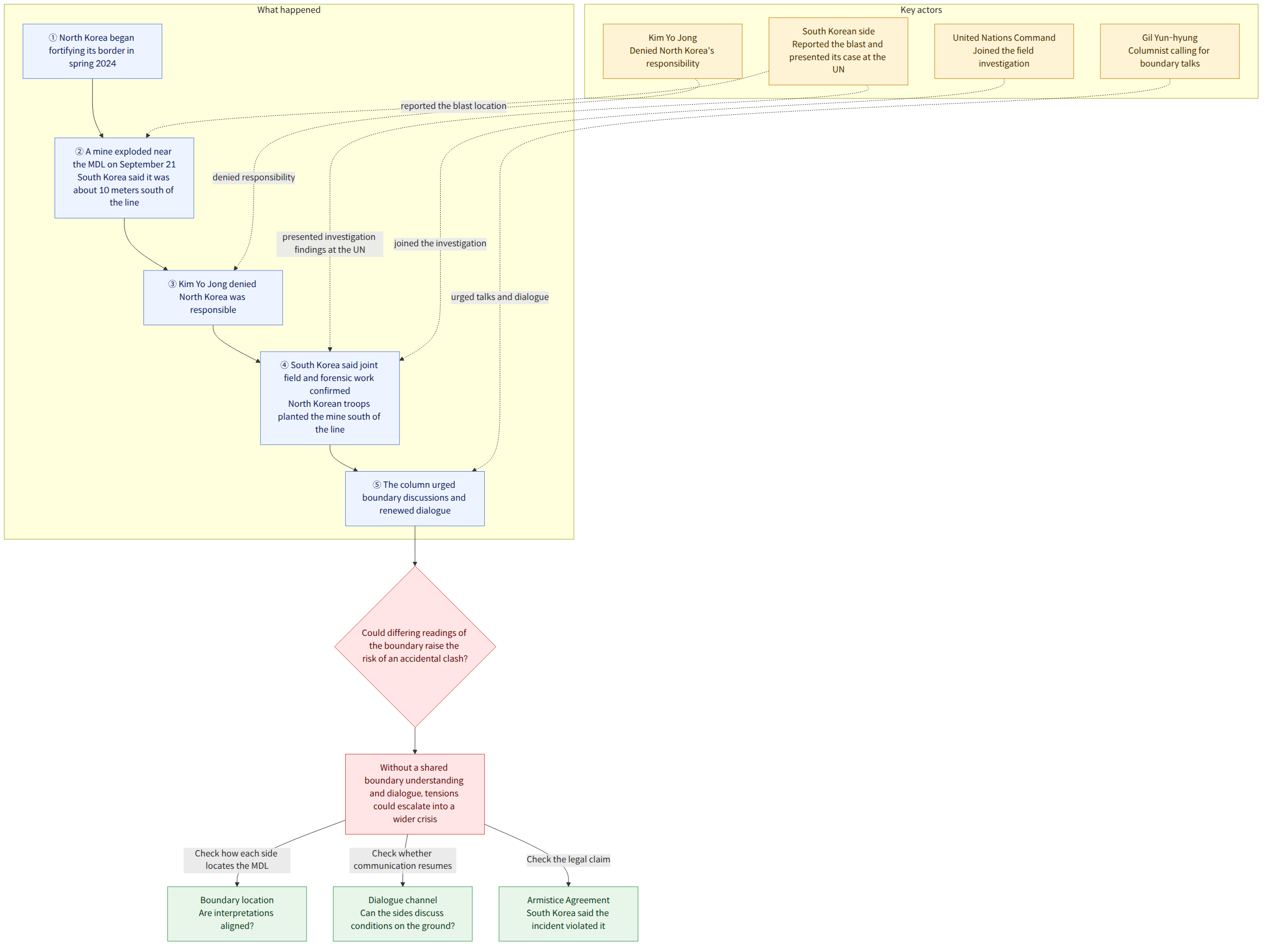
North Korea denied responsibility for a mine blast near the Military Demarcation Line, while South Korea’s side argued at the United Nations that a joint field investigation and forensic analysis confirmed that North Korean troops had deliberately planted a mine south of the line. As Kim Yo Jong’s denial clashed with South Korea’s accusations, columnist Gil Yun-hyung called for discussions on the boundary line and a resumption of dialogue, warning that unless the two Koreas resolve their differing understandings of its location, an accidental clash could escalate into a wider crisis.
Background and context
Kim Yo Jong denied that North Korea was responsible for the border mine explosion. South Korea’s Joint Chiefs of Staff (합동참모본부) announced that the mine had exploded about 10 meters south of the Military Demarcation Line, and the United Nations Command (유엔군사령부) was reported to have found one North Korean antipersonnel mine south of the line.
According to a separate report, South Korea’s ambassador to the United Nations called on North Korea to take “responsible measures” at the United Nations on Thursday. The report said a joint field investigation and forensic analysis by the South Korean military and the United Nations Command confirmed that the September 21 explosion was caused by a mine that North Korean troops had deliberately planted south of the Military Demarcation Line. It also described South Korea’s position that the incident violated the Armistice Agreement.
The column says that not only the mine blast but also the military activity continuing near the boundary line should be considered. The column reported that South Korea’s Joint Chiefs of Staff said North Korean troops had crossed the Military Demarcation Line about 20 times in August and about 30 times in September. These figures were reported as an announcement by the South Korean side, while North Korea said its troops had never crossed the boundary line.
According to the column, North Korea began fortifying its border in spring 2024. Kim Yo Jong claimed this was an exercise of sovereignty unrelated to military purposes, but the column says work to strengthen the physical separation continued, including the installation of walls, tactical roads and barbed wire, as well as the laying of mines.
Behind this is a change in North Korea’s view of inter-Korean relations. The column notes that Kim Jong Un shifted course in late 2023 toward defining inter-Korean relations as relations between two separate hostile states. As a result, the column reported, a territorial clause was added to North Korea’s constitution in March, while existing clauses related to unification were removed.
What this news means
The column’s central point is not that either side’s account of responsibility for the mine should be accepted, but that the possibility that the two sides understand the Military Demarcation Line differently should be seen as a source of danger. The column cites a 2019 paper by Kye Yong-ho, which says the Military Demarcation Line was drawn on a map at a scale of 1:50,000 during the armistice talks in July 1953. If the pencil line is assumed to have been 1 mm thick, the line on the map could correspond to a margin of error of 50 meters on the ground, the paper explains. This does not mean that the actual boundary is necessarily inaccurate by that much; rather, it means that differences in how its location is interpreted could arise depending on how the line was drawn and what assumptions are made.
If such differences in interpretation widen in an area where border fortification and military activity are continuing, one side could see something as construction or troop movement while the other views it as a boundary violation. The column’s concern is that tensions could rise further if warning broadcasts, warning shots and accusations against the other side compound one another. This is the column’s analysis; it does not mean that an actual clash is inevitable.
For example, if the two sides assess the location of troops working near the border differently, a warning measure by one side could be taken as a provocation by the other. Without a channel for communicating about the boundary line’s location and conditions on the ground, tensions could escalate before the facts are verified.
The column’s point is that the risk of an accidental clash could rise if the two sides lack both a boundary standard they can agree on and a channel for dialogue, beyond their dispute over responsibility.
Columnist Gil Yun-hyung wrote that at first he felt a peculiar sense of relief, rather than anger, at Kim Yo Jong’s statement. The column reported that the National Intelligence Service (국가정보원) described the statement as an “extremely low-level response,” but the writer interpreted it as a sign that North Korea was taking the situation seriously. The figures suggesting the possibility of resuming inter-Korean dialogue had risen from 0% to 2–3% since talks broke down in late 2018 are not a verified forecast, but the column writer’s judgment.
What different reports emphasized
The column and the separate report covered the same incident but differed in their emphasis and assessment of responsibility. The column presented Kim Yo Jong’s denial and North Korea’s position, focusing on differences in how the Military Demarcation Line is interpreted and the need for dialogue. The separate report said that, based on the findings of a joint investigation by the South Korean military and the United Nations Command, South Korea’s side argued at the United Nations that North Korean troops had deliberately planted the mine, and conveyed South Korea’s assessment that this violated the Armistice Agreement.
Therefore, what the available material establishes is that North Korea’s denial and South Korea’s accusations of responsibility coexist. Rather than combining the two positions into a single conclusion, it is necessary to distinguish who presented which investigation findings and interpretations.
What is confirmed and what remains unknown
Confirmed facts
- Kim Yo Jong denied that North Korea was responsible for the border mine explosion.
- The column reported that South Korea’s Joint Chiefs of Staff announced that the explosion site was about 10 meters south of the Military Demarcation Line.
- The column reported that the United Nations Command found one North Korean antipersonnel mine south of the Military Demarcation Line.
- In a separate report, South Korea’s ambassador to the United Nations cited the joint investigation’s findings, alleged that North Korean troops had deliberately planted the mine and called for responsible measures.
- The column reported that South Korea’s Ministry of National Defense (국방부) proposed talks on demarcating the Military Demarcation Line in November 2025, but North Korea did not respond.
What remains unknown
- The available material does not state the current condition of the South Korean soldiers injured in the mine explosion.
- It has not been confirmed whether the two Koreas plan to resume discussions on demarcating the Military Demarcation Line.
- The separate report describes the findings of a joint investigation, but the available material does not say whether further investigations were conducted afterward or whether new findings emerged.
- The material does not provide enough detail on how each side determines the Military Demarcation Line’s precise location or how large the difference is on the ground.
What readers should watch for
- In future announcements about responsibility for the mine blast, it will be important to distinguish the investigation’s organizers and findings from the claims made by each party.
- Watching for whether a proposal for talks on demarcating the Military Demarcation Line is made, or whether discussions between the two Koreas resume, could help gauge the potential for easing tensions.
- Readers should watch for the release of information about the injured soldiers’ condition and any additional investigation findings, while distinguishing information not included in the available material from confirmed facts.
References
- Other coverage consulted: koreatimes.co.kr
- Other coverage consulted: en.yna.co.kr
















