On October 6, 2026, Chief Justice Jo Hee-dae publicly stated his position on the conflict with the Presidential Office over the referral of a Supreme Court justice nominee during the National Assembly Legislation and Judiciary Committee’s (국회 법제사법위원회) audit of the Supreme Court (대법원). Chief Justice Jo said, “The National Assembly (국회) and the president cannot be involved at all in the Chief Justice’s referral,” and argued that prior consultation with the president is not an obligation grounded in the Constitution (헌법), but cooperation he had undertaken voluntarily to enable appointments to be made quickly. The Presidential Office (청와대) is calling for a new referral, but the article does not yet establish the nominee’s prospects or the final outcome of the conflict.
Background and context
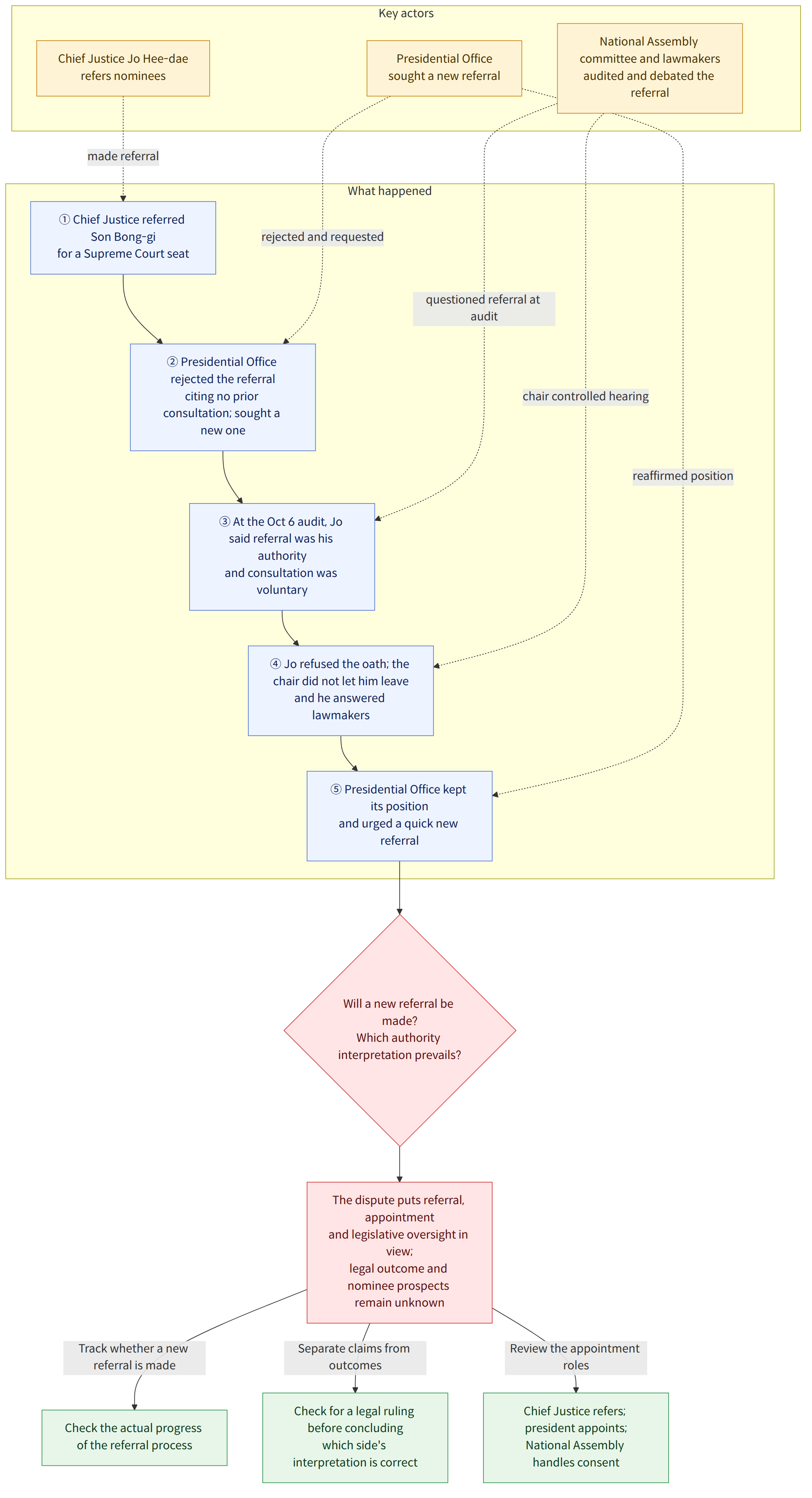
In the process of appointing Supreme Court justices, the Chief Justice refers a nominee, the president appoints the justice, and the National Assembly handles the consent process. The focus of the dispute is how the president’s appointment authority relates to the Chief Justice’s referral authority, and whether prior consultation with the president can be required rather than treated as a convention.
According to reports, the Presidential Office has rejected Chief Justice Jo’s referral of Son Bong-gi, a presiding judge at the Daegu District Court, on the grounds that he made it without prior consultation, and has called for a new referral. Chief Justice Jo said the official letter requesting a new referral did not clearly set out specific reasons or a constitutional basis. However, the reports provided do not include materials that would allow the full contents of the letter or all the legal arguments presented by both sides to be verified.
Chief Justice Jo said there would be no constitutional problem if he did not consult the president in advance, and that previous presidents had ultimately respected the referral authority. Democratic Party (민주당) lawmakers, by contrast, argued in effect that the referral authority is a procedural power to cooperate with the president’s selection of Supreme Court justices, and called for a new referral. The positions of the two sides show that they interpret the boundaries between referral and appointment authority differently within the same appointment process. These statements alone do not establish which side’s interpretation is correct.
The dispute over authority at the audit also extended to the witness oath and testimony. Chief Justice Jo refused to take the oath, saying it could undermine the separation of powers and judicial independence. Legislation and Judiciary Committee Chair Seo Young-kyo did not allow him to leave, so Chief Justice Jo remained at the audit and answered lawmakers’ questions. According to reports, this was the first time a chief justice had answered lawmakers’ questions at a National Assembly audit of the Supreme Court since such audits resumed following the 1987 constitutional amendment.
What this news means
The dispute has brought into public view not only the selection of one nominee, but also the division of authority among the Chief Justice, who refers Supreme Court nominees; the president, who appoints them; and the National Assembly, which handles the consent process. In particular, because the Chief Justice characterized the National Assembly’s questions about referral authority as interference with judicial independence, the extent to which the legislature can demand explanations from the head of a senior judicial institution has also become an issue. Conversely, the reported positions alone do not make it possible to conclude whether the National Assembly’s questions and witness procedures constitute political checks on the exercise of authority or could infringe on judicial independence.
For the public, this may be an opportunity to consider the principles governing the process of selecting Supreme Court justices and the independence of the judiciary. However, the current reports do not say that the conflict has led to any specific change in court proceedings or people’s rights. For example, readers following whether a new referral is made should distinguish between claims by political actors, the actual progress of the process, and any legal ruling on the matter.
Kang Yoo-jung, a senior spokesperson for the Presidential Office, said there had been no change in its existing position in response to Chief Justice Jo’s remarks and called for the process of making a new referral to proceed quickly. The next issue, therefore, is not only whether the two sides’ public positions have moved closer, but also how the nominee referral process actually proceeds.
Related legal procedures and support information
An internal legal guide describes an adjudication on a competence dispute (권한쟁의심판) as a procedure through which a national or local government body claims that its authority has been infringed or is at risk of infringement. It says individuals cannot petition for this procedure, and that a petition must meet both of two deadlines: within 60 days of learning of the grounds and within 180 days of the date on which the grounds arose.
However, this guide provides a general description of the procedure. The article does not establish who, if anyone, has petitioned for an adjudication on a competence dispute in the current referral conflict, whether the requirements for a petition have been met, or what procedure may actually be chosen. It therefore should not be assumed that an adjudication on a competence dispute applies to this matter.
The guide also explains that an impeachment trial (탄핵심판) is a procedure in which the National Assembly passes an impeachment motion and the Constitutional Court (헌법재판소) decides whether to remove a public official from office. The article mentions a Democratic Party lawmaker raising the possibility of impeachment, but that statement alone does not establish that an impeachment motion has been passed or that proceedings have begun at the Constitutional Court.
What is confirmed and what remains unknown
Confirmed facts
- Chief Justice Jo Hee-dae attended the National Assembly Legislation and Judiciary Committee’s audit of the Supreme Court on October 6, 2026.
- Chief Justice Jo said prior consultation with the president has no constitutional basis and that there would be no constitutional problem if he did not consult the president.
- According to reports, the Presidential Office has rejected the referral of Son Bong-gi, a presiding judge at the Daegu District Court, and called for a new referral.
- Chief Justice Jo refused to take the witness oath but remained at the audit after the committee chair denied his request to leave, and answered lawmakers’ questions.
- Kang Yoo-jung, a senior spokesperson for the Presidential Office, maintained its existing position and called for the process of making a new referral to proceed quickly.
What remains unknown
- Whether Chief Justice Jo will refer Son Bong-gi again.
- The final legal ruling on the Presidential Office’s rejection of the referral and its demand for a new referral.
- Whether this dispute over authority will lead to a separate constitutional procedure and, if so, what the outcome will be.
What readers should check
- Follow subsequent announcements about the Presidential Office’s demand for a new referral and the Chief Justice’s response to see how the nominee referral process actually proceeds.
- Distinguish politicians’ legal interpretations or references to impeachment from a definitive legal ruling. The current article does not establish that there has been a final ruling or that an impeachment motion has been passed.
- If an adjudication on a competence dispute or an impeachment trial is discussed, check who has actually initiated which procedure and what requirements apply. Keep in mind that individuals cannot petition for an adjudication on a competence dispute.
References
- Guide to Other Constitutional Issues and Constitutional Court Proceedings
- Other coverage consulted: chosun.com
- Other coverage consulted: hani.co.kr