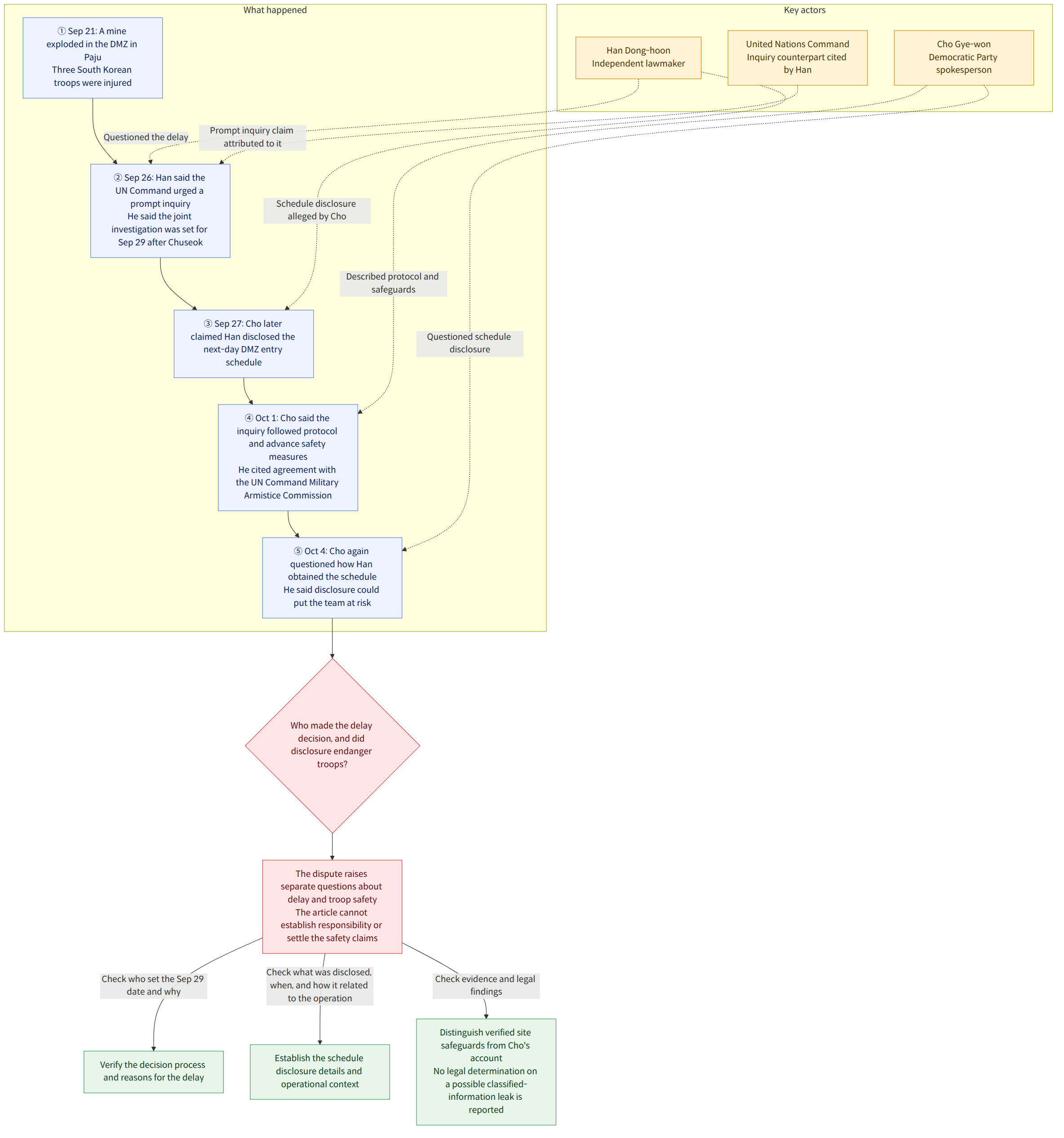
On September 21, a mine planted by North Korean troops exploded in the South Korean side of the Demilitarized Zone (DMZ) in Paju, Gyeonggi Province, injuring three South Korean troops. Afterward, independent lawmaker Han Dong-hoon and the Democratic Party of Korea (더불어민주당) clashed over when the site investigation should take place and whether the operation schedule should be disclosed. Han questioned why the investigation had been set for the 29th, after the Chuseok holiday, while the Democratic Party argued that the schedule he disclosed could threaten the safety of troops involved in the operation. The responsibility for the delay in investigating the incident and concerns about safety and information security during the investigation have both become political issues.
Background and context
At a press conference in front of the Ministry of National Defense (국방부) on September 26, Han claimed that the United Nations Command (유엔군사령부) had called for a prompt site investigation, but that, due to opposition from the South Korean military, the sides had agreed to conduct a joint investigation on the 29th, after the Chuseok holiday. He later wrote on Facebook, calling for an explanation of why the investigation had been postponed until after Chuseok following North Korea’s mine attack, and who had made the decision. He wrote, in effect, that the public would be more interested in why the investigation was delayed than in how he obtained the information.
On October 1, Democratic Party spokesperson Cho Gye-won claimed that the investigation had been conducted according to protocol, in agreement with the United Nations Command Military Armistice Commission (유엔사 정전위), and that the necessary safety measures had been taken in advance for an investigation near the Military Demarcation Line. On October 4, he again asked Han how he had obtained the operation schedule, arguing that disclosing it could put the investigation team at risk. However, the article does not establish the specific circumstances or identify who was responsible for setting the joint investigation for the 29th.
The two sides’ arguments about safety emphasize different risks. Han’s criticism focuses on when the incident site was investigated and who was responsible. The Democratic Party spokesperson emphasized the risks to investigators and troops during entry to the site, as well as the risks of disclosing the operation schedule. The article alone does not make it possible to judge whether either side’s claims fully explain the actual decision-making process or the risks at the site.
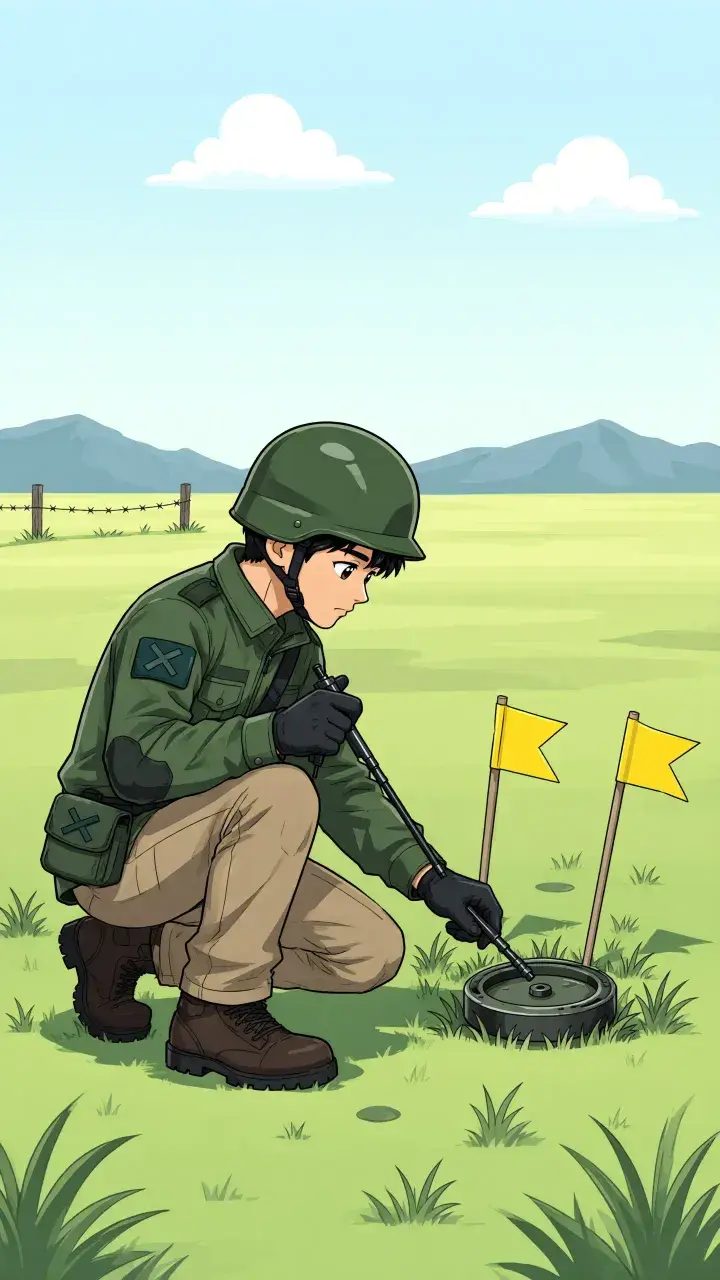
The Democratic Party spokesperson said the site shown in publicly released body-camera footage was a minefield, with grass that had grown as high as a person. He also claimed that the grass had to be cut to 3 centimeters for mine detectors to work, that the grass had to be cleared three times, and that the resulting passage would be 1 meter wide. These details were reported as the spokesperson’s account and should be distinguished from facts independently verified in the article.
What this news means
The dispute highlights the tension between calls to investigate the site promptly and the argument that safety measures must be taken in a dangerous area. Questions about a delayed investigation bring demands for an explanation of the reasons for the decision and who was responsible. On the other hand, determining whether disclosure of the operation schedule actually threatened troop safety requires specific information about what was disclosed, when it was disclosed, and how it related to the operation. “Why was the investigation delayed?” and “Who disclosed the schedule, and how?” are separate questions that each require verification.
The Democratic Party spokesperson claimed that Han disclosed on September 27 an operation to enter the DMZ one day in advance. He also said the ruling party’s senior member of the National Assembly (국회) National Defense Committee had not known about the schedule, and called on Han to explain how he obtained the information and respond to the Ministry of National Defense’s consideration of legal action. However, the report does not provide an answer about how Han learned of the schedule or how that information was disclosed. Nor does it present a legal determination on whether the disclosure could be considered a leak of classified information.
For example, if readers conclude from the disclosed schedule alone that the operation was either safe or dangerous, they may overlook aspects of the site conditions and advance safety measures that have not been verified. Conversely, the claim that safety measures were necessary does not, by itself, resolve questions about the timing of the investigation or responsibility for the decision. It is important to consider the two issues separately and distinguish claims from verified facts.
News of a North Korean missile launch reported on the same day illustrates the security environment in which this debate took place, but does not explain the decision-making around the mine incident investigation. The report said North Korea launched one ballistic missile toward the East Sea from an eastern area early on October 3. North Korean media reported that leader Kim Jong Un observed the launch drill, and on October 4 the Ministry of National Defense said the ballistic missile launch was a serious act that violated United Nations Security Council (유엔 안전보장이사회) resolutions. These facts should not be used to link North Korea to responsibility for the mine incident or the delay in the investigation.
Relevant legal and support information
The provided legal guide (L1) explains that whether an offense has been committed can depend on the nature and purpose of the act, the specific circumstances, and the evidence, among other factors. However, the material does not provide specific legal provisions or criteria for determining whether disclosure of an operation schedule constitutes a leak of classified information. Therefore, the material alone is not enough to treat the Democratic Party spokesperson’s claim of a “leak of classified information” as a settled legal finding, or to conclude that there is no legal liability.
The general caution offered by the guide is that liability cannot be determined solely on the basis of the name of an offense or a party’s claim; the applicable laws and specific evidence must be examined. The article mentions that the Ministry of National Defense was considering legal action, but does not establish whether any action was taken or what the outcome of any legal assessment was.
Points reported differently
Rather than directly describing the same event in conflicting ways, the two reports focused on different issues. One covered the back-and-forth between the ruling and opposition parties, particularly the dispute over the investigation date and disclosure of the schedule. The other reported North Korea’s October 3 missile launch and the Ministry of National Defense’s statement on October 4, interpreting North Korea as having dismissed South Korea’s calls for an apology and dialogue as an attempt to demonstrate military force. The latter is the report’s interpretation; it has not been established that the missile launch was North Korea’s official response to the DMZ investigation dispute.
There are also details about the operation schedule and dates that require clarification. At his September 26 press conference, Han claimed that the sides had agreed to conduct a joint investigation on the 29th. The Democratic Party spokesperson claimed that Han disclosed on September 27 an operation to enter the DMZ one day in advance. The reports do not explain how these two schedules relate to each other or whether they refer to different operations.
What is known and what remains unclear
What is known
- It was reported that a mine planted by North Korean troops exploded on September 21 on the South Korean side of the DMZ in Paju, injuring three South Korean troops.
- On September 26, Han Dong-hoon questioned the timing of the site investigation and who was responsible for the decision.
- Democratic Party spokesperson Cho Gye-won claimed that the investigation had been conducted in agreement with the United Nations Command Military Armistice Commission and that advance safety measures had been taken.
- The Democratic Party claimed that disclosing the schedule could threaten the safety of the investigation team and troops involved in the operation.
What remains unclear
- How Han learned the schedule for the joint investigation or the operation to enter the DMZ
- The decision-making process and who was responsible for setting the site investigation for after the Chuseok holiday
- Whether disclosure of the operation schedule actually constituted a leak of classified information and whether legal action will be taken
- Whether the schedules mentioned in the reports refer to the same operation
What readers should look for
- In follow-up reporting, look for specific information about the grounds for the decision on the investigation date and who was responsible.
- In the dispute over disclosure of the operation schedule, distinguish whether the content and timing of the disclosed information and its relationship to the actual operation have been established, and whether a legal determination has been made.
- For information about safety at the site, distinguish claims made by the political parties from confirmed investigation findings, and check who provided the account of the body-camera footage.
References
- Other Crimes under the Criminal Act: Elements and Points to Note
- Other coverage consulted: hani.co.kr