U.S. President Donald Trump said he would give foreign companies about a year and a half to build factories in the United States and, if they did not, impose tariffs of 150% to 300%. He made the remarks at a rally supporting candidates in the November midterm elections. The day before, he had said that if South Korea did not soon sign on to the Alaska gas project, he would “double it,” but he did not say what he would double.
Background and context
At a rally on the 3rd (local time) at a high school in Ohio, President Trump claimed that China, Japan, South Korea, Canada and others had used tariffs against the United States to its disadvantage for years, making the country a laughingstock. He also claimed that tariff policies were bringing the United States trillions of dollars and prompting foreign companies to build factories there. These should be understood as claims made by President Trump at a rally, not as an account supported by confirmed figures for tariff revenue or investment.
The remarks can be read both as presenting tariffs as a way to encourage domestic production and as a signal of pressure on companies to invest in the United States. However, the remarks alone do not establish when tariffs would actually take effect or which countries or products they would apply to. The reports did not specify the targets or implementation date.
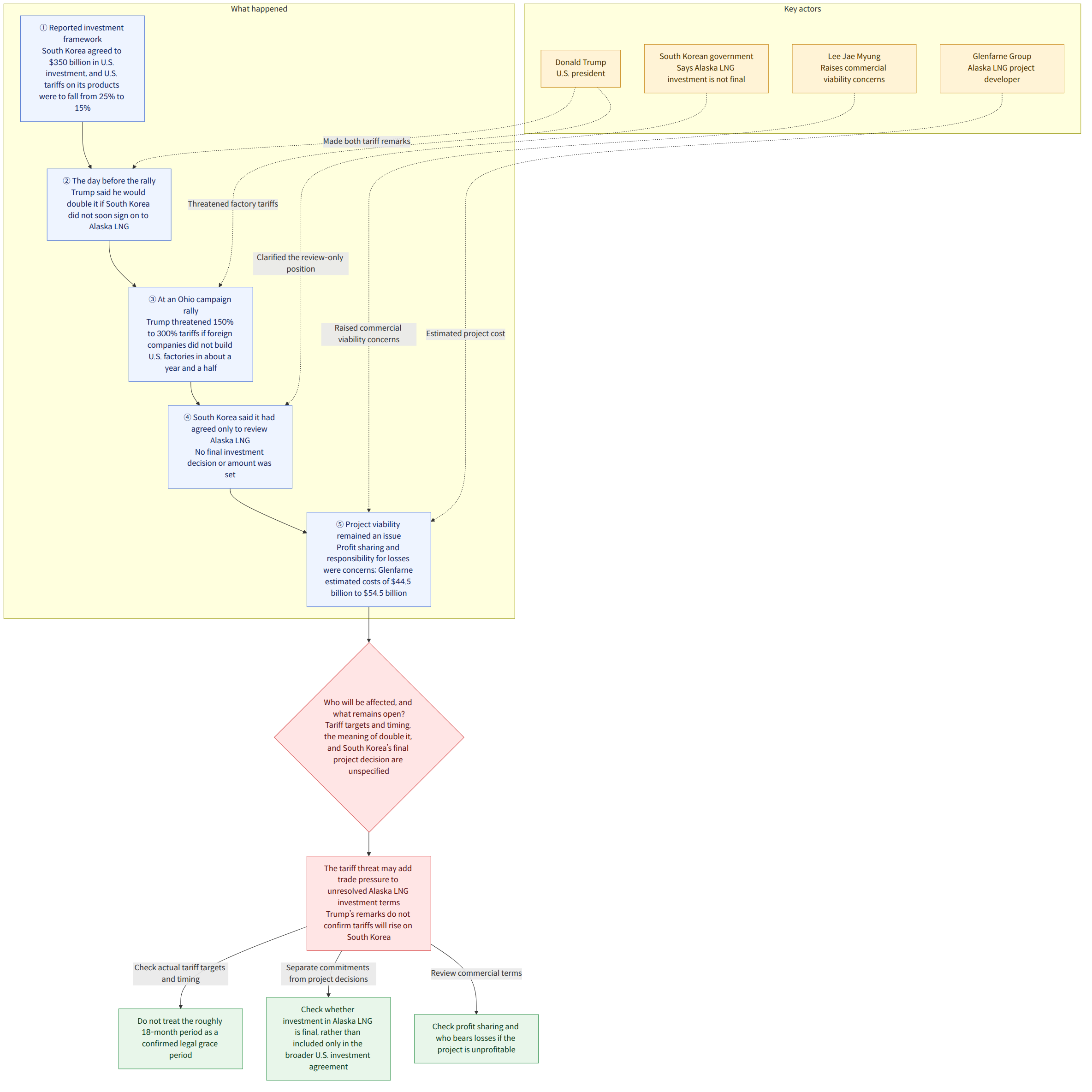
The pressure on South Korea is linked to the Alaska liquefied natural gas (LNG) development project. According to reports, as part of an agreement to invest $350 billion in the United States, South Korea agreed to allocate $150 billion to shipbuilding cooperation and $200 billion to strategic investments, while the United States agreed to lower tariffs on South Korean products from 25% to 15%. However, the South Korean government (한국 정부) says it agreed only to begin reviewing the Alaska project and has not made a final decision on whether to invest or on the amount.
The project’s commercial viability is also at issue. Reports said project developer Glenfarne Group estimated the cost of the Alaska LNG project at $44.5 billion to $54.5 billion. The project would require an 800-mile (1,287-kilometer) gas pipeline from northern Alaska to Nikiski, as well as gas processing facilities and an export terminal. President Lee Jae Myung said commercial viability—including how profits would be shared and how losses from an unprofitable project would be handled—was an obstacle in negotiations. South Korea was reportedly seeking to include the phrase “commercially reasonable” in the investment agreement.
What this news means
When South Korean companies or the government consider investment projects in the United States, it may be important to distinguish between an investment commitment and a final decision to participate in a particular project. With differences between the two countries still unresolved over South Korea’s involvement in Alaska LNG, the accompanying tariff threat could add trade pressure to questions about the project’s profitability and investment terms. However, President Trump’s remarks alone do not establish that tariffs on South Korea will actually be raised.
For example, if a South Korean company is considering building a factory in the United States, it should not treat the roughly 18-month period cited by President Trump as a confirmed legal grace period. It should check whether the targets and timing of any actual policy have been established. In the case of the Alaska project, too, it is important to distinguish investments included in the U.S. investment agreement from a confirmed investment in that particular project, and to review commercial terms such as profit-sharing and responsibility for losses.
The election context is also relevant. A New York Times–Siena poll (뉴욕타임스·시에나 여론조사) released on October 3 showed Democratic Senate candidates leading or in close races in five Republican-leaning states: Alaska, Ohio, Texas, Iowa and Kansas. The results alone do not establish the purpose of the tariff remarks or predict the election outcome, but they help explain the context in which President Trump touted tariffs and investment as economic achievements at campaign rallies.
What is confirmed and what remains unknown
Confirmed facts
- President Trump said he would give foreign companies about a year and a half to build factories in the United States and impose tariffs of 150%, 200%, 250% or 300% if they did not.
- In relation to South Korea’s signing on to the Alaska gas project, he said he would double it if South Korea did not sign soon, but did not specify what would be increased.
- Reports said the South Korean government had not finalized whether to invest in the Alaska project or the amount.
- Polling showed Democratic Senate candidates leading or in close races in five Republican-leaning states.
What remains unknown
- What are the specific targets and implementation date of the tariff threat?
- What did Trump mean when he said he would double something for South Korea: tariffs or something else?
- What were the candidates’ support levels and the margins of error in each state in the poll?
What readers should watch for
- If U.S. tariff policy takes shape, it will be important to check whether the targets and timing of the measures actually implemented match those of the announced threat.
- Readers can watch whether South Korea’s U.S. investment agreement and its decision on participation in the Alaska LNG project are separate, and how the project’s profit-sharing and responsibility-for-losses terms are resolved.
- Because the target of the “double” remark about South Korea was not specified, readers should not treat it as a confirmed tariff increase and should check subsequent announcements to see what it refers to.
References
- Other coverage consulted: hani.co.kr
- Other coverage consulted: m.koreaherald.com