

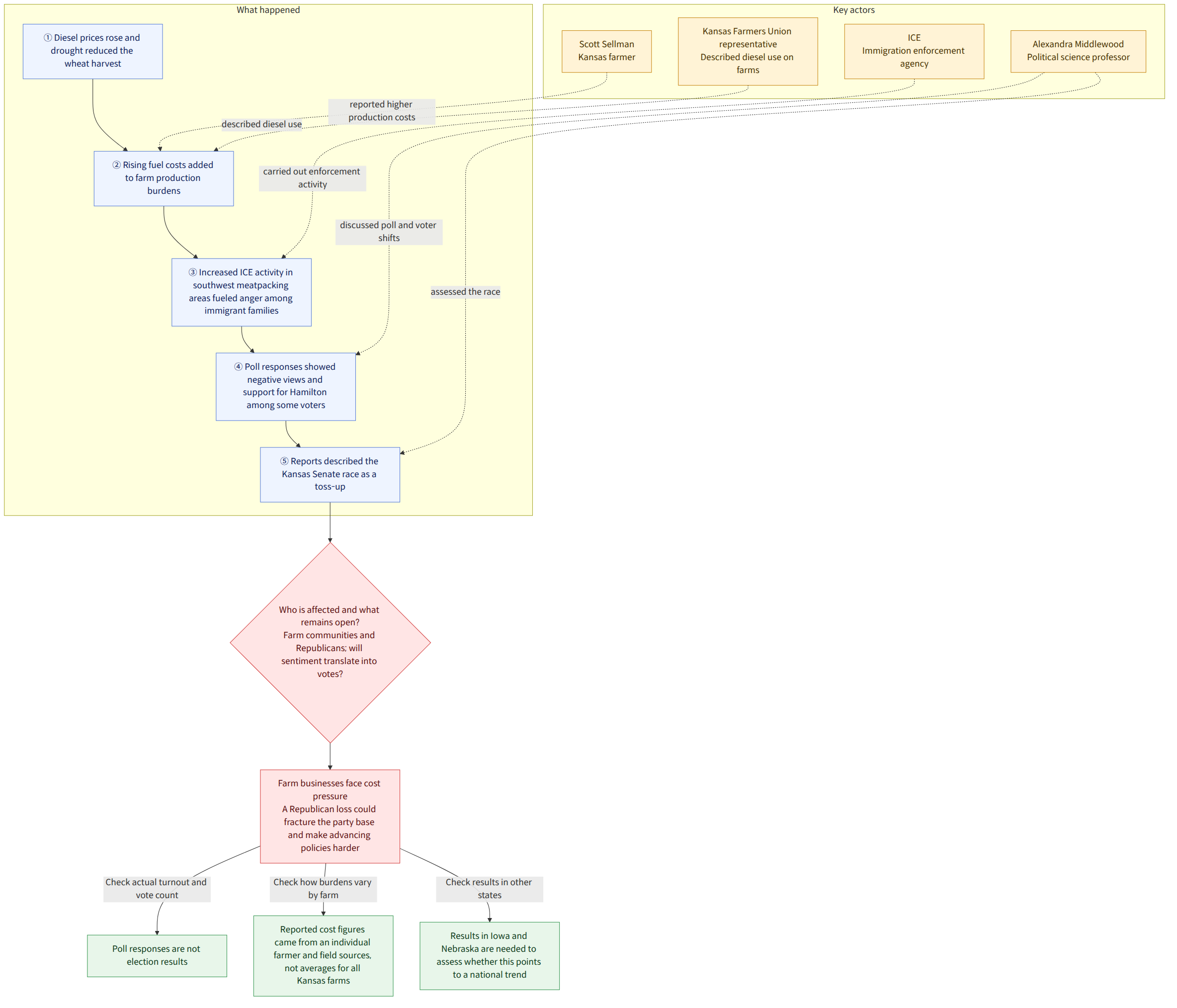
Reports say the Democratic and Republican candidates are locked in a close race in Kansas, a traditionally strong state for Republicans, ahead of the U.S. midterm elections. Alexandra Middlewood, a political science professor at Wichita State University (위치토주립대학교), said in an interview on the 30th of last month (local time) that there is strong sentiment in Kansas this year to punish the party in power. She said that if Republican supporters defect while independent voters shift their preferences, the Kansas election could affect national politics beyond the state.
Background and context
One factor behind the reported shift in public sentiment is the cost burden on farmers. Diesel prices were around $3.50 per gallon before the Iran war, but recently topped $6.50, reaching a record high. As fuel costs rise for farm machinery and grain transport, farm production costs inevitably increase. Professor Middlewood also explained that the drought had reduced the wheat harvest.
On-the-ground reporting also included examples of farms facing these burdens. Farmer Scott Sellman said production costs this year were 20% to 35% higher than last year, depending on the crop, and he expected fuel costs to rise by more than 40% compared with last year. A representative of the Kansas Farmers Union (캔자스농민연합) noted that most tractors, combines and grain-hauling trucks run on diesel, and that fuel costs are rising during the harvest and winter wheat planting seasons. These figures come from an individual farmer and people working in the field; they were not presented as averages for all Kansas farms.
The composition of the electorate is also cited as a factor in the close race. Kansas has more registered Republican voters than any other party, but reports say independents make up a larger share of voters than Democrats do. Professor Middlewood said that in an Emerson College (에머슨대) poll, 62% of independents and 23% of Republicans viewed the president’s job performance negatively. She said 42% of independents and 15% of Republicans said they would vote for Democratic candidate Adam Hamilton. These are responses in a poll, however, not actual election results.
The activities of U.S. Immigration and Customs Enforcement (ICE; 이민세관단속국) have also been cited as a factor affecting local sentiment. Professor Middlewood said enforcement activity had increased in meatpacking areas in the southwest, fueling anger among immigrant families. Her analysis is that voters who normally do not participate in midterm elections may turn out this time, and that Hamilton could win more votes than expected in rural counties where Democrats have been weak.
What this news means
The fact that farmers’ cost burdens and shifts in candidate support are emerging together in one electoral district shows how economic discontent can become linked to assessments of a particular party. The poll responses and interviews in the articles do not, however, determine the election outcome. Only turnout and the vote count will show who actually received more votes.
Farmers and agricultural communities are the first to be affected. For example, if a farm uses a lot of diesel during harvest, rising fuel prices can drive up production costs and, alongside lower yields, increase the strain on the business. How much this burden affects voters’ choices may vary from farm to farm; the articles offer no basis for concluding that all farmers will vote the same way.
The election result also matters to Republicans. Professor Middlewood said that losing the Kansas seat, which Republicans have held for nearly 100 years, could create a major fracture in the party’s base. She also predicted that even if Republicans retain their Senate majority, a broader wave of criticism of the president could make it very difficult to advance policies over the next two years. This is the professor’s analysis; it does not mean that policy gridlock after the election has already been confirmed.
Reports also say that political shifts in Kansas are not confined to the state. Republican candidates are also struggling unexpectedly in Iowa and Nebraska. After campaigning in all three states, Republican Senator John Kennedy said he would not have expected to spend time in those states six months ago. Actual election results will need to be considered to determine whether struggles across several states point to a national trend.
Confirmed facts and what remains unknown
Confirmed facts
- Professor Middlewood said there is strong sentiment in Kansas to punish the party in power.
- According to the articles, diesel prices have recently topped $6.50 per gallon, up from around $3.50 before the Iran war.
- Regarding the Emerson College poll, the professor said 62% of independents and 23% of Republicans viewed the president’s job performance negatively.
- The professor predicted that losing the Kansas seat could make it harder for Republicans to advance policies.
What remains unknown
- What will the actual results of the Kansas Senate election be?
- What was the sample size of the Emerson College poll, and when was it conducted?
- What are the specific causes of the rise in diesel prices before and after the Iran war?
What readers should check
- When reviewing poll figures, checking whether the field dates, sample size and question wording are disclosed can help prevent responses from being overinterpreted as an actual election forecast.
- After the election, it will be important to look not only at the candidates’ vote totals but also at turnout among independent voters and Republican supporters, as well as results in rural counties.
- To assess the actual effect of concerns about agricultural costs on the election, readers can look for follow-up reporting and additional on-the-ground examples related to diesel prices and farm production costs.
References
- Other coverage consulted: hani.co.kr

















