
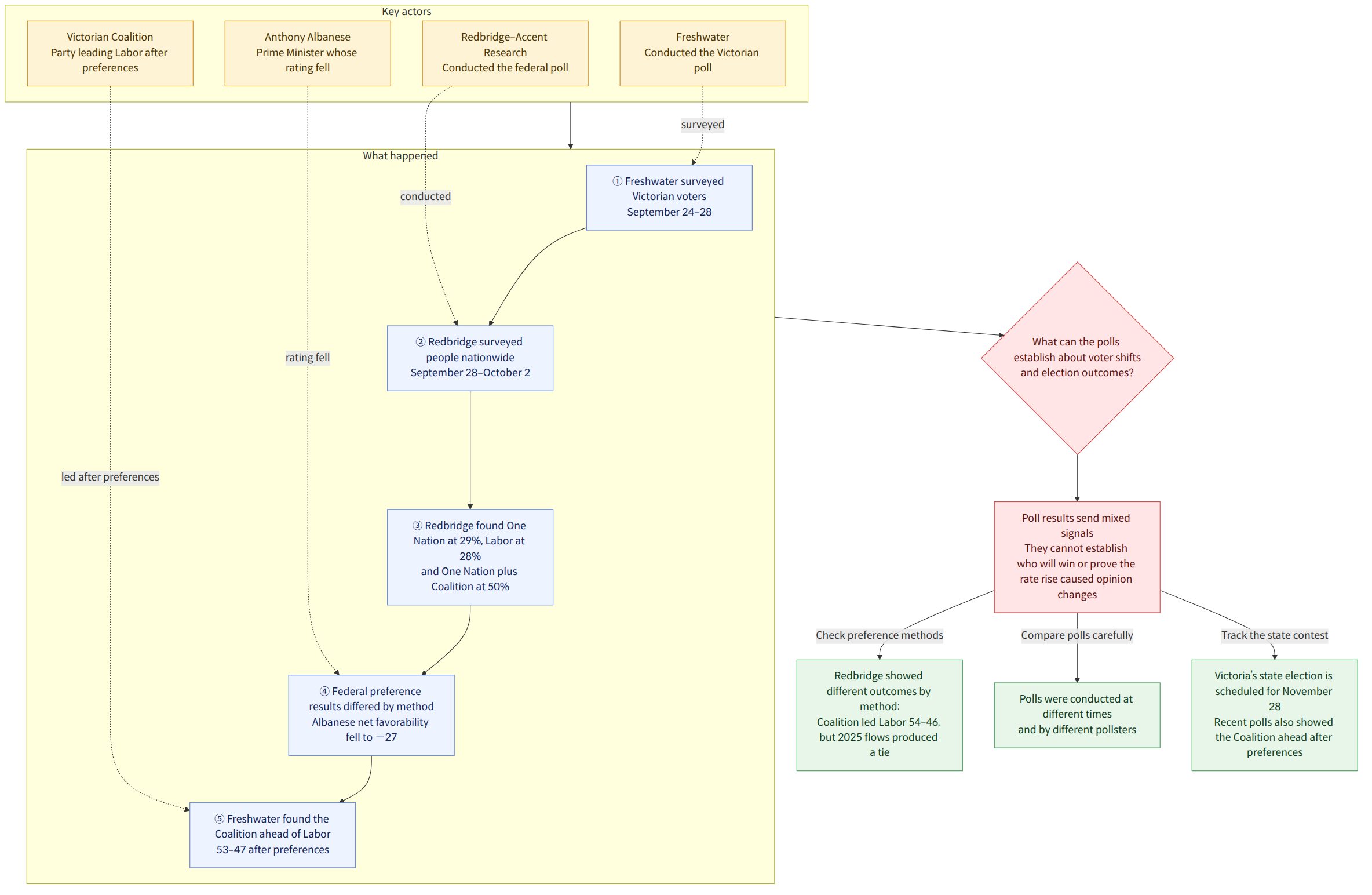
In the Australian federal Redbridge poll, combined support for One Nation and the Coalition has held at 50% since late August. One Nation rose 1 percentage point to 29%, moving ahead of Labor (28%), while the Coalition stood at 21%. Prime Minister Anthony Albanese’s net favorability—the share of positive ratings minus the share of negative ratings—fell 10 points to -27, its lowest level in the poll. The article suggested that the cash rate increase last Tuesday may have had an effect, but it has not been confirmed as the direct cause.
Background and context
The Redbridge–Accent Research poll was conducted nationwide among 1,000 people from September 28 to October 2. Party support was One Nation 29% (up 1 percentage point), Labor 28% (down 1 percentage point), the Coalition 21% (down 1 percentage point), the Greens 11% (down 1 percentage point), and other parties 11% (up 2 percentage points). These figures are primary-vote shares, reflecting respondents’ first-choice party, and should be distinguished from results after preferences are allocated.
When respondents’ preferences were taken into account, Labor led One Nation 52 to 48, while the Coalition led Labor 54 to 46. By contrast, applying the preference flows from the 2025 election produced a 50-to-50 tie between Labor and the Coalition. Preference allocation is calculated on the assumption that votes for candidates eliminated after the first-choice count are transferred to other candidates according to voters’ ranked preferences. As a result, the outcome of a two-party contest can vary in the same poll depending on the preference-allocation method used.
Ratings of political leaders also declined. Treasurer Jim Chalmers’s net favorability fell 9 points to -23; Pauline Hanson’s rose 2 points to -10; and Angus Taylor’s fell 3 points to -6. Central bank governor Michele Bullock’s net favorability was -3. In a three-way preferred-prime-minister question, Albanese was at 31%, Hanson at 26%, and Taylor at 15%.
However, the changes in public opinion cannot be explained solely by the immediate aftermath of the rate increase.
What this means
One notable feature of federal politics is that One Nation’s primary-vote share has moved ahead of Labor’s, while the preference-allocation results vary depending on the method used. Combined support for One Nation and the Coalition is stable at 50% in the Redbridge poll, but that figure alone cannot show which party will win seats or form government. With party support, two-party preference results, and leader ratings sending different signals, it is difficult to draw firm conclusions about the political trend from any one measure.
The declines in Albanese’s and Chalmers’s net favorability could put pressure on the government, but the poll alone cannot establish that voters’ opinions changed because of the rate increase. For example, even if a voter lowered their rating of the government after the rate increase, the poll results alone cannot establish that voter’s reason or how they would actually vote. The rate increase and the changes in support cited in the article occurred close together in time, but any causal relationship would need to be established separately.
In Victoria, the Coalition’s lead over Labor is drawing attention in a state-election context distinct from that of the federal poll. In a Freshwater poll of 1,030 people conducted from September 24 to 28, the Coalition’s primary-vote share was 29%, Labor’s was 24%, One Nation’s was 22%, the Greens’ was 14%, and other parties’ was 11%. After preferences were allocated, the Coalition led Labor 53 to 47. The Victorian state election is scheduled for November 28, and according to the article, recent polls have also shown the Coalition ahead of Labor after preferences are allocated.
Where reports differ
Federal party-support polls have produced different results. In an Essential poll conducted from September 23 to 27, Labor was at 29%, One Nation at 25%, and the Coalition at 22%; based on respondents’ preferences, Labor led the Coalition 48 to 46. This was the opposite of the result in August, when the Coalition led 50 to 45.
In a Morgan poll conducted from September 14 to 27, Labor was at 26%, One Nation at 25.5%, the Coalition at 22.5%, the Greens at 14.5%, and other parties at 11%. The original report put combined support for right-wing parties at 48%. That differs from Redbridge’s 50% combined figure for One Nation and the Coalition, but the polls were conducted at different times by different pollsters, so their results should not be combined or treated as a single figure.
Leader ratings also differ across polls in terms of both the measures used and the timing.
What is confirmed and what remains unknown
Confirmed facts
- In the Redbridge poll, One Nation was at 29% and Labor at 28%, while combined support for One Nation and the Coalition was 50%.
- In the Redbridge poll, Albanese’s net favorability was recorded at -27, down 10 points.
- In Redbridge, the preference-allocation results for Labor and the Coalition differed: 46 to 54 based on respondents’ preferences, and 50 to 50 using the preference flows from the 2025 election.
- In the Victoria Freshwater poll, the Coalition led Labor 53 to 47 after preferences were allocated, and the state election is scheduled for November 28.
What remains unknown
- The specific size of the cash rate increase last Tuesday and the policy rate after the increase were not given.
- The original report does not say what sampling or weighting methods the Redbridge poll used to make its sample representative of the full electorate.
- This poll alone cannot establish how much the cash rate increase actually contributed to the decline in Albanese’s net favorability.
What readers should check
- When looking at the next poll, check whether the figure is a primary-vote share, a result based on respondents’ stated preferences, or one calculated using preference flows from a previous election.
- Consider the polling dates and sample size together. The federal polls cited here were conducted over different periods and among different numbers of respondents.
- When reading explanations linking the rate increase to changes in leader ratings, distinguish between a suggested possibility and a confirmed causal relationship.