

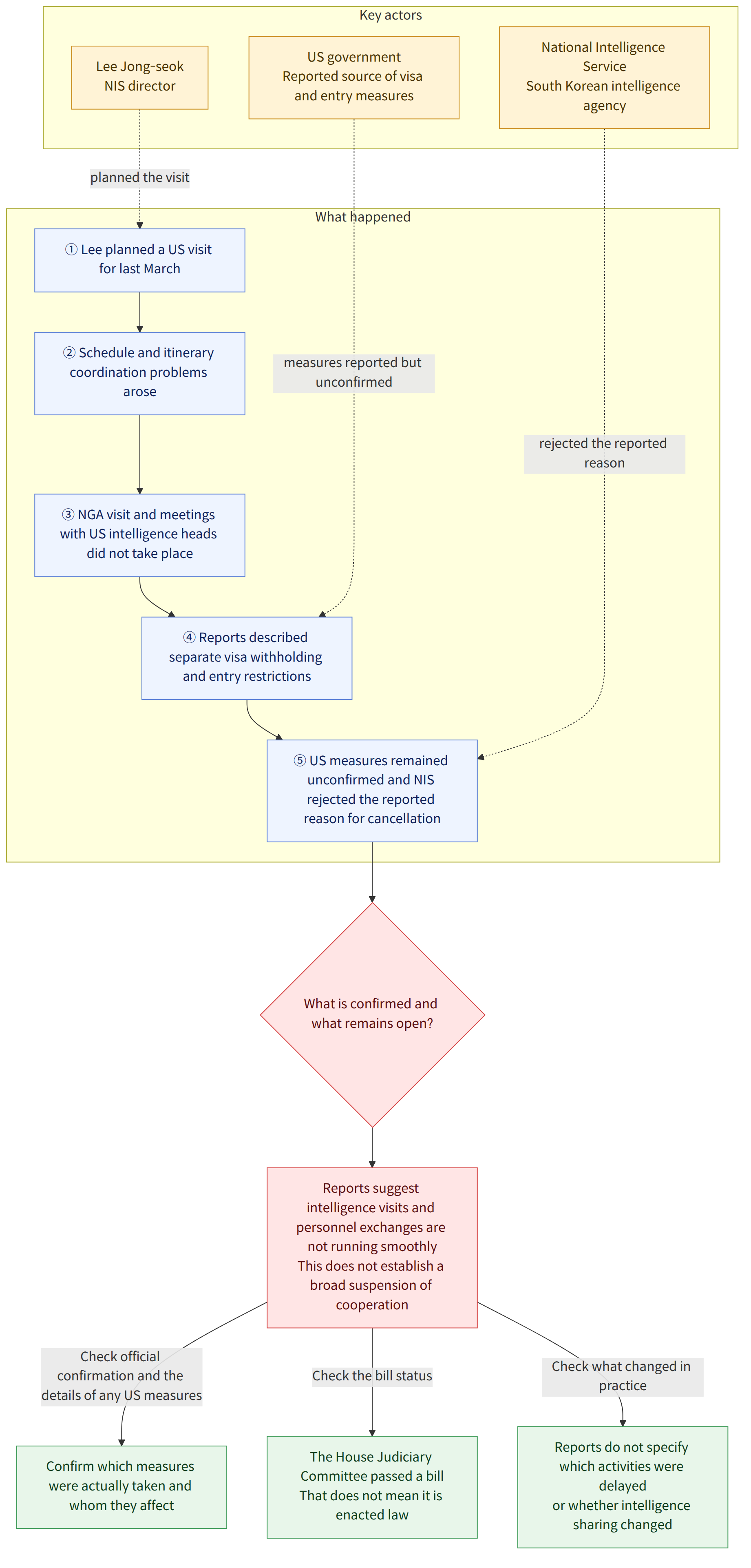
On the 7th, it was reported that a U.S. visit planned last March by National Intelligence Service Director Lee Jong-seok fell through because of problems coordinating schedules and itineraries, and that visits to the U.S. National Geospatial-Intelligence Agency (국가지리정보국), an agency under the U.S. Department of Defense (미국 국방부), and meetings with the heads of U.S. intelligence agencies also did not take place. Separately, reports said the U.S. government had placed several NIS agents involved in the response to the Coupang (쿠팡) personal data breach on a list of people barred from entering the country. However, neither matter was presented as having been officially confirmed by the U.S. government.
Background and context
The National Geospatial-Intelligence Agency (NGA) is a U.S. intelligence agency under the Department of Defense. It analyzes imagery collected by satellites, drones and other means to produce geospatial intelligence (GEOINT; 지형 공간 정보). According to reports, this information is used to map the locations of terrain, facilities and people, and is also relevant to monitoring North Korea. For that reason, reports that the director’s request to visit the NGA did not come to fruition could raise concerns that the avenues for intelligence cooperation were constrained, rather than the matter being merely a scheduling problem.
However, the matter should not be described as a U.S. refusal to admit him into the country. A Washington source explained that the U.S. did not deny Lee entry or refuse to issue him a visa; rather, requests for a visit and meetings fell through. Asked whether the canceled NGA visit was why he had called off his U.S. trip, the NIS said, “That is not true,” and added that it could not confirm the movements of the head of the intelligence agency.
Separately, reports continued about the withholding of visas for NIS employees and restrictions on their entry. According to reports, the U.S. government is withholding visas for several employees who were to be posted to the South Korean Embassy in Washington (주미 한국대사관), while several agents involved in the Coupang response were reportedly placed on a list of people barred from entering the country. The reports described the employees whose visas were being withheld and the Coupang-related agents subject to entry restrictions as separate groups facing separate measures.
What this news means
The key point is that reports suggest both channels for U.S.–South Korea intelligence cooperation and personnel exchanges have not been operating smoothly. A visit to the NGA could be a symbolic moment in cooperation between intelligence agencies, while visa issues affecting employees posted to the embassy in Washington concern the movement of personnel who would carry out work locally. If the reports are accurate, the matter is noteworthy because trust and working-level consultations between the two countries could affect not only intelligence sharing but also agency visits and personnel postings. This is an interpretation drawn from the reported facts; it should not be taken to mean that the U.S. has broadly suspended cooperation.
The Coupang case shows how corporate investigations can intersect with intelligence and diplomatic relations between countries. According to reports, the U.S. side took issue with the role of NIS agents involved in the response to the incident, and the U.S. House Judiciary Committee (미 하원 법사위) named Kim Chang-seop, the NIS’s third deputy director, in an interim report related to the case. Reports also said that a bill passed by the committee on the 16th of last month would make foreign government officials who discriminatorily investigate or penalize U.S. companies subject to denial of entry or deportation. This refers to the bill’s passage by the House Judiciary Committee; it does not mean that the measure has already been enacted into law and put into effect.
For example, if a South Korean government agency were to post an employee in the U.S. or pursue intelligence consultations, whether that person received a visa and whether visit schedules could be coordinated could affect the work. However, the reports available so far do not show which agency activities have been delayed, or to what extent, nor do they reveal what specific changes, if any, have occurred in intelligence sharing.
What is confirmed and what remains unknown
Confirmed
- It was reported on the 7th that National Intelligence Service Director Lee Jong-seok had planned a U.S. visit last March, but it fell through because schedules and itineraries could not be coordinated.
- A Washington source said that the visit to the NGA and the meeting with the head of a U.S. intelligence agency did not take place.
- Asked whether he had canceled his U.S. trip because the NGA visit fell through, the NIS said, “That is not true,” and said it could not confirm the director’s movements.
- Reports said that NIS agents involved in the Coupang case were subject to entry restrictions and that visas were being withheld for employees posted to the South Korean Embassy in Washington.
- Kim Chang-seop, the NIS’s third deputy director, was named in an interim U.S. House Judiciary Committee report related to Coupang, and a bill addressing the denial of entry to or deportation of foreign government officials was also reported to have passed the committee.
What remains unknown
- What specific reasons did the U.S. government have for not permitting Lee’s visit to the NGA and meeting with the head of a U.S. intelligence agency?
- How many NIS agents were included on the list of people barred from entering the U.S., and who are they?
- Have the U.S. government and the NIS officially confirmed the reports about the canceled visit and the entry restrictions on the agents?
- To what extent, in practice, has intelligence sharing on North Korea been restricted following Unification Minister Jeong Dong-young’s remarks about North Korean uranium enrichment facilities?
What readers should check
- Watch for follow-up statements to see whether the U.S. government and the NIS separately confirm the reports about the failed visit request and the visa and entry restrictions.
- It is important to distinguish the bill passed by the U.S. House Judiciary Committee from any later steps it may undergo, and to check whether its implementation and scope are confirmed.
- Since reports about restrictions on intelligence sharing on North Korea cite sources, readers should look for any further official explanation or disclosure of specific changes in cooperation.

















