
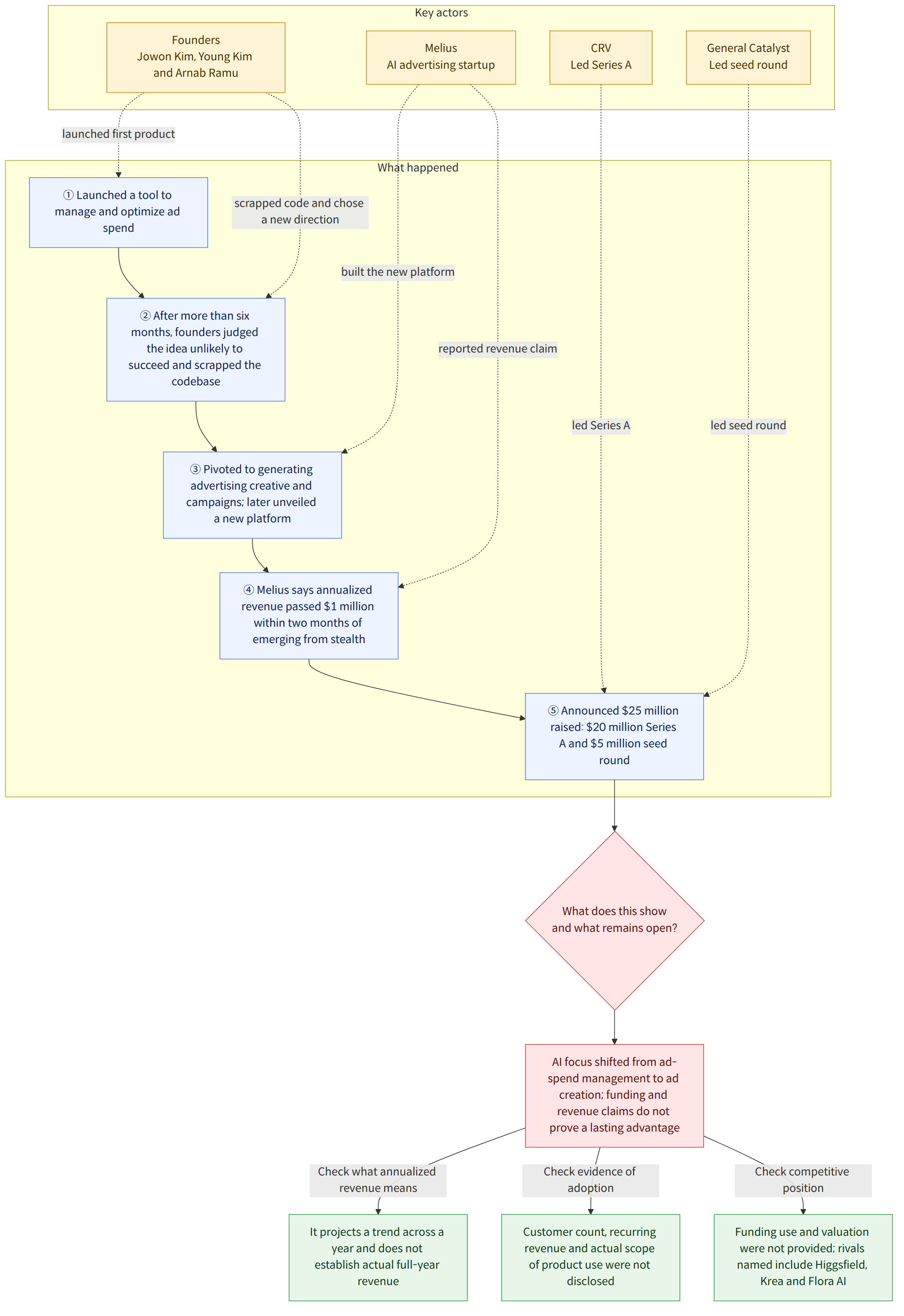
New York-based AI startup Melius announced Tuesday that it has raised a total of $25 million. The funding consists of a $20 million Series A led by CRV and a $5 million seed round led by General Catalyst. Melius is developing an AI platform that generates advertising campaigns, images and videos.
The company says it surpassed $1 million in annualized revenue within two months of emerging from stealth mode—a period in which a company does not disclose details of its product or business—last July. Annualized revenue is a figure that projects a revenue trend over a given period across a full year. This figure alone therefore does not mean that the company actually generated the same amount of revenue over a full year.
Background and context
Melius started out with a different idea. Co-founders Jowon Kim, Young Kim and Arnab Ramu met while working as engineers at Ramp, a corporate spending and finance software company. When they first launched Melius more than a year ago, they intended to build an AI-powered performance marketing tool. The idea at the time was to help marketers manage and optimize ad spend.
But after working on the product for more than six months, the founders decided the initial idea had no chance of succeeding. Jowon Kim said they scrapped the entire existing codebase—the program code that makes up the product. Instead of managing ad spend, the team decided to focus on tools that generate the creative assets and campaigns used in advertising.
Nearly a year after its initial launch, Melius unveiled a new platform that it describes as an “agent lab for creative work.” Here, an agent means an AI tool that helps users with their tasks. In other words, Melius’s shift was not simply a matter of adding generative features to an existing advertising tool: it changed the problem its product was meant to solve, from managing ad spend to creating advertising content.
The pivot also stands out because the founding team abandoned its first attempt and rebuilt the product. Scrapping code developed over more than six months shows that the team chose to build a new product aimed at a different demand rather than keep refining its initial idea. The funding announcement and revenue claim offer clues about the market’s response to that decision, but they do not establish the company’s long-term prospects.
What this news means
Rather than helping users decide how to allocate ad spend, Melius is targeting the creation of images, videos and campaigns needed for advertising. Improving the efficiency of ad operations and producing advertising materials are different tasks, so this pivot reflects a change in the founding team’s judgment about which work AI should support.
However, the two figures alone do not reveal how many customers the company has, whether its revenue is recurring, or how widely its generated content is used in actual work. The company has also not provided a specific plan for using the funding or its valuation after the investment. The funding can therefore be seen as a signal of the market’s growth potential, but it should not be taken as proof that Melius has gained a competitive advantage.
The competitive landscape also matters. According to the article, companies in the same field as Melius include Higgsfield, Krea and Flora AI. Higgsfield was valued at $5.4 billion in August, and Jowon Kim said the three-year-old company had surpassed $700 million in annualized revenue. He acknowledged that competition is intense but believes the market is large enough to support multiple companies. This is the founder’s outlook on the market and should be distinguished from a verified figure confirming that the market is in fact that large.
For example, a team responsible for producing an advertising campaign might look for a tool to turn its ideas into images or videos. A generative platform like Melius could be one option to consider. But that hypothetical scenario alone cannot establish the benefits of adopting it, because the basis for the company’s revenue claim, its customer count and the actual scope of product use have not been disclosed.
Confirmed facts and what remains unknown
Confirmed facts
- Melius announced that it had raised a total of $25 million, combining a $20 million Series A led by CRV and a $5 million seed round led by General Catalyst.
- The company is developing an AI platform that generates advertising campaigns, images and videos.
- The founders worked on their initial performance marketing product for more than six months before changing direction, and Jowon Kim said they scrapped the existing codebase.
- The company says it surpassed $1 million in annualized revenue within two months of emerging from stealth mode in July.
What remains unknown
- The company has not disclosed specifically how it plans to use the funding.
- Melius’s valuation after this investment has not been confirmed.
- The company has not provided its customer count or the basis for calculating annualized revenue.
- The article does not explain how extensively the new platform is used in customers’ advertising production processes.
What readers should look for
- Do not confuse annualized revenue with actual revenue over a full year; look for whether the company discloses the period and calculation method behind the figure.
- Companies considering AI advertising tools can first distinguish between the problem they want to solve: managing ad spend or generating ad creative and campaigns.
- Checking whether Melius discloses its customer count, revenue calculation method and plans for using the funding in its next announcement could help readers assess the significance of this funding more specifically.