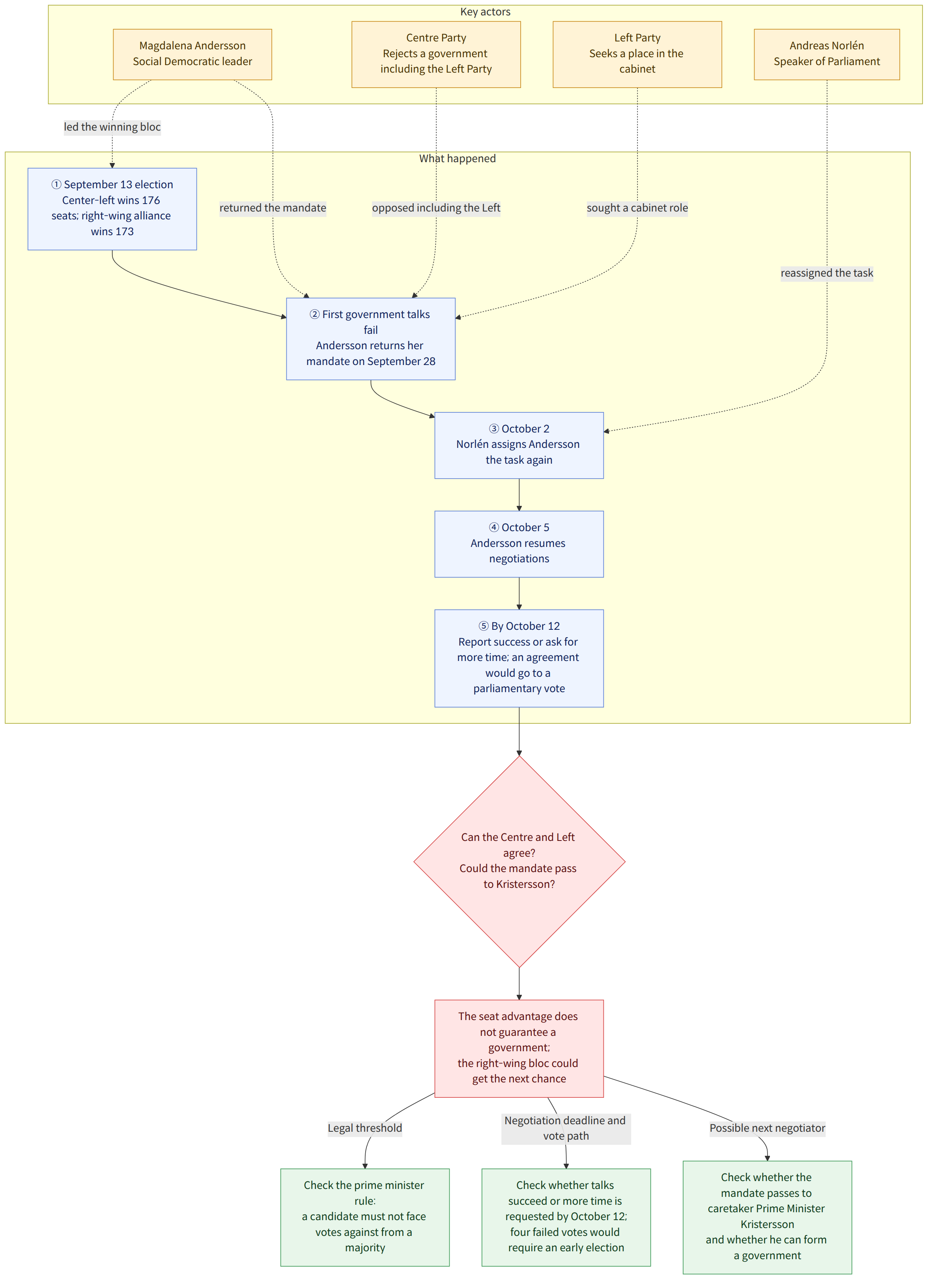
After leading the center-left bloc to victory in Sweden’s general election, Social Democratic Party (사회민주당) leader Magdalena Andersson was tasked with forming a government again on October 2, following the failure of her first round of talks. Speaker of Parliament Andreas Norlén said he had decided to reassign the task after consulting the leaders of the political parties. Since an election victory has not immediately led to a new government, the key question in these negotiations is whether the parties can resolve their differences over participation in a coalition, rather than simply how many seats they hold.
Background and context
In the September 13 general election, the center-left bloc led by Andersson’s Social Democrats won 176 seats. The right-wing alliance led by then-Prime Minister Ulf Kristersson won 173, leaving it behind the center-left. Kristersson stepped down as prime minister immediately after the defeat and is currently serving as caretaker prime minister.
But the center-left’s seat advantage alone was not enough to secure the formation of a government. Its first attempt fell apart because of differences between the Centre Party (중앙당) and the Left Party (좌파당). The Centre Party says it cannot support a government that includes the Left Party, while the Left Party says it cannot cooperate with a government in which it has no place in the cabinet.
On September 28, Andersson returned the mandate to form a government to Norlén, concluding that there was no way to form a government led by the Social Democrats. At the time, Andersson interpreted the Left Party’s support for Norlén, a member of the Moderate Party (온건당), to continue as speaker as a de facto refusal to join a coalition. Some analysts also suggested that returning the mandate was intended to pressure the parties she was negotiating with to compromise. This, however, is an interpretation offered by some observers; the purpose of returning the mandate has not been officially established.
What this means
Norlén said that the underlying balance of power in parliament had not changed and that it would be preferable for Andersson to complete the task of forming a government. With the distribution of seats unchanged since the election, this can be seen as another test of whether the center-left’s parliamentary majority can be translated into an actual government. A seat advantage can give a party a favorable starting point in negotiations, but it does not guarantee that a government will be formed if the Centre Party and the Left Party cannot agree on a government both can accept.
Sweden’s method of electing a prime minister is also important to understanding the situation. A prime ministerial candidate does not need to win the support of a majority of parliament, but must not face votes against from a majority of all members. This means a candidate can be elected even without majority support, as long as opposition does not reach a majority. For example, hypothetically, a candidate could be elected under this rule if the votes in favor fell short of a parliamentary majority and the votes against also fell short of one.
It has been reported that if Andersson fails to form a government again, the mandate could pass to caretaker Prime Minister Kristersson. In other words, if the bloc that won more seats than the right-wing bloc in the election fails to form a government, the right-wing bloc could get the next chance to negotiate. It is not yet known, however, whether the mandate will actually pass to Kristersson or whether he would succeed in forming a government.
Andersson will resume negotiations on October 5. By October 12, she must either report to the speaker that the talks have been successful or ask for more time to negotiate. If an agreement is reached, parliament will vote on Andersson’s nomination as prime minister. Parliament can hold up to four votes on a prime ministerial candidate, and if the candidate fails to be elected in all four, an early election must be held. At the time this article was written, no vote on a prime ministerial candidate had taken place.
What is known and what is not yet known
What is known
- In the September 13 general election, the center-left bloc won 176 seats and the right-wing alliance won 173.
- The first attempt to form a government fell apart because of differences between the Centre Party and the Left Party, and Andersson was tasked with forming a government again on October 2.
- Andersson will resume negotiations on October 5 and must report the outcome by October 12 or ask for more time to negotiate.
- A prime ministerial candidate can be elected without the support of a parliamentary majority, as long as a majority does not vote against them. There can be up to four votes.
- No vote on a prime ministerial candidate had taken place at the time this article was written. If all four votes fail, an early election will be held.
What is not yet known
- It is not yet known whether Andersson can bridge the differences between the Centre Party and the Left Party and reach an agreement by October 12.
- If a nomination for prime minister is put to a vote, it is not yet known how members of parliament will vote.
- If the mandate to form a government passes to caretaker Prime Minister Kristersson, it has not yet been determined whether he will succeed in forming a new government.
What readers should watch for
- Check whether Andersson reports the outcome of the negotiations by October 12 or asks for more time.
- If the negotiations succeed, watch to see whether a vote on the prime ministerial candidate is held and whether the candidate avoids opposition from a majority.
- If Andersson fails to form a government, check whether the mandate passes to caretaker Prime Minister Kristersson and whether a vote on a prime ministerial candidate follows.