Greenairy, a startup focused on purifying office air, has disclosed the results of a short-term test in Singapore and its plans for mass production. Co-founder Tanvi Thombre said that both the daily average and peak VOC levels fell by 50% during regular working hours. The company said the results were validated by the German testing and certification organization TÜV SÜD, but has not yet disclosed the specific figures or test conditions.
Background and context
Greenairy is a startup that makes plant towers to purify office air. Co-founders Thombre and Raksha Saraf were unknowingly exposed to toxic gases from a laser cutter, 3D printer and soldering iron at a university makerspace, Thombre said. She said she began investigating indoor air pollution after her best friend fainted and was taken to the hospital.
Saraf explained that conventional air purifiers are effective at removing particulate matter such as dust and pollen, but less effective at removing gases such as carbon dioxide, formaldehyde and benzene. VOCs (volatile organic compounds, chemicals that evaporate easily into the air) are one category of such substances.
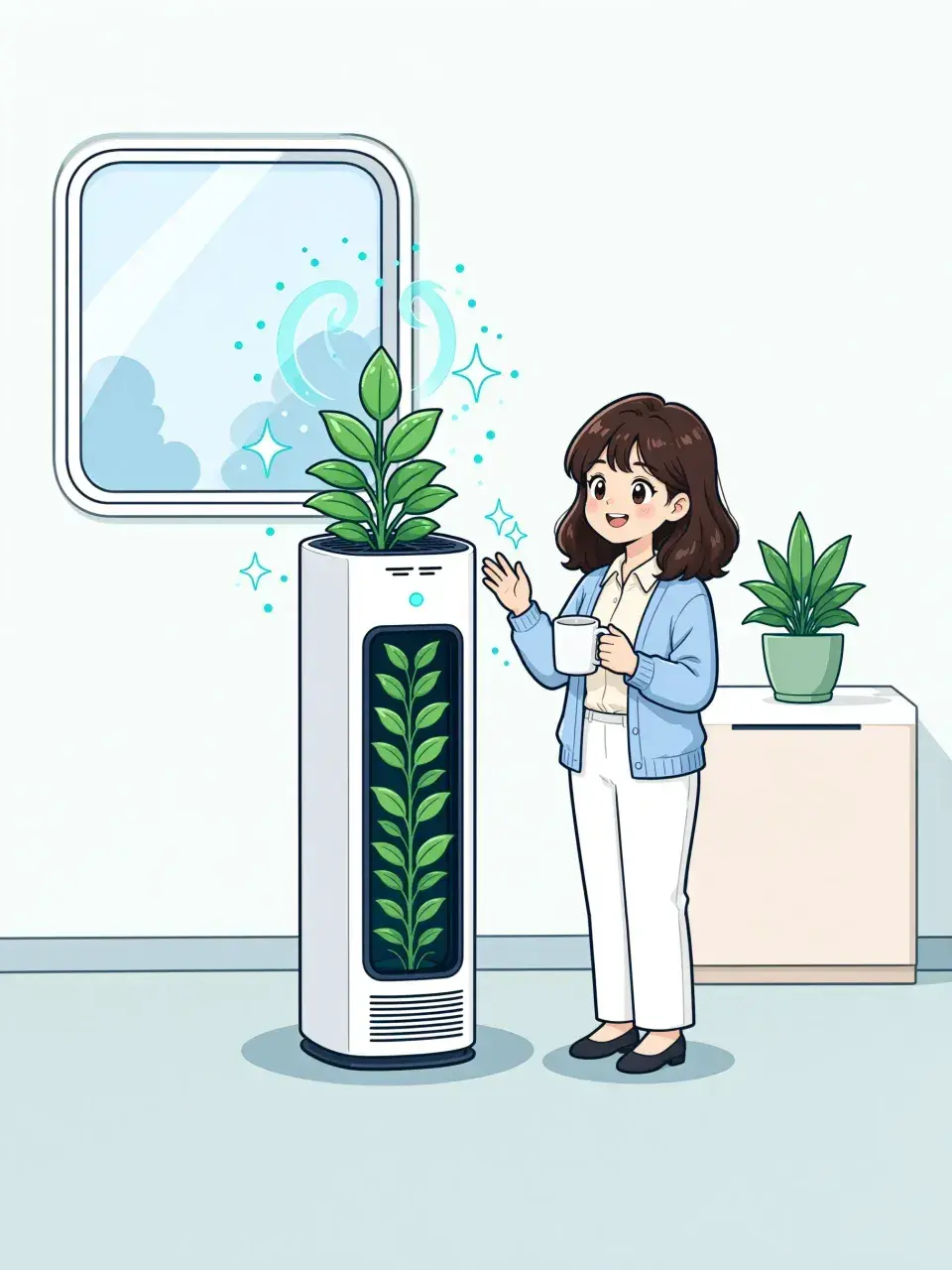
Greenairy’s plant towers are designed to draw in air, break down toxic gases and release purified air. Saraf said the approach, which changes the conditions around the plants, purifies air more quickly and effectively than plants in pots. This is the company’s stated operating principle and claim; assessing the product’s performance independently requires reviewing the published test results and conditions.
What this news means
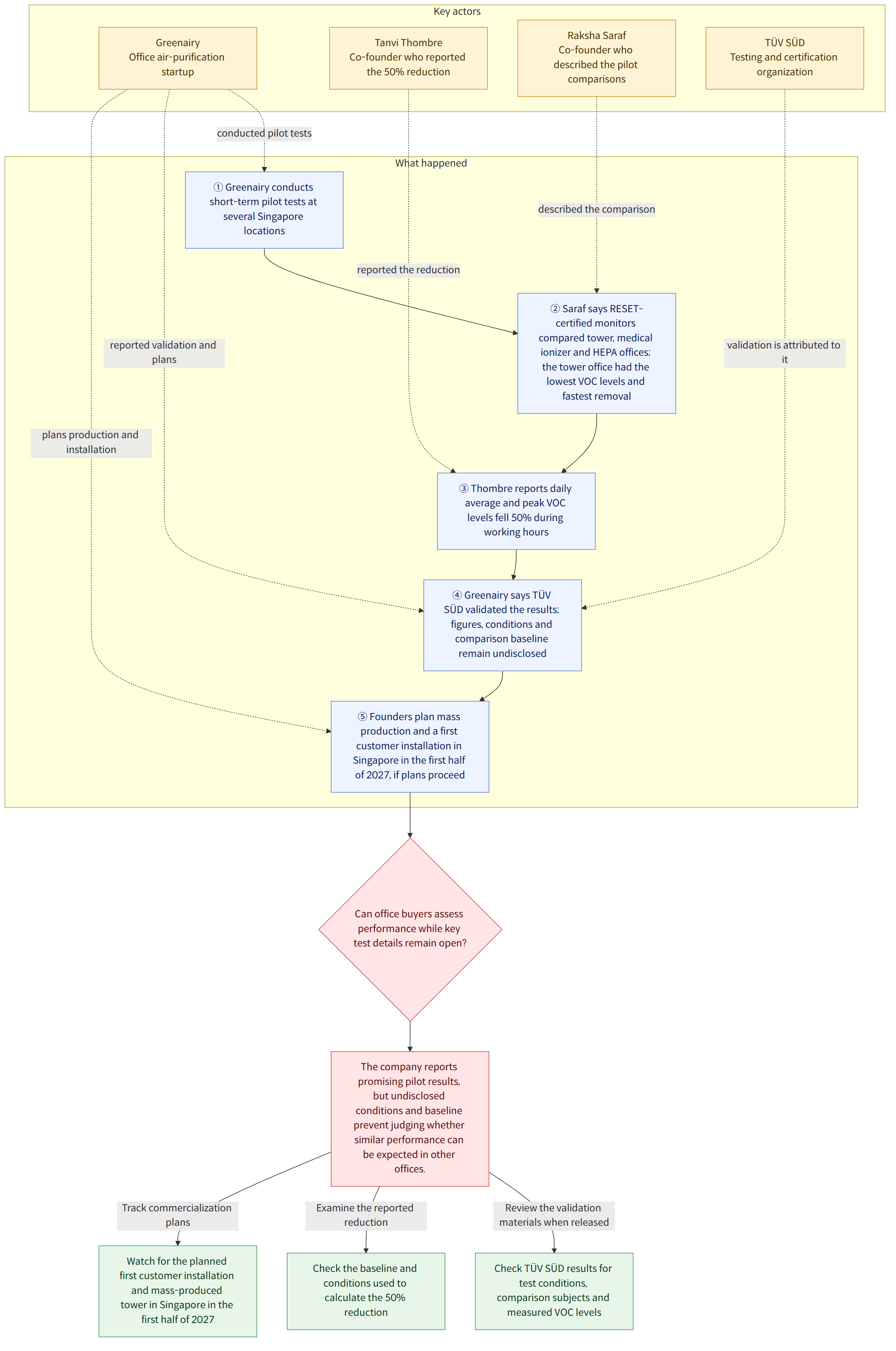
Greenairy conducted short-term pilot tests at several locations in Singapore. According to Saraf, the company used RESET-certified air monitors to compare an office with a plant tower, an office with a medical ionizer (a device that uses electric charge to clump together particles such as dust), and an office with a HEPA air purifier. In the company’s own tests, the office with a Greenairy tower had the lowest VOC levels and the fastest VOC removal rate, Saraf said.
Thombre said both the daily average and peak VOC levels fell by 50% during regular working hours. However, the information provided does not reveal the specific test conditions or comparison baseline used to calculate this reduction. It is therefore more appropriate to understand this figure as a result reported by the company, rather than generalize it as performance that can be expected in every office.
The company said TÜV SÜD had validated the results and that it plans to publish them soon. The founders said they plan to launch their first mass-produced tower in Singapore and install it at their first customer’s site in the first half of 2027, if plans proceed as expected. The forthcoming release of the validation results and the product launch plan are worth watching, as both will allow a more specific assessment of whether the product is commercialized and how it performs.
For example, an office manager considering air-purification equipment can look beyond the reduction rate reported by the company and check the conditions under which the test results were obtained, as well as whether there is reason to expect similar results in their own space. In particular, a key factor in evaluating the product will be how the validation materials from the certification organization, which the company says it plans to release, support the conditions and results of its own tests.
What is confirmed and what remains unknown
What is confirmed
- Greenairy is developing plant towers designed to break down toxic gases and release purified air.
- The company conducted short-term pilot tests at several locations in Singapore.
- Saraf said the company compared three offices using RESET-certified air monitors, and that the office with its tower had the lowest VOC levels and the fastest removal rate.
- Thombre said both the daily average and peak VOC levels fell by 50% during regular working hours.
- The founders said they plan to launch their first mass-produced tower in Singapore and install it at their first customer’s site in the first half of 2027, if plans proceed as expected.
What remains unknown
- What were the specific figures and test conditions in the results validated by TÜV SÜD?
- What baseline and comparison conditions did the company use to calculate the 50% reduction in its own tests?
- What will Greenairy’s plant tower cost, and who is its first customer?
What readers should check
- When the TÜV SÜD validation results are released, review the test conditions, comparison subjects and measured VOC levels together.
- If considering installing a tower, check how the conditions in the company’s test results differ from those in the space under consideration.
- Follow subsequent announcements to see whether the first mass-production launch and installation at the first customer’s site proceed according to the company’s stated plan.