
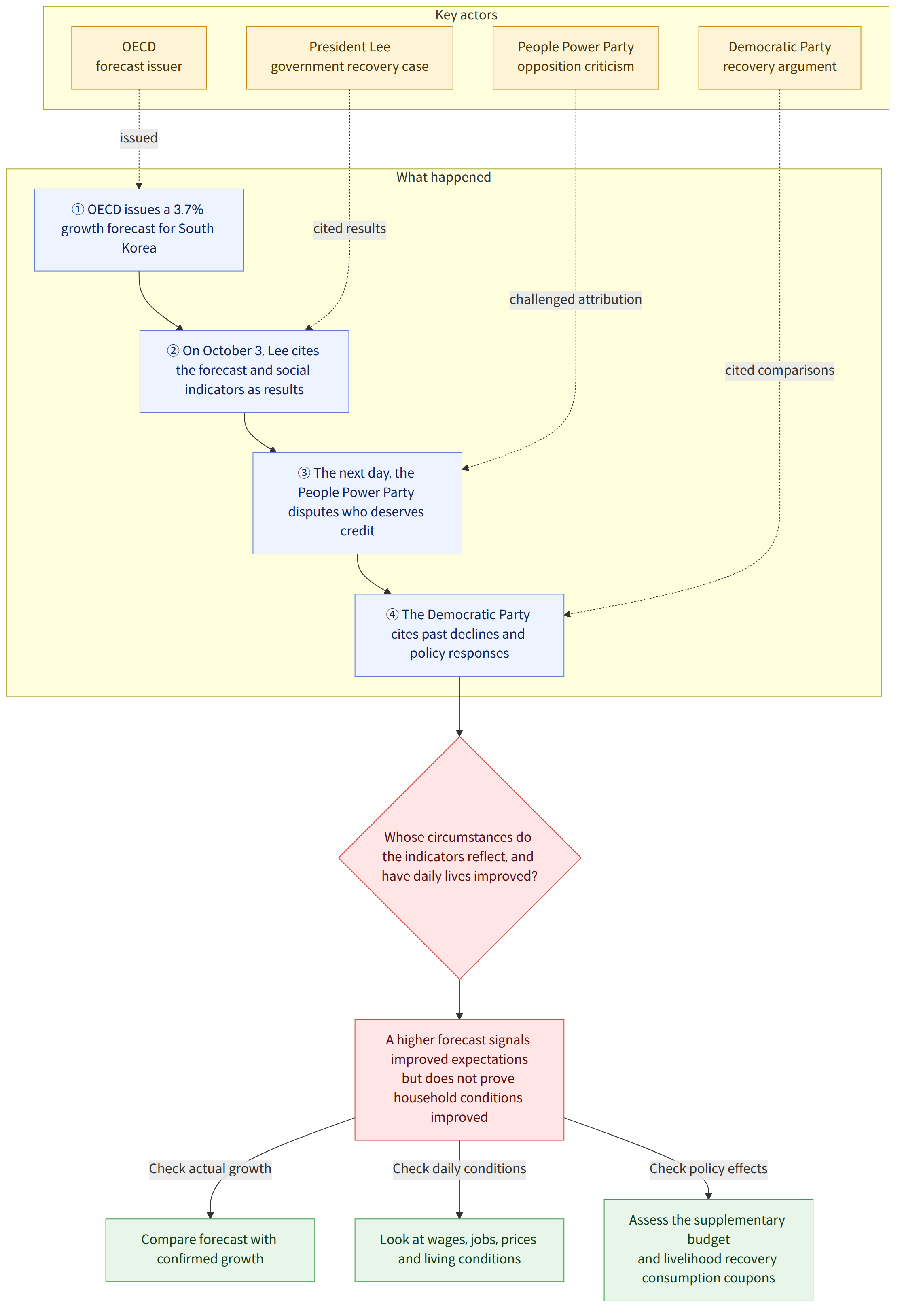
The ruling and opposition parties offered diametrically opposed interpretations of the 3.7% growth forecast for South Korea issued by the OECD. President Lee Jae-myung said efforts to normalize the economy were delivering results. The People Power Party (국민의힘) criticized the government for presenting gains made by businesses and exporters as its own achievements. The Democratic Party (더불어민주당) argued that the economy was recovering, citing past declines in growth and the current government’s policy response.
Background and context
On October 3, 2026, President Lee Jae-myung shared on X a list of achievements highlighted by the Ministry of Planning and Budget (기획예산처). The post cited an increase in the growth forecast, along with decreases in the suicide rate, deaths from industrial accidents and the number of workers affected by unpaid wages. The president praised Minister of Planning and Budget Park Hong-geun and the ministry. He wrote that restoring an economy that had been contracting was urgent and that efforts to normalize the economy were achieving considerable results.
The next day, People Power Party spokesperson Cho Yong-sul criticized the president for citing the OECD’s 3.7% growth forecast for South Korea as evidence of an economic recovery. He attributed the higher forecast to companies’ technology development and efforts to open up export markets, particularly strong exports driven by semiconductors. In other words, he was not disputing the improved forecast itself, but arguing over whether the gains were due to the government or businesses.
Spokesperson Cho said that 65.7% of respondents in an opinion poll released on September 23 rated the current economic situation as “bad.” He also argued that businesses were struggling outside a few export industries. On the stock market, he said that gains in indexes through exchange-traded funds (products that invest across multiple securities) or increases in the share prices of some companies should not be presented as gains for the public as a whole. He also claimed that apartment prices in Seoul had risen for 86 consecutive weeks and that a “balloon effect”—in which rising home prices spread to the Seoul metropolitan area—was emerging.
Democratic Party spokesperson Lee Yong-woo offered a different point of comparison. He said that growth was -0.5% in the fourth quarter of 2022 under the Yoon Suk Yeol administration, and -0.2% in both the second quarter of 2024 and the first quarter of 2025. He also argued that the current government had boosted domestic demand through a supplementary budget (추가경정예산) and livelihood recovery consumption coupons (민생 회복 소비쿠폰), and had lowered reciprocal tariffs from 25% to 15% in trade negotiations with the United States. He also cited a revision to the Commercial Act (상법 개정), separate taxation of dividend income (배당소득 분리과세), the AI budget and the National Growth Fund (국민성장펀드) as policy initiatives.
What this news means
A growth forecast is an estimate of future economic growth, not a record of growth that has already been confirmed or a direct measure of every household’s circumstances. A higher forecast can be read as a sign that expectations for the economy have improved, but it alone does not establish that wages, employment, prices or people’s living conditions have also improved. Conversely, claims about a large share of negative responses in a single opinion poll are not enough to establish the overall direction of the economy.
That is why the two sides are relying on different indicators in this dispute. The government and the Democratic Party emphasize the growth forecast, policy responses and past negative growth. The People Power Party argues that people’s day-to-day economic circumstances may differ, pointing to the contrast between export industries and others, respondents’ assessments of the economy, and housing prices. The key question for readers is not simply “Has the economy improved?” but which people’s circumstances each indicator reflects, and whether the changes have affected their daily lives.
For example, someone working for an export-related company could consider whether strong exports and an improved growth outlook might affect the company’s performance or employment. However, the information in this article alone cannot establish that this person’s wages or job have actually improved. A rising forecast and the economic conditions an individual experiences need to be considered separately.
What is confirmed and what remains unknown
What is confirmed
- On October 3, President Lee posted figures on the growth forecast and social indicators on X, and wrote that efforts to normalize the economy were producing results.
- Spokesperson Cho Yong-sul cited the OECD’s 3.7% growth forecast for South Korea and the 65.7% negative assessment in an opinion poll released on September 23.
- Spokesperson Lee Yong-woo cited past quarterly growth figures and current government policies, including the supplementary budget, consumption coupons and tariff negotiations, as evidence of an economic recovery.
- The causes and policy effects cited by the ruling and opposition party spokespeople were reported as their respective claims. The information in the article is not enough to determine whether either side’s claims about cause and effect have been proven.
What remains unknown
- Who conducted the opinion poll released on September 23, and what were its sample size and methodology?
- What reference period and economic indicators were used to calculate the OECD’s 3.7% growth forecast for South Korea?
- To what extent did the higher forecast and policies such as the supplementary budget, consumption coupons and tariff negotiations each affect growth or people’s day-to-day economic circumstances?
- What specific data support the claims about rising apartment prices in Seoul and the balloon effect in the Seoul metropolitan area?
What readers should check
- When looking at opinion poll figures, readers should check not only who conducted the poll, but also its sample size, methodology, question wording and timing. Without this information, it is difficult to assess how representative the figure of 65.7% is and how broadly it can be interpreted.
- When reviewing an OECD forecast, it is useful to check the year being forecast, the basis of comparison and the reasons for any revision, and to distinguish the forecast from actual growth figures. The figures cited in this report do not reveal the methodology used to calculate the forecast.
- To assess whether the economy is recovering, readers should consider several indicators separately, including employment, income and business conditions relevant to them, rather than relying only on exports or growth forecasts. The effects of policies and how the public as a whole feels about the economy cannot be determined from one party’s account alone.