In a column, Jeong Hwan-bong, a social desk editor at the Hankyoreh (한겨레), wrote that when he was covering vetting of Kim Seung-won, a nominee for Minister of Justice (법무부), lawmaker Han Dong-hoon, an independent, led the release of a recording related to the nominee and mentioned and shared Hankyoreh reports several times. Jeong juxtaposed this with Han’s past lawsuit against Hankyoreh reporters who had scrutinized him, accusing them of defamation, and asked whether Han applied different standards to protecting tipsters and to media scrutiny of himself and others.
Background and context
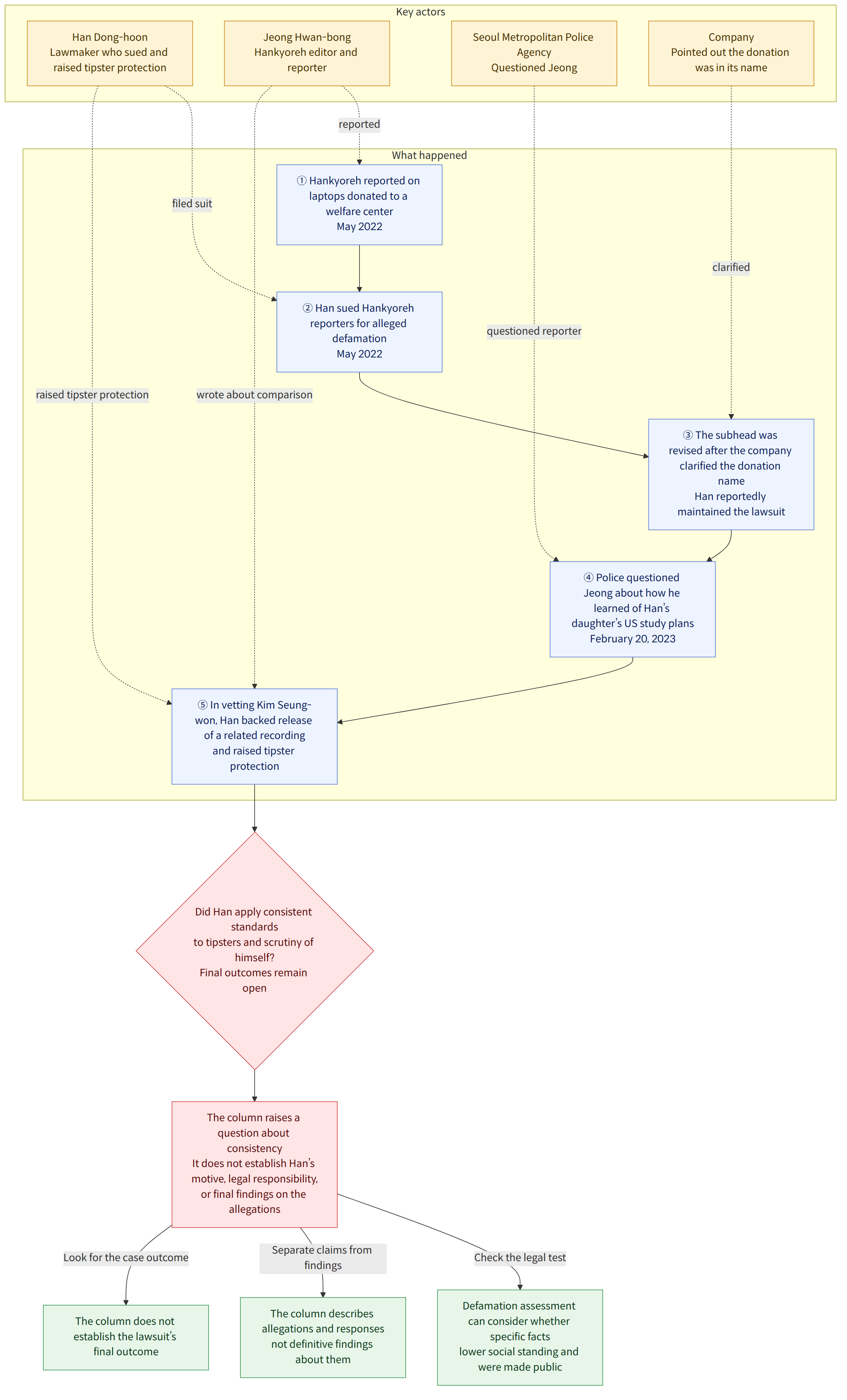
The lawsuit revisited in the column was filed in May 2022, when Han was a nominee for minister of justice. The Hankyoreh report covered how Han’s daughter donated laptops to a welfare center where a volunteer organization headed by Han was active. According to the column, Han’s daughter said in an interview with foreign media that she had asked companies for donations and received more than 50 laptops from one company, which she donated to the welfare center.
Jeong wrote that his reporting found that the company’s executive responsible for social contribution was a close acquaintance of Han and his wife, and a fellow alumnus of Seoul National University’s College of Law. The company said other volunteer groups had also requested laptop donations, and the column reported that the 50 donated laptops had a book value of 13 million won. This is an account of the reporting described in the column; it does not, in itself, establish that the donation was unlawful or improper.
Jeong said the issue in the lawsuit was the phrase “in her daughter’s name,” which appeared in a subhead. The passage was revised after the company pointed out that the donation had been made in the company’s name, but Han reportedly maintained the lawsuit. Jeong wrote that he was questioned on February 20, 2023, by the Anti-Corruption Investigation Unit (반부패수사대) of the Seoul Metropolitan Police Agency (서울경찰청), and that investigators asked how he had learned that Han’s daughter was preparing to study in the United States.
The column also mentions allegations that Han’s daughter’s paper was ghostwritten. According to Jeong, the paper was posted on a preprint website in the United States before being submitted to an academic journal, and Benson, a Kenyan listed as the document’s author, told the Hankyoreh in an interview that he had written it. After the allegations surfaced, Han said that what had been submitted to the journal was not a paper but a “practice report.” The column reported that Han said “I’m sorry” at a confirmation hearing and was then appointed minister of justice. This passage, too, describes allegations in the column and the person’s response; it does not constitute a final determination of the facts.
What this news means
The column’s central purpose is not to establish the legal validity of the earlier reporting. It asks whether the same principles are applied when a politician responds to reporting about himself with a lawsuit, but emphasizes protecting tipsters when publicly raising allegations about someone else. This should be distinguished from a definitive finding about Han’s motives or legal responsibility.
Jeong wrote that after the Hankyoreh reported that a child of nominee Kim Seung-won had falsely registered a residence, several media outlets published related stories, but Han did not share them. He then noted that it had previously emerged that Han’s wife had falsely registered a residence to buy a car. Jeong described as a “guess” the idea that Han stayed silent because of the earlier revelation about his wife; it cannot be stated as a confirmed motive.
The comparison raises a question about consistency in standards of scrutiny, separate from whether the reporting was true. When reporting on allegations involving public figures, both protecting tipsters and verifying the reported claims are important; emphasizing one does not make scrutiny of the other unnecessary. For example, if a politician publicly raises allegations about someone else and says a tipster’s identity will be protected, readers can also consider what procedures and standards the politician used when responding to reporting about himself.
Related legal information and support
The reporting in this case alone is not enough to determine whether defamation occurred. According to an internal legal guide, defamation involves considering whether specific facts that could lower a person’s social standing were made public, and whether the expression could have been communicated to an unspecified number of people or to a large group. Because the wording and the broader context and potential reach are all relevant, it is difficult to reach a conclusion based on one part of a headline alone.
Even stating facts that are true can raise an issue of defamation, but Article 307(1) of the Criminal Act (형법) provides that an act covered by the provision is not punishable when it concerns true facts and is solely in the public interest. As the guide explains, this exemption from punishment in the public interest does not apply to defamation through publications, so the analysis may differ depending on which offense is at issue. It is therefore not possible to conclude from the article alone whether the requirements were met in this case.
The procedure for withdrawing a complaint also depends on the stage of the case and where the request is submitted. The guide explains that a complaint may be withdrawn before the first-instance judgment is handed down, and that after an indictment has been filed, the withdrawal must be submitted to the court handling the trial, not to the investigative agency. However, the column does not state the final outcome of the complaint or the current stage of the proceedings, so this guidance should not be read as a description of what actually happened in this case.
What is confirmed and what remains unknown
Confirmed — as stated in the column
- Jeong Hwan-bong wrote that he covered the vetting of nominee Kim Seung-won, and that lawmaker Han Dong-hoon led the release of a related recording and mentioned and shared Hankyoreh reports.
- The column reported that Han sued Hankyoreh reporters for defamation in May 2022, and maintained the lawsuit after the phrase “in her daughter’s name” in a subhead was revised.
- Jeong said he was questioned by the Anti-Corruption Investigation Unit of the Seoul Metropolitan Police Agency on February 20, 2023.
- The column discussed the circumstances of the laptop donation and its book value, the allegations of ghostwriting and Han’s claim that the submission was a “practice report,” reporting on the alleged false registration of residence by a child of nominee Kim, and a past matter involving Han’s wife.
What remains unknown
- The column does not say how the defamation lawsuit Han filed against Hankyoreh reporters was ultimately resolved.
- It does not state what the parties involved or relevant authorities said about the allegations that a child of Kim had falsely registered a residence.
- The material does not establish the outcome of any investigation or final institutional findings concerning the allegations that Han’s daughter’s paper was written by someone else.
What readers can check
- When considering the controversy, distinguish between the body of the article and its headline. The issue in the lawsuit, as described in the column, was not the entire article but a specific phrase in a subhead.
- To assess whether defamation occurred, check the exact wording at issue, whom it referred to, and the scope and context of its publication. Whether a statement is fact or opinion, and whether it concerns the public interest, are also important to the legal analysis.
- To learn the outcome of a lawsuit or allegation, separately check subsequent proceedings and the positions of the parties and relevant authorities, none of which are included in the column. The available material does not establish the final disposition or findings.