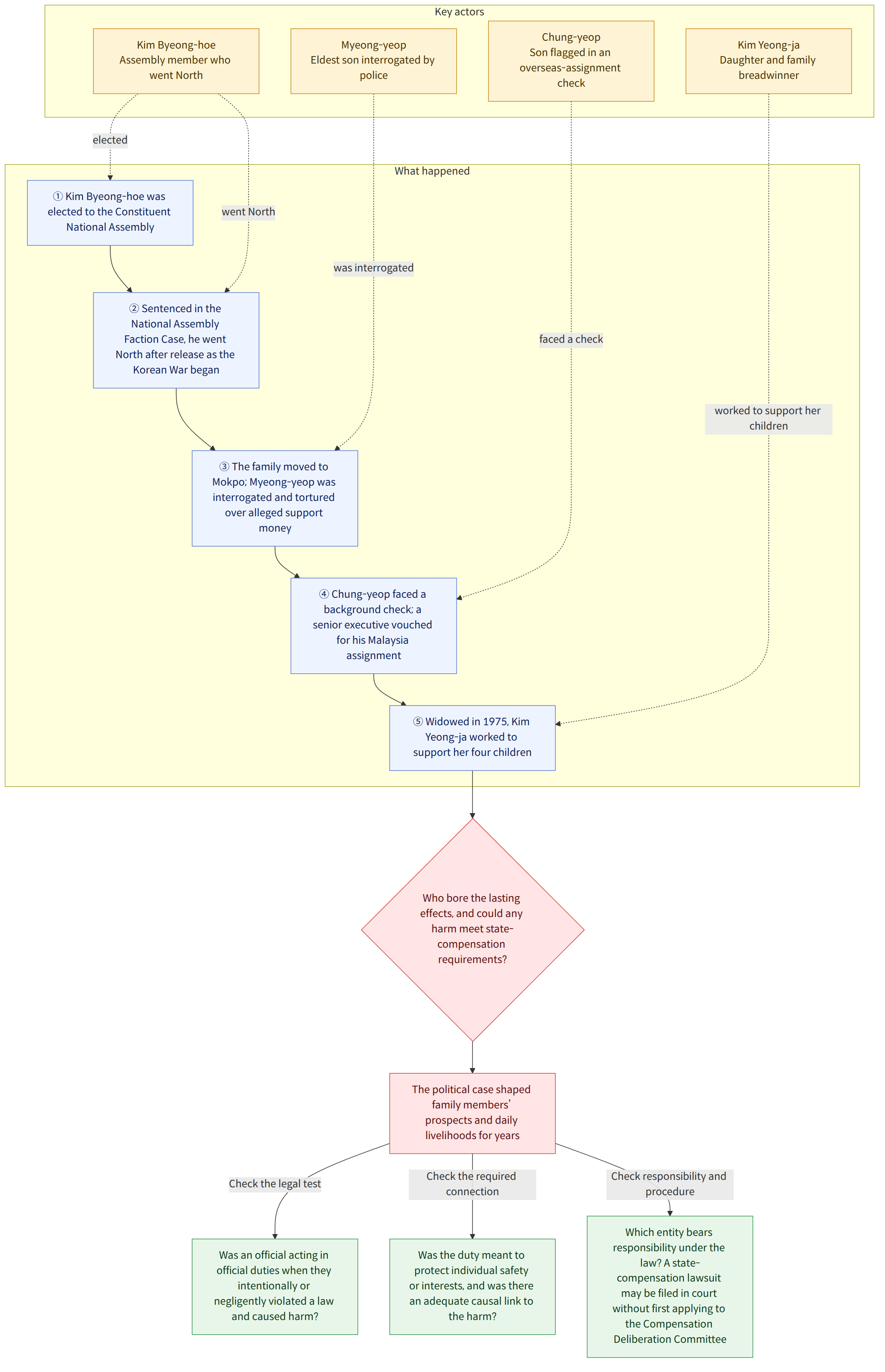
Kim Yeong-ja’s father, Kim Byeong-hoe, ran as an independent in South Jeolla Province’s Jindo in the May 10, 1948 general election and became a member of the Constituent National Assembly. A former head of the Mokpo bureau of the Chosun Ilbo, he was sentenced to six years in prison at trial and went to North Korea after being released from Seodaemun Prison just after the Korean War began. His family had to live apart from him. In Kim Yeong-ja’s memories, the interrogations, background checks and efforts to earn a living that changed her family’s life remain intertwined.
The last time Kim Yeong-ja saw her father was when she visited him with her mother at Seodaemun Prison, shortly before the Korean War broke out. Her father stroked his daughter’s hair and said, “You’re pretty.”
Background and context
Kim Byeong-hoe is described as a leading proponent of the Land Reform Act (농지개혁법) in the Constituent National Assembly. After debate in the Constituent National Assembly, the Land Reform Act was promulgated in June 1949 and took effect in March 1950. Kim Yeong-ja said her mother described her father’s aim as “for everyone to live as equals.”
After her father left, the family moved to her grandfather’s home in Daeui-dong, Mokpo. Her eldest brother, Myeong-yeop, had no money to attend university and was preparing for the civil service examination. He was taken to the Mokpo Police Station, where he was interrogated and tortured over whether their father in North Korea had sent money for living expenses.
Myeong-yeop passed the first stage of the bar examination, but after he asked someone to guarantee him for the second-stage exam and was turned down, he took pills in a suicide attempt. His mother, Kim Gwi-rye, found him and saved his life. Myeong-yeop later learned the art of mounting and framing and worked as a picture framer for the rest of his life. Her younger brother Mu-yeop later followed him into the framing business.
Her younger brother Chung-yeop attended the chemical engineering department of Seoul National University’s College of Engineering on a full scholarship and then joined Samsung Petrochemical. Kim Yeong-ja said he was flagged in a background check ahead of an overseas assignment, but a senior executive vouched for him, allowing him to go to Malaysia. She also said that a North Korean agent approached Chung-yeop and asked whether he wanted to see his father, who was in North Korea. Chung-yeop declined, saying he had a large family in South Korea, and then informed his company.
What this story means
The family’s experience shows how events following their father’s move to North Korea affected each family member’s life in different ways. Their experiences are an example of how the repercussions of an event can extend beyond the people directly involved and affect their family’s prospects and daily lives as well.
Kim Yeong-ja also faced the burden of making a living. Her husband died of acute liver cancer in 1975. She married at 21, spent 10 years with her husband, and was widowed at 31. To support her four children, who were then 1, 3, 5 and 7 years old, she went to work. She started selling insurance but quit, sold used clothes and scouring pads, and traveled around selling goods with a dining table loaded into the back seat of a Hyundai Pony I.
For example, if a family claims it suffered harm because of past actions by a state agency, memories of those events alone do not automatically establish a right to compensation. As the legal guidance below explains, specific requirements must be examined, including the relationship between an unlawful act committed in the course of official duties and an individual’s harm.
Relevant systems and support information
According to an in-house legal guide, the state or a local government may be liable for compensation if a public official, in performing official duties, intentionally or negligently violates laws or regulations and causes harm. However, it must be determined whether the official’s duty was intended to protect individuals’ safety and interests, and whether there is an adequate causal relationship—that is, a legally recognized connection—between the breach of duty and the harm.
The party responsible may vary depending on which entity the relevant administrative work belongs to and on the allocation of responsibility under the law. The guide also notes that a lawsuit seeking state compensation may be filed in court without first applying to the Compensation Deliberation Committee. However, these general standards are not enough to determine the specific legal rights or prospects for compensation of Kim Yeong-ja’s family, and the materials do not explain the time limit for filing a claim.
What is established and what remains unknown
Established facts
- Kim Byeong-hoe ran as an independent in Jindo, South Jeolla Province, in the May 10, 1948 general election and became a member of the Constituent National Assembly. He was sentenced to six years in prison at trial and went to North Korea just after the Korean War began.
- Myeong-yeop was interrogated and tortured by police over whether he had received living expenses from his father in North Korea. He took pills in a suicide attempt but survived after his mother found him.
- Kim Yeong-ja said Chung-yeop was flagged in a background check ahead of an overseas assignment but was able to go to Malaysia after a senior executive vouched for him.
- In 2021, Kim Yeong-ja and Kim Jin-won applied to the Truth and Reconciliation Commission (진실화해위원회) for a determination of the truth about the National Assembly Faction Case. According to the article, human rights violations against Myeong-yeop were also established.
- The Land Reform Act proposed by Kim Byeong-hoe was promulgated in June 1949 and took effect in March 1950.
What remains unknown
- The original article does not state when or where the North Korean agent approached Chung-yeop.
- The original article does not give the specific findings or grounds on which the Truth and Reconciliation Commission determined that Myeong-yeop had suffered human rights violations.
- It is not known how the truth-finding results affected the Commission’s assessment of Kim Byeong-hoe or any separate legal remedies available to his surviving family.
What readers should check
- When examining legal responsibility for actions by a state agency in the past, it is important to distinguish what evidence supports the alleged unlawful act in the course of official duties, the harm, and the causal relationship between them.
- When reviewing the scope of an application for a truth determination or of the resulting findings, it is important to check the relevant documents to establish who was the subject of the application and who was found to have suffered what kind of harm.
- When considering the possibility of state compensation, the responsible agency and the specific time limit for filing a claim should be checked separately. The legal guide provided does not determine the time limit in this case or the individual rights of the surviving family.