The moment a skill seems suddenly replaceable
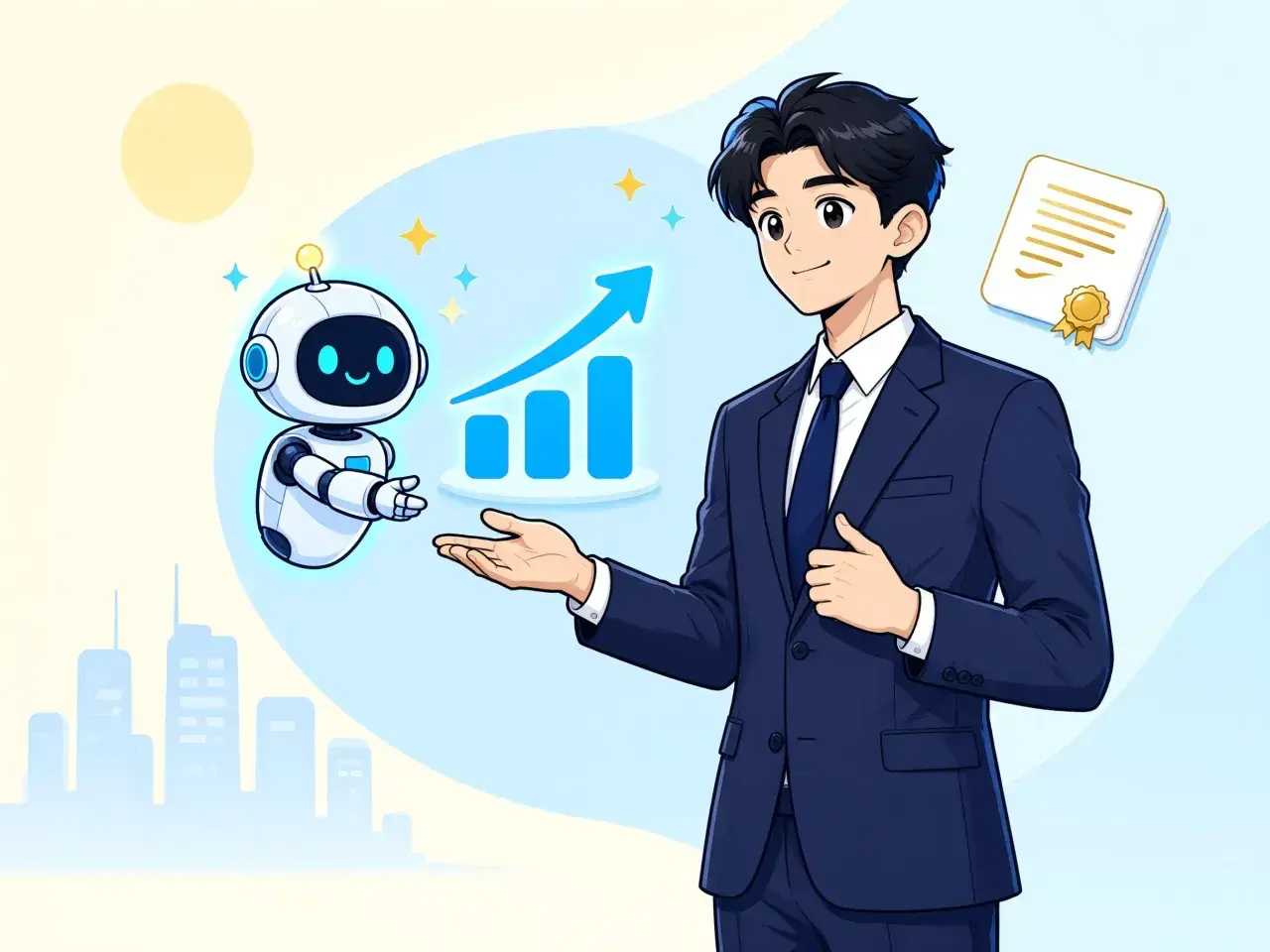
Imagine a planning manager still at the office at 1 a.m. after several late nights. A generative AI system (a tool that creates text, images or other content from instructions) produces a first draft of the business plan in three minutes. After checking the figures and editing the language, the manager sends it to executives—and then wonders whether 15 years of experience have just been made less valuable.
The anxiety is about more than losing a job. It is also a question of identity: if a machine can reproduce work that once took years to learn, what proves that a person is still needed? For many people, work has long been a source of income and a way to see that their knowledge helps colleagues, customers and communities.
AI puts pressure on three different meanings of work’s value. Market price is what an employer pays; social contribution is how much the work helps other people; and dignity is the sense that one’s effort and presence matter. These measures can move in different directions: a task can become cheaper to produce even as the people who do it remain essential to society.
AI may change the price of a task without settling the value of the person who performs it.
When expertise becomes cheaper to buy
AI can now help with tasks that once required years of study and practice, including drafting reports, reviewing routine legal documents, translating text and writing basic code. When a company can obtain a first draft from software at a much lower cost than paying for many hours of human work, the bargaining power of workers who specialize in those tasks may weaken.
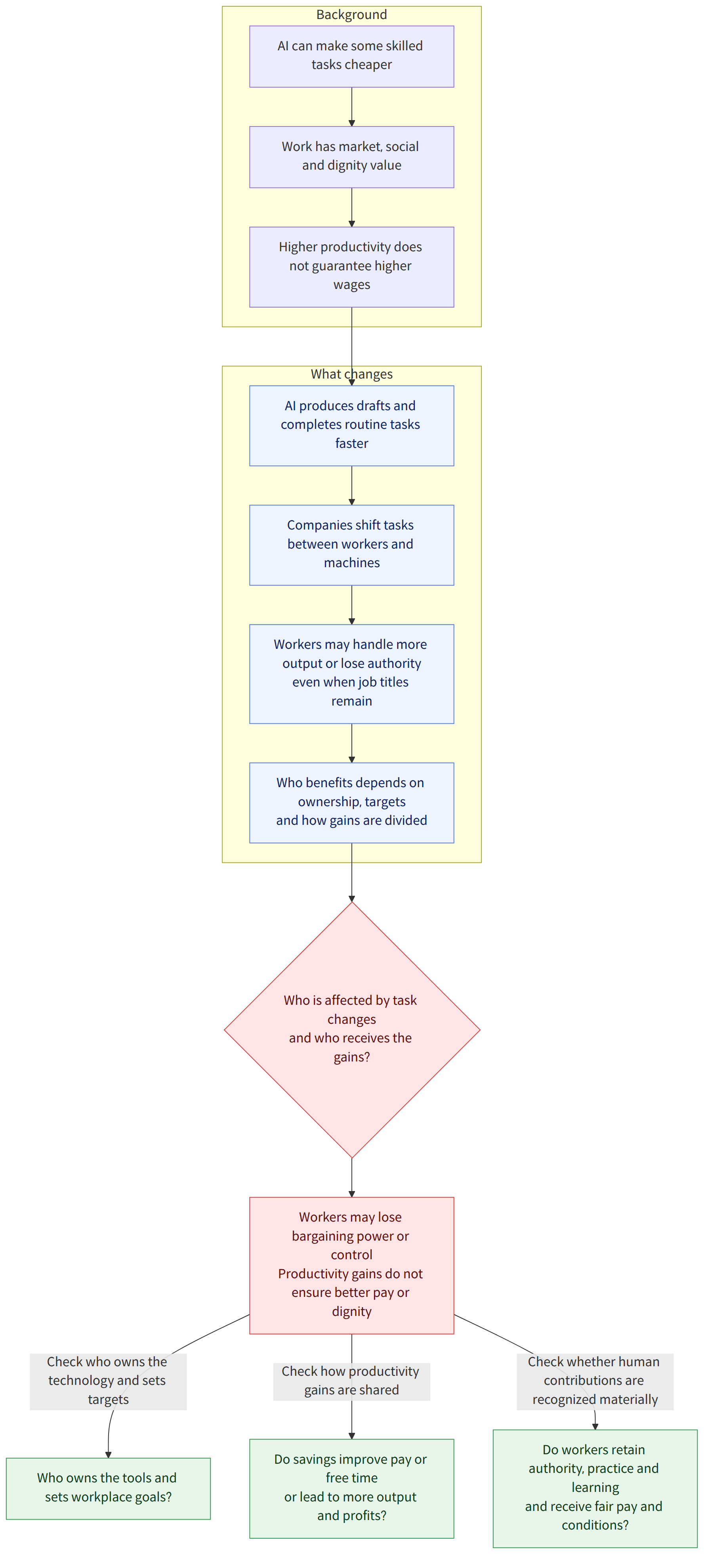
Economists Daron Acemoglu and Pascual Restrepo describe automation as a question of task allocation (deciding which tasks are done by people and which by machines), not simply a story of technology making everyone more productive. If a machine takes over tasks previously performed by workers, a company may produce more while labor receives a smaller share of the result. Higher productivity does not automatically mean higher wages.
For example, if AI cuts the time needed to prepare a proposal in half, an employee’s pay does not automatically double. An employer might instead assign that employee more proposals, reduce future hiring or use the savings to increase profits. Without rules or bargaining power that direct productivity gains back to workers, saved time does not necessarily become free time or higher pay.
The change may also happen without a job disappearing. A senior analyst or manager might keep the same title but gradually lose responsibility for research, drafting or decisions, becoming the person who checks and approves machine-generated work. Employment numbers can therefore look stable even as workers lose control, practice and authority in their jobs.
- Tasks can be automated while job titles remain.
- Workers may be expected to handle more output in the same hours.
- Experience and decision-making authority can erode before layoffs appear in the statistics.
Productivity is not the same as prosperity
A productivity gain means that more output can be produced with a given amount of time or resources. Whether workers benefit depends on who owns the technology, who sets workplace targets and how employers, employees and governments divide the gains. A faster process can improve workers’ lives—but it can also make work more intense if every saved minute becomes a new target.
Why the promise of “more human work” is not enough
One optimistic view is that as AI makes routine intellectual work abundant, distinctly human abilities—care, empathy, ethical judgment and trust—will become more valuable. The comparison is familiar: when machine-made goods become common, handmade products may seem more precious. But a quality can be socially important without commanding a high wage.
Care workers already demonstrate this contradiction. They help older people with daily needs, support families in crisis and comfort young children. Their work sustains other people’s lives, yet its social importance has not automatically translated into high pay or status.
Calling care work priceless is not a substitute for paying care workers fairly.
The same risk applies to claims that human qualities will be especially valuable in the AI era. If employers praise empathy and responsibility but do not change wages, staffing levels or working conditions, the praise can become a cheap reward in place of material recognition. The value society gives to human work and the price paid for it are not the same thing.
This distinction matters beyond care. A teacher who notices a struggling student, a nurse who reassures a worried patient and a mediator who helps people resolve a conflict may contribute in ways that are difficult to measure with a simple output count. Yet workplaces often reward what is easiest to count, not necessarily what matters most.
AI can assist workers—or monitor them
A more practical view is that AI will often change parts of a job rather than erase an entire occupation at once. Most jobs combine different activities: some may be suitable for automation, while others require human context, communication, physical presence or responsibility for a decision.
A 2025 International Labour Organization analysis estimated that roughly one in four workers worldwide held jobs with some exposure to generative AI. Exposure does not mean that a worker will certainly lose a job; it means that AI could affect some tasks in that occupation. The organization’s central point was that many jobs are more likely to be transformed than fully replaced because they include work that still requires human involvement.
Research by economist Erik Brynjolfsson and colleagues offers one example of how this transformation can help workers. In a study of 5,179 customer-support agents, access to a generative AI assistant was associated with an average 14% increase in problems resolved per hour. The gains were particularly large for less experienced or lower-skilled agents, whose productivity rose by about 34%.
One possible explanation is that the system made useful suggestions and more experienced workers’ approaches available to newer colleagues. In that sense, AI can act like an on-the-job assistant, helping a beginner handle situations that might otherwise take longer to learn. But a productivity increase alone does not tell us whether workers received better pay, more time or greater control over their work.
AI can also be used to measure workers more closely. A system that tracks call length, response speed and the number of cases handled may help managers identify problems, but it can also turn every interaction into a score. If employees are judged mainly by those metrics, they may have less freedom to slow down, listen carefully or make a decision that serves a customer’s needs.
- As an assistant, AI can make information and experienced workers’ methods easier to access.
- As a monitoring tool, it can track speed and output in ways that reduce autonomy.
- The same technology can support workers or intensify pressure, depending on how it is designed and used.
The central question is who controls the gains
The important issue is not simply whether people and AI work together. It is who owns the system, who decides what counts as successful work and who receives the benefits when tasks become faster. The future of work is therefore not only a technology question; it is also a question of power and distribution.
The training ladder could lose its lower rungs
AI is often presented as a way to free people from routine work so they can focus on creativity, judgment and responsibility. But those abilities do not appear automatically. People develop them through practice, mistakes and repeated exposure to real situations.
A junior lawyer learns by reviewing documents and comparing cases. A trainee journalist learns by contacting sources, checking facts and rewriting drafts. A junior software developer learns by writing basic code, finding errors and seeing how small pieces fit into a larger system. Tasks that look repetitive from the outside can be the first steps toward professional judgment.
If employers give more entry-level work to AI and hire only people who already have experience, young workers may find it harder to get the practice needed to become experienced. They can be told to assess whether an AI answer is wrong without having had enough opportunities to learn what a reliable answer looks like.
This creates a potential experience gap (a shortage of chances to build the skills that employers later demand). It could affect not only new graduates but also workers changing careers or people entering industries where routine tasks once served as training. Organizations may need to create supervised practice, rotations, apprenticeships and other routes to build expertise when traditional starter assignments shrink.
If AI takes over the beginner’s tasks, employers and educators must create new ways for beginners to learn.
The challenge is not to preserve every old task simply because it exists. It is to preserve the learning that used to happen through those tasks. That may mean giving workers responsibility for reviewing AI outputs, explaining their reasoning, handling exceptions and gradually making decisions—with experienced colleagues available to coach them.
What society chooses to reward
If market prices are the only measure, some workers may lose value as AI makes their skills less scarce. But social contribution is a broader measure. Caring for someone, resolving a dispute, deciding what should be done and accepting responsibility for the consequences can remain important even when a machine can produce text or calculations more quickly.
The difficulty is that these contributions are not automatically reflected in market prices. Markets reward what buyers will pay for, while communities may depend on work that is underpaid or difficult to measure. Public policy, workplace rules and collective bargaining can influence whether the benefits of AI are shared or concentrated among companies and technology owners.
Two goals are especially important:
- Sharing productivity gains: ensure that workers and communities benefit from the time and resources AI saves, through fair pay, better conditions, shorter hours or other forms of shared value.
- Protecting dignity and participation: make sure people have meaningful opportunities to contribute, learn and be recognized, not only financial support when work changes.
Income support can help people meet basic needs, but money alone may not provide the sense that one’s contribution matters. A broader response could include better pay and staffing in care work, new apprenticeship systems for young workers, and recognition for contributions in education, culture, environmental work and local communities.
A different measure of success
The key question is not only how many jobs AI may eliminate. It is also how the wealth and time created by AI will be shared, and whether people retain real opportunities to contribute to society. If technology produces more with less human effort, society must decide whether the result is mainly greater profit, more secure lives or some combination of the two.
A person’s worth is not an AI performance score
Return to the planning manager facing a screen in the early hours. The unease is not simply fear of a new tool. It is a deeper question: will I still be needed tomorrow, and will anyone recognize what I contribute?
AI may lower the market price of some tasks, but it does not determine the worth of the people who once performed them. That worth depends partly on what societies choose to recognize, how they distribute the gains from technology and whether they make room for people to learn, care, judge and take responsibility.
AI can take over work without society having to devalue the people who do it. The difference depends on the choices people and institutions make.
The speed of machines will not, by itself, decide the future value of human work. The decisive choices concern how technology is governed, who shares its benefits and whether every person can find a respected place in the community.