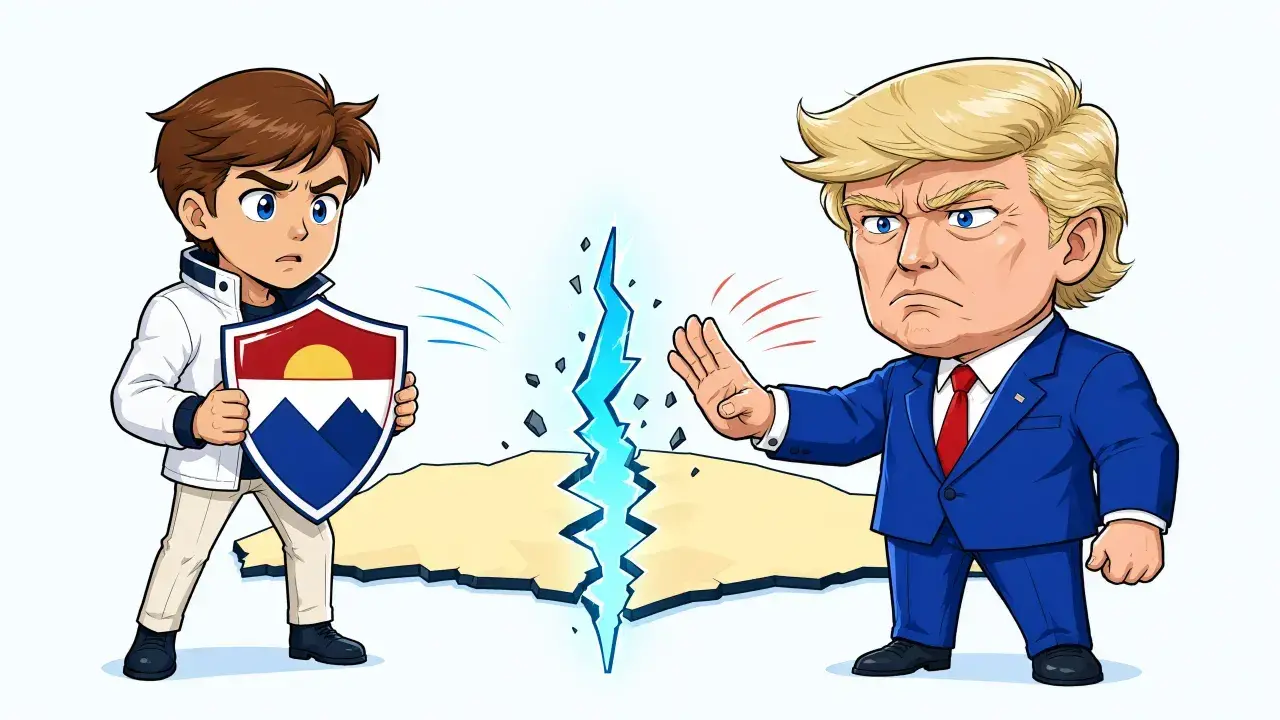
A study has found that information linking U.S. President Donald Trump to Alberta’s separatist movement may lower willingness to vote for independence. In a survey of 1,260 Alberta residents, the condition that showed a link between Trump and separatism and prompted participants to recall what other residents think of Trump lowered willingness to vote by 5.4 percentage points. The researchers also said that most Albertans strongly oppose leaving Canada.
Background and context
The article reports that over the past 18 months, interest in Alberta separatism in the United States has ranged from public support by senior government figures and congressional allies to backing from the MAGA online media ecosystem. In late January, Republican political activists from Michigan reportedly visited Alberta to discuss voter-engagement software with separatist organizers.
A few weeks later, key Alberta separatist organizers acknowledged meeting with U.S. officials in Washington to discuss the possibility of Alberta leaving Canada. However, they distanced themselves from President Trump. As one clue to the reasons behind this, the study points to Trump’s unpopularity in Alberta and the possibility that associating the separatist movement with him could reduce support.
The researchers conducted the survey through Vox Pop Labs in late May 2026. The 1,260 respondents were concentrated mainly in Calgary and Edmonton and along Highway 2. According to the researchers, compared with the 2021 census, the sample had higher levels of education, a slightly higher share of men and higher incomes.
Participants were randomly assigned to receive different bundles of information or no information. They were then asked how they would vote if there were a referendum on independence and how much they agreed with the proposition that Alberta should separate from Canada and become independent. The researchers said they did not use the Alberta government’s referendum question, whose wording experts had criticized as confusing.
What this means
The key finding is that underlying attitudes toward separatism and actual willingness to vote can move differently. The researchers said that most respondents strongly opposed separatism, and that because opposition was already strong, information linking the issue to the United States, Trump or anti-Trump norms did not further change levels of agreement or disagreement. However, the information did affect willingness to vote.
Social norms refer to how members of a group generally behave and what kinds of behavior are considered expected. The researchers say Albertans correctly perceived a social norm against Trump. Their interpretation is that linking separatism to Trump could affect voting choices by leading people to expect that support for independence might draw negative judgment from those around them.
For example, even if a voter’s view of separatism itself did not change, their willingness to vote could change if they encountered information linking the movement to Trump and became conscious of other residents’ opposition to him. This is a hypothetical illustration of the study’s findings; it does not mean that a particular voter actually reacted this way.
In this respect, the study also has implications for campaign strategy in the separatism debate. The researchers predicted that linking Trump to separatism could be more effective if Trump intervened more actively ahead of a referendum or if the campaign to remain in Canada made use of his image. This is the researchers’ projection, however, not evidence that the strategy has been proven effective in an actual campaign. Also, the survey measured willingness to vote, which should be distinguished from actual voting behavior or a referendum result.
What is established and what remains unknown
What is established
- The researchers surveyed 1,260 Alberta residents in late May 2026.
- The sample was concentrated mainly in Calgary, Edmonton and areas along Highway 2. Compared with the 2021 census, it had higher levels of education and income and a slightly higher share of men.
- In the no-information control group, only a minority said they would vote for independence. Groups that received information linking the issue to the United States, Trump or anti-Trump norms showed lower willingness to vote than the control group.
- In the condition that presented a link between Trump and separatism and prompted participants to consider other Albertans’ feelings about Trump, willingness to vote fell by 5.4 percentage points.
- The researchers said that the information conditions did not further change levels of agreement or disagreement because there was already strong underlying opposition to separatism.
What remains unknown
- The method used to select the survey sample and the margin of error for the results were not provided.
- The source text does not establish when an actual referendum on independence is scheduled to take place.
- The specific percentage willing to vote in each information condition, and whether the observed difference was statistically significant, are not given in the material provided.
- The extent to which differences between the sample’s demographic composition and that of the population affected the results cannot be determined from this material alone.
What readers should check
- Claims citing this study should distinguish changes in willingness to vote from changes in attitudes for or against separatism. The researchers said the two measures did not produce the same results.
- Readers should check which information condition produced the 5.4-percentage-point figure. It came from the condition that showed a link between Trump and separatism while prompting participants to recall other residents’ feelings about Trump.
- When generalizing the results to all Alberta residents, readers should take into account that the sample differed from the 2021 census and that the material provided does not state the sampling method or margin of error.