

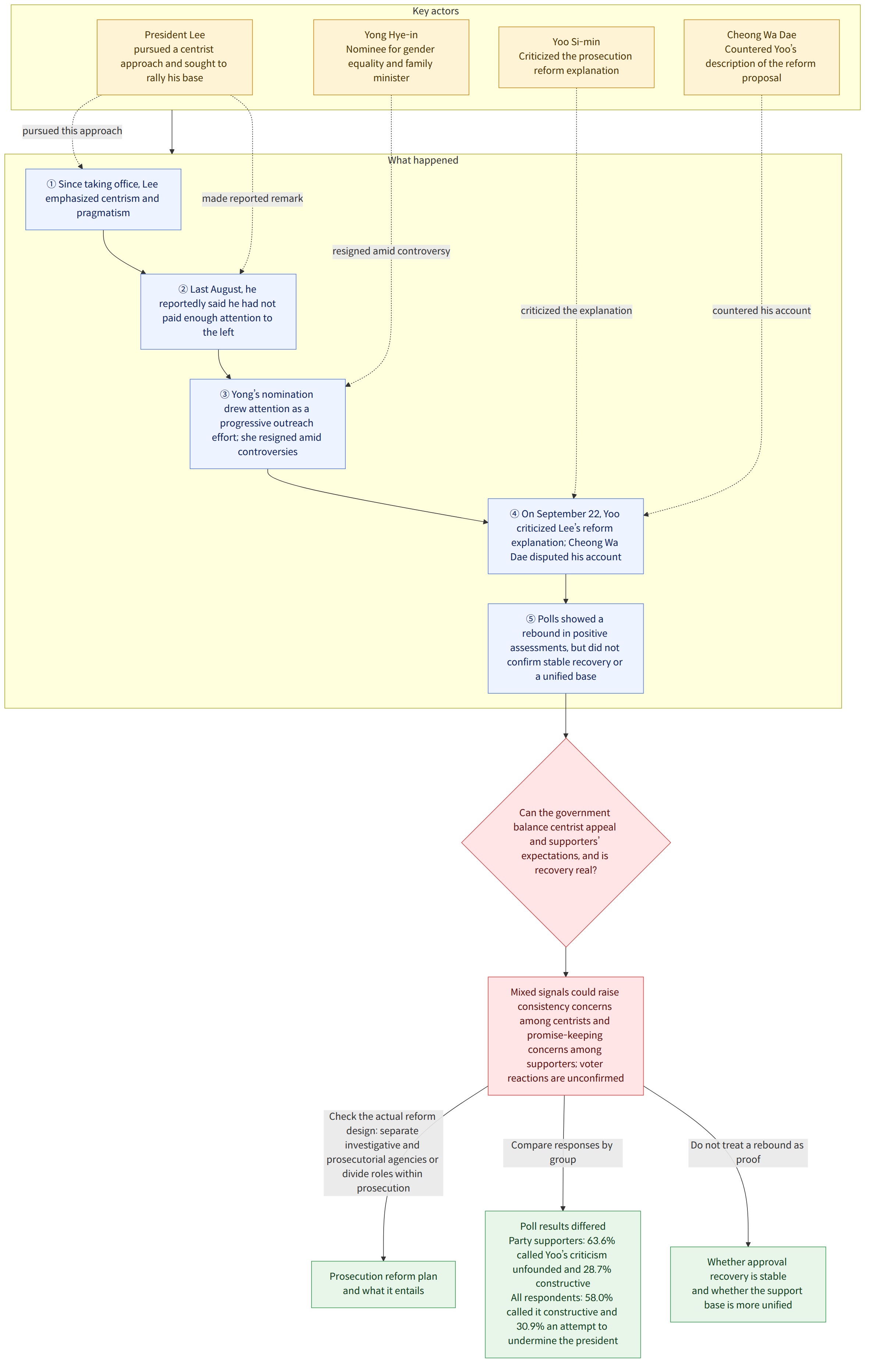
As President Lee Jae-myung seeks to broaden his appeal through a centrist, pragmatic approach while rallying his existing support base, the political strategy of the government and ruling party has been put to the test. At a dinner last August with the newly elected leadership of the Democratic Party of Korea (더불어민주당), he reportedly said he had “not paid enough attention to the left.” Since then, disputes over appointments and prosecution reform have continued. One poll showed a rebound in positive assessments of his performance, but that figure alone cannot confirm a stable recovery or a more unified support base.
Background and context
Since taking office, President Lee has sought to broaden his support by emphasizing centrism and pragmatism. But if his existing supporters come to question whether his policies and appointments take their views sufficiently into account, it may become difficult to expand his appeal while also rallying his base. A Democratic Party official quoted in the article said Lee was in a “bind,” unable to adequately serve both centrist voters and his existing supporters.
Interpretations of his leftward message also differed. Eom Kyung-young, director of the Era Spirit Research Institute (시대정신연구소), said it amounted to a de facto declaration that he was giving up on expanding his appeal to the center. This is one expert’s assessment and does not, in itself, demonstrate that voters actually shifted. Concerns that voters could be confused by receiving both a message of aspiring to be “a president for everyone” and a signal that a particular political camp would be prioritized have become a point of debate.
Disputes over appointments and prosecution reform brought these tensions into sharper focus. The nomination of Yong Hye-in, a lawmaker from the Basic Income Party (기본소득당), for minister of the Ministry of Gender Equality and Family (성평등가족부)—a move that drew attention as an effort to embrace the progressive camp—ended with her resignation amid various controversies. The available reporting does not establish what actual effect her resignation had on rallying the support base.
The direction of prosecution reform and whether promises were being fulfilled became the focus of controversy. On September 22, writer Yoo Si-min said on a YouTube broadcast that he was shocked by President Lee’s explanation of the prosecution reform plan, and also used the phrase “the president has deceived the public up to now.” Cheong Wa Dae (청와대) reportedly countered that this account described a proposal to separate investigative and prosecutorial agencies as if it were merely a division of roles within the prosecution service. The dispute is drawing attention because it could fuel distrust not only over the pace of reform but also over what the president said reform would entail and what the actual plan is.
What this news means
The issue is not simply which side—left or right—to choose. A challenge for the government and ruling party is how to explain and carry out, together, a pragmatic approach aimed at centrist voters and the direction of reform and appointments expected by existing supporters. If messages, appointments and policy directions are interpreted as pointing in different directions, they could raise questions among centrist voters about consistency and among existing supporters about whether promises are being kept. However, this is a possibility that can be inferred from the reported disputes; it does not mean the reactions of any particular voter group have been confirmed.
Poll figures also need to be interpreted with differences between groups in mind. In a Media Tomato (미디어토마토) poll, 63.6% of Democratic Party supporters described Yoo’s criticism as “an unfounded attempt to undermine the president,” while 28.7% called it “constructive criticism.” Among all respondents, the results were reversed: 58.0% called it “constructive criticism,” and 30.9% called it “an attempt to undermine the president.” The difference between responses from Democratic Party supporters and all respondents is established, but it does not allow us to conclude that all party supporters think alike or that the criticism moved approval ratings.
For example, a voter who supports a centrist, pragmatic approach but also considers fulfillment of promises on prosecution reform important might look at both the government’s messaging and its actual institutional design and personnel choices. This is a hypothetical example, not a claim about the actual behavior of any particular voter; it illustrates how different issues can figure in one person’s judgment.
Approval ratings and internal divisions may also affect one another. Choi Chang-ryeol, a professor at Yongin University, described falling presidential approval and divisions within the political camp as a vicious cycle that worsens both, and said that a recovery in approval could quiet internal criticism. Eom, by contrast, said it might be difficult to win back lost support through political messaging alone. The two assessments address the conditions for recovery from different angles, but it will take time to see which forecast proves accurate.
What is confirmed and what remains unknown
Confirmed facts
- In a Realmeter (리얼미터) poll commissioned by Energy Economy News (에너지경제신문), 1,508 people aged 18 or older nationwide were surveyed from September 21 to 23. Positive assessments of the president’s performance stood at 37.9%, up 3.1 percentage points from the previous week.
- In a Media Tomato poll commissioned by News Tomato (뉴스토마토), 1,040 people aged 18 or older nationwide were surveyed on September 25 and 26. Assessments of writer Yoo’s criticism differed between Democratic Party supporters and all respondents.
- Yong Hye-in resigned as a nominee amid various controversies, and reports covered both Yoo’s criticism and Cheong Wa Dae’s response over the prosecution reform plan.
- After calling for the withdrawal of Kim Ji-yong’s nomination to lead the Central Investigation Agency for Serious Crimes (중대범죄수사청), lawmaker Kim Yong-min said, in connection with his reassignment from the Legislation and Judiciary Committee, that it was not appropriate to penalize people carrying out reform or forcibly change their committee assignments.
- Follow-up reports said opposition within the ruling camp to Kim’s nomination continued, and that lawmaker Park Ji-won proposed at a lawmakers’ meeting that the party decide its position through a vote.
What remains unknown
- These reports do not establish whether President Lee’s approval rating continued to recover afterward.
- They also do not establish what actual effect Yong Hye-in’s resignation and the prosecution reform debate had on rallying the support base.
- The available polls are not enough to determine whether the one-time rebound in approval was a temporary fluctuation or the beginning of a stable trend.
What readers should check
- When looking at follow-up polls, check whether the survey dates, respondents and question wording are the same. Because the two polls were conducted at different times and used different samples, their figures cannot be compared directly.
- The Realmeter poll had a response rate of 3.8% and a margin of error of ±2.5 percentage points at the 95% confidence level. The Media Tomato poll had a response rate of 2.3% and a margin of error of ±3.0 percentage points. Because the margin of error indicates how results may vary depending on the sample, it is important not to treat small differences as definitive changes in public opinion.
- The controversy over Kim Ji-yong’s nomination and the prosecution reform plan should be considered by distinguishing reported criticism from responses to it. In particular, how the personnel issue and the substance of reform lead to subsequent decisions and explanations remains unanswered by the information currently available.
References
- Other coverage consulted: chosun.com

















