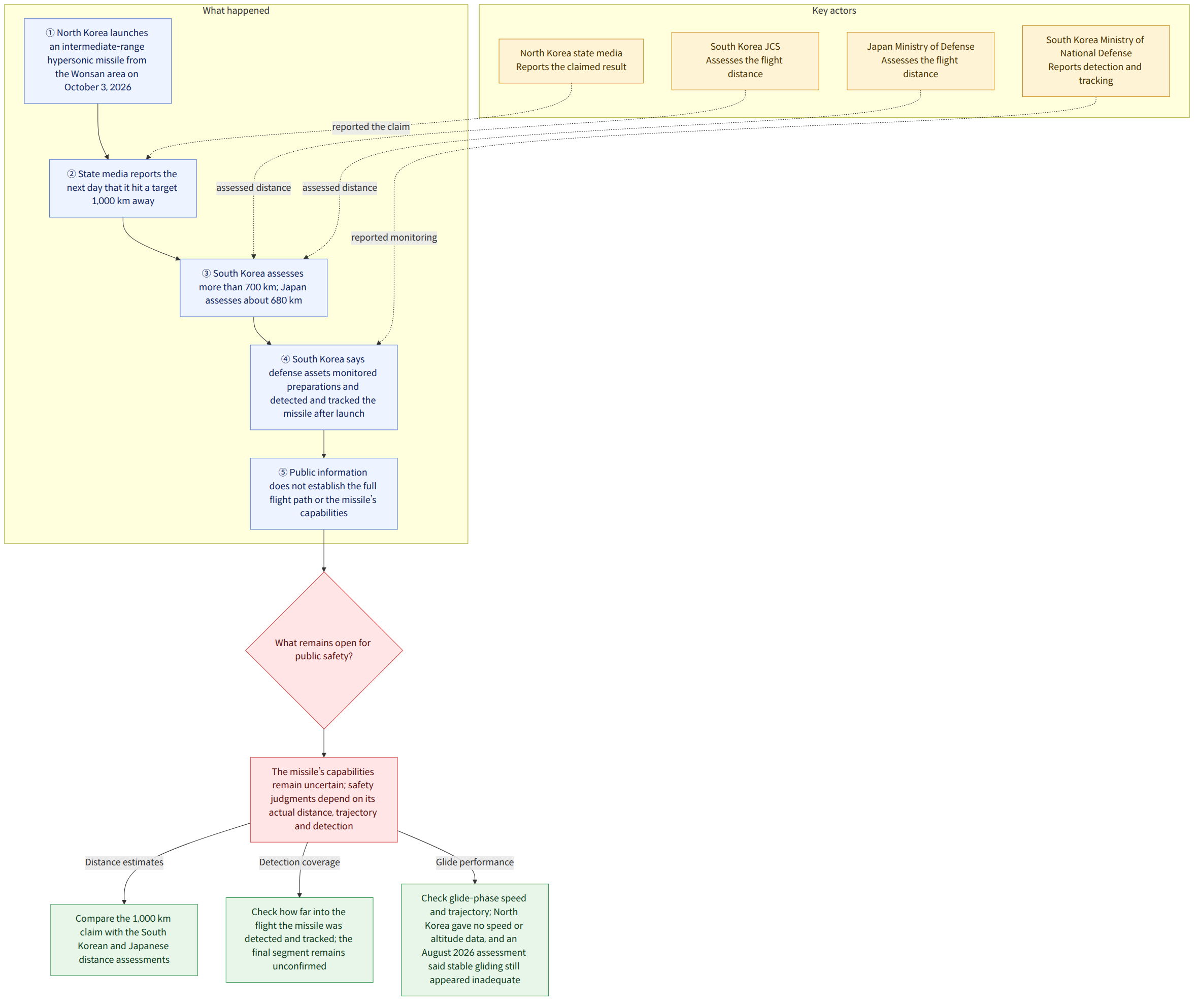
North Korea launched an intermediate-range hypersonic missile on October 3, 2026. State media reported the following day that the missile, fired from the Wonsan area, hit a target 1,000 km away over the East Sea. But South Korea’s Joint Chiefs of Staff (합동참모본부) assessed that it flew more than 700 km, while Japan’s Ministry of Defense (방위성) put the distance at about 680 km. North Korea’s account differs from the assessments of South Korean and Japanese authorities on the missile’s performance and whether it was detected.
Background and context
The launch followed a reported September 20 launch by North Korea of a short-range hypersonic missile intended for use against South Korea. Hypersonic missiles are defined as missiles that travel at speeds of Mach 5 or greater. According to reports, they can follow irregular trajectories, including by changing direction within the atmosphere, which may make them harder to track and intercept than conventional ballistic missiles.
However, the label “hypersonic” does not in itself confirm a missile’s actual capabilities. Reports explained that when assessing key performance characteristics, the speed and flight behavior of the vehicle during the glide phase—after it ascends and re-enters the atmosphere—are important. Kim Yo Jong, director of the Workers’ Party’s General Affairs Department, did not disclose the speed during the glide phase, and North Korea’s announcement did not provide altitude data that could be used to verify the flight trajectory.
State media reported that Kim Jong Un attended the launch and said the exercise was intended to further advance the country’s nuclear war deterrent. This shows that North Korea is promoting the launch as part of its nuclear deterrence, but it does not confirm that North Korea has actually acquired the technology to equip a hypersonic missile with a nuclear warhead.
This was not North Korea’s only test. One report said the country had conducted about eight publicly announced test launches since September 2021. However, reports said South Korean military authorities did not classify four tests conducted before 2024 as hypersonic missile launches, citing inadequate accuracy and range. The number of tests should be distinguished from whether they were technically successful.
What this news means
For security on the Korean Peninsula, the key questions are not what a missile is called, but how far it actually flew, what trajectory it followed and how much of its flight the defense systems detected. North Korea claimed that South Korean and Japanese military authorities had failed to track the missile. By contrast, the Ministry of National Defense assessed that South Korean and U.S. defense assets could detect and intercept it at its demonstrated level. It said the launch had been monitored from the preparation stage, that the missile was detected and tracked immediately after launch, and that its launch point was identified.
The difference matters for judgments that directly affect public safety. If North Korea’s claim is true, it would be a matter for reviewing defense systems’ detection and tracking capabilities. But the publicly available evidence does not include actual flight data supporting that claim. Conversely, the ministry’s statement does not explain every detail, including precisely how far into the flight the missile was detected and tracked or how it assessed the irregular trajectory North Korea described.
For example, if it were true that the missile’s final flight segment was missed, that could mean important information was unavailable for assessing whether it could be intercepted. But the information currently available to the public does not establish whether that actually happened. It is therefore important to examine distance, speed, trajectory and detection results separately, rather than underestimating the threat or accepting North Korea’s performance claims at face value.
The Ministry of National Defense had assessed in August 2026 that North Korea’s technology for stable gliding in a hypersonic environment still appeared inadequate. The publicly available information makes it difficult to determine how much the technology has changed as a result of this launch. An editorial urged North Korea to stop its missile provocations and respond to inter-Korean dialogue, while also arguing that South Korea should expand its systems for countering missile threats. This shows that easing diplomatic tensions and strengthening defensive capabilities are both being presented as priorities.
Differences in reporting
The reported flight distances differ: North Korean state media claimed 1,000 km, South Korea’s Joint Chiefs of Staff assessed more than 700 km, and Japan’s Ministry of Defense estimated about 680 km. The discrepancy is an important source of uncertainty when assessing how far the missile actually flew and whether the test was successful.
Accounts also differ over whether the missile was detected and tracked. Kim Yo Jong claimed that South Korea and Japan had failed to track it, while the Ministry of National Defense said it had detected and tracked the missile immediately after launch and identified its launch point. The public information does not establish which account more accurately describes the entire flight.
What is confirmed and what remains unknown
Confirmed facts
- North Korea launched a missile from the Wonsan area on October 3, and state media reported the following day that it had hit a target 1,000 km away.
- South Korea’s Joint Chiefs of Staff assessed the flight distance at more than 700 km, while Japan’s Ministry of Defense put it at about 680 km.
- North Korean state media reported that Kim Jong Un attended the launch, and Kim Yo Jong claimed that South Korea and Japan had failed to track the missile.
- The Ministry of National Defense assessed that South Korean and U.S. defense assets could detect and intercept a missile at this level, and said it had detected and tracked the missile immediately after launch.
- In August 2026, the Ministry of National Defense assessed that North Korea’s technology for stable gliding flight still appeared inadequate.
What remains unknown
- What was the missile’s actual flight trajectory, and what were its speed and performance during the glide phase?
- At what stages of the flight did South Korean, U.S. and Japanese authorities detect and track the missile?
- Has North Korea acquired the technology to equip a hypersonic missile with a nuclear warhead?
What readers should look for
- In follow-up announcements, readers can look for information not just on flight distance, but also on trajectory, speed during the glide phase, and the range of detection and tracking.
- North Korea’s claims about the missile’s performance should be assessed separately from analyses by South Korean and Japanese authorities and the Ministry of National Defense’s assessment.
- When new statements about the ability to defend against the missile emerge, it is important to clarify what “detection,” “tracking” and “interception capability” each mean and what scope they cover.
References
- Other coverage consulted: hani.co.kr
- Other coverage consulted: hani.co.kr