
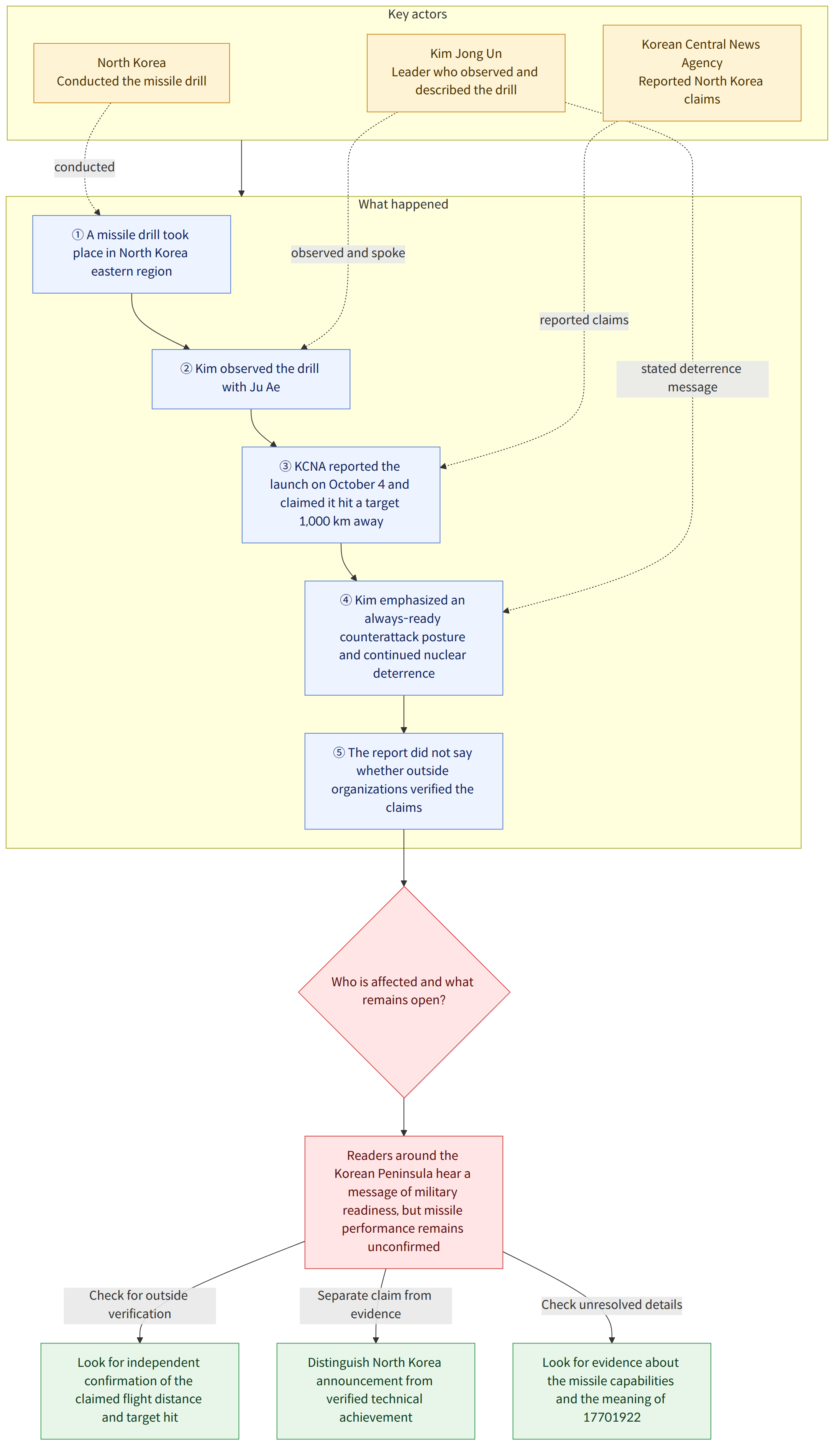
On October 4, the Korean Central News Agency (조선중앙통신) reported that a training launch of an intermediate-range strategic missile toward the East Sea had taken place in North Korea’s eastern region in the early hours of the previous day. Leader Kim Jong Un observed the drill with his daughter Ju Ae, and the agency claimed that the missile flew northeast and hit a designated target point 1,000 km away over the East Sea. Kim said the drill demonstrated that strategic missile forces could be mobilized at any time to counterattack, and that there had been no change in the course of strengthening nuclear deterrence.
Background and context
North Korea said the drill was intended to hone the missile forces’ ability to operate a hypersonic strategic weapons system and to assess the reliability, effectiveness and operational readiness of its war deterrent. Deterrence here means demonstrating the capacity to respond militarily so that an adversary does not choose to attack. North Korea’s announcement went beyond reporting a launch: it linked the drill to messages about military readiness and strengthening nuclear deterrence.
Kim said that demonstrating the constant readiness of a powerful and reliable nuclear deterrent and the military’s means of counterattack was important to guaranteeing national security. He also stressed the need to continue efforts to make adversaries repeatedly recognize the reliability and lethality of strategic offensive capabilities. This can be read as the North Korean leadership presenting the drill not only as a way to hone weapons operation, but also as an act intended to convey its military resolve to the outside world.
The official report did not mention Ju Ae or Ri Sol Ju by name, but it was reported that publicly released photos showed both watching the drill. Those reported to have observed it were Kim, Kim Jong Sik, first vice department director of the Workers’ Party of Korea Central Committee (노동당 중앙위원회), and Jang Chang Ha, director of the Missile General Bureau (미사일총국). The photos also included a missile marked with the national flag and the number “17701922.” These details in the published photos form part of the report, but the meaning of the number cannot be determined from the evidence provided.
What this news means
For readers around the Korean Peninsula, including in South Korea, an important point is that North Korea described the drill as a demonstration of an “always-ready counterattack posture” and the reliability of its nuclear deterrent. It is therefore necessary to distinguish the missile launch itself from the message North Korea sought to convey through it when assessing the significance of the announcement. The stated purpose of the drill and Kim’s remarks show that North Korea emphasized military readiness and reaffirmed its course of advancing its nuclear war deterrent. But North Korea’s claims alone do not establish the missile’s actual performance or whether it hit its target.
For example, if readers encounter the claim that the missile “flew 1,000 km and hit its target,” they should first understand it as a North Korean announcement and separately look into whether outside organizations have verified it. Distinguishing who made an announcement from what has been verified helps prevent confusion between a military message and a technical achievement.
North Korea claimed that the missile hit a designated target point 1,000 km away over the East Sea. The report provided does not say whether outside organizations verified the flight distance or the claim that it hit the target.
What is confirmed and what remains unknown
What is confirmed
- On October 4, the Korean Central News Agency reported a missile launch drill conducted in the early hours of the previous day.
- North Korea described the purpose of the drill as honing the missile forces’ operational capabilities and assessing its war deterrent.
- Kim emphasized the constant readiness of its means of counterattack and the strengthening of nuclear deterrence.
- It was reported that photos accompanying the report showed Ju Ae and Ri Sol Ju watching the drill with Kim.
What remains unknown
- The report provided does not say whether outside organizations verified the flight distance announced by North Korea or whether the missile hit its designated target point.
- The report did not explain what the number “17701922” marked on the missile means.
- The information made public is not sufficient to independently assess the missile’s specific capabilities.
What readers should check
- In follow-up reporting, look for whether outside organizations verified the flight distance and whether the missile hit its target, and whether the reporting identifies the verifying parties and their evidence.
- When reading North Korean announcements, distinguish confirmed facts about the drill from claims about its purpose and performance.
- If interpretations are offered about people in the photos or the number marked on the missile, check whether the report presents their meaning as confirmed fact or speculation.
References
- Other coverage consulted: koreatimes.co.kr
- Other coverage consulted: en.yna.co.kr

















