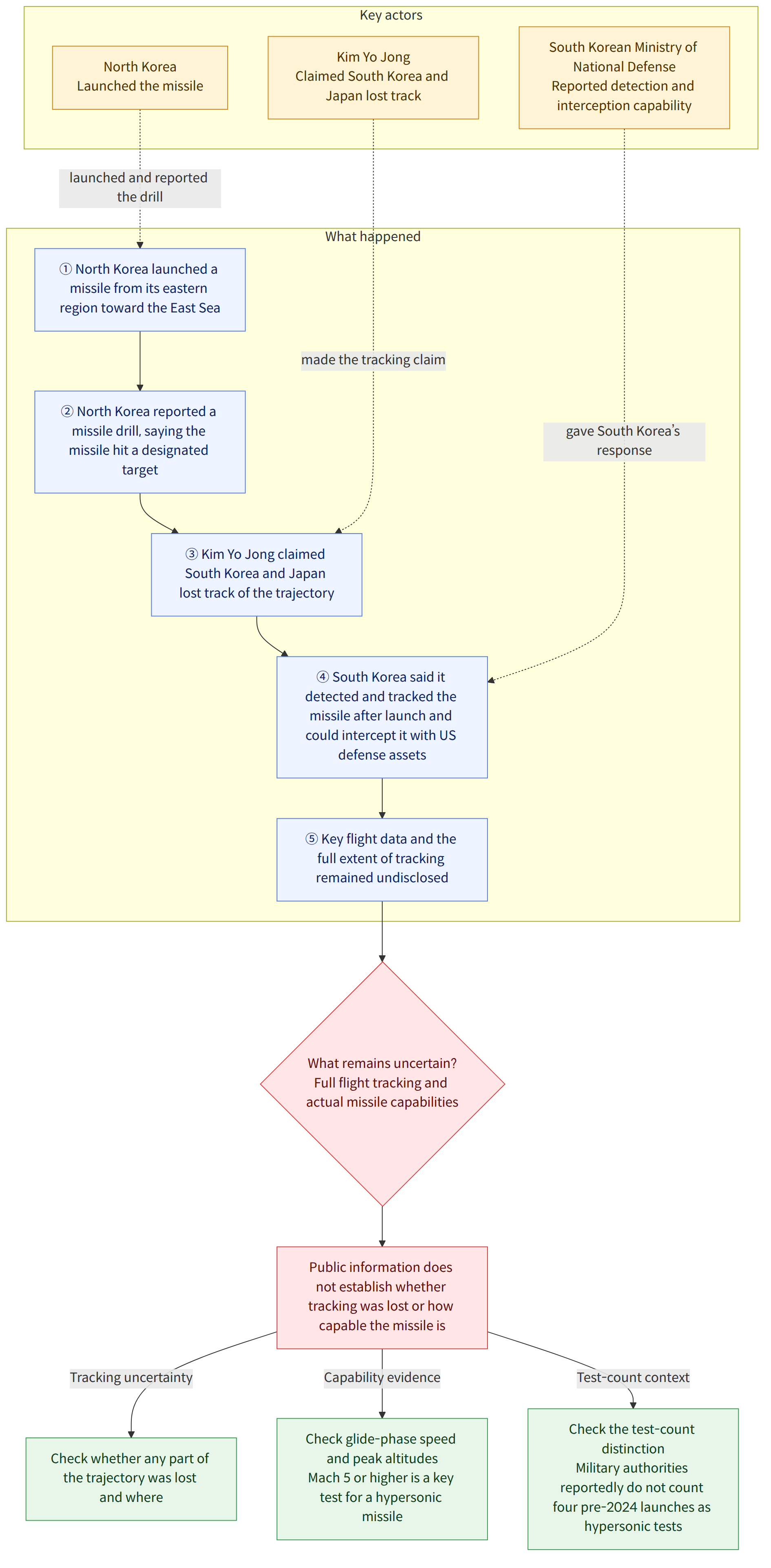
After North Korea launched a missile from its eastern region toward the East Sea in the early hours of October 3, Kim Yo Jong, director of the General Affairs Department of North Korea’s Workers’ Party of Korea, claimed that South Korea and Japan had lost track of its flight trajectory and that there was virtually no way to avoid being struck. South Korea’s Ministry of National Defense, by contrast, said the South Korean military detected and tracked the missile immediately after launch and identified its launch point, and that South Korean and U.S. defense assets could detect and intercept it. The issue is not so much the fact that the missile was launched as how far it was actually tracked and how capable it is, including its ability to maneuver unpredictably.
Background and context
The Korean Central News Agency (조선중앙통신) reported on the 4th that North Korea had conducted a launch drill of an “intermediate-range strategic missile” toward the East Sea from the country’s eastern region, with leader Kim Jong Un in attendance. Kim Yo Jong called the missile an “intermediate-range strategic missile (hypersonic missile).” North Korea announced that the missile had hit a designated target point in the East Sea, and Kim Jong Un said the drill was aimed at advancing the country’s nuclear war deterrent.
Hypersonic missiles are notable not only for their high speed but also for their ability to change trajectory during the glide phase. According to the original explanation, a missile can change direction within the atmosphere after ascending, and can fly on an irregular trajectory through maneuvers such as a “skip-glide” (a movement in which the warhead bounces back upward) or a “lateral maneuver” (movement from side to side). The extent to which such maneuvers were actually achieved is important to assessing the likelihood of detection and interception.
However, North Korea’s announcement alone is not enough to determine whether this launch was successful. According to the article, the key test for a hypersonic missile is whether it reaches speeds of Mach 5 or higher during the glide phase. Kim Yo Jong stressed that the missile’s speed must be known, but the speed during the glide phase and the altitudes of its first and second peaks were not disclosed for this launch. Therefore, the label “hypersonic” alone cannot establish the missile’s capabilities or whether it can penetrate defense systems.
According to publicly available reports, North Korea has conducted about eight hypersonic missile test launches since September 2021. However, South Korean military authorities were reported to have said that they do not count four test launches before 2024 as hypersonic missile launches, citing inadequate accuracy and range. This means the number of tests and the number of launches that military authorities recognize as tests of that weapons system may differ.
What this news means
Kim Yo Jong’s claim raises questions about South Korea’s and Japan’s detection capabilities while also emphasizing the threat posed by North Korean missiles. In response, the Ministry of National Defense said it had monitored the launch preparations and detected and tracked the missile immediately after launch, as well as identified its launch point. But saying that a missile was detected immediately after launch is not the same as saying it was tracked throughout its entire flight. The information made public does not establish whether there was a section of the trajectory that South Korea and Japan “lost track of,” as Kim Yo Jong claimed, or, if so, where it was.
The Ministry of National Defense assessed that the missile was within the capabilities of South Korean and U.S. defense assets to detect and intercept. The original report also explains that even a hypersonic missile with a range of 1,000 kilometers follows a trajectory similar to that of a conventional ballistic missile up to the ascent phase, so there is no difference in the ability of air defense systems to respond during that phase. A military official was reported to have assessed that North Korea’s claims involved deception and exaggeration, and that its development of glide-flight technology remained inadequate. This is the assessment of South Korean military authorities; it does not mean that the missile’s actual capabilities have been independently verified using publicly available information.
For readers assessing the defense posture on the Korean Peninsula, this issue also highlights the need to distinguish between “detected,” “tracked throughout every section,” and “can be intercepted.” For example, even if it is confirmed that a missile was detected immediately after launch, separate information would be needed to determine whether it continued to be tracked through later sections involving unpredictable maneuvers. Rather than drawing a conclusion based on only North Korea’s threat claims or South Korea’s assessment of its response, it is important to consider which flight phase and capabilities each statement addresses.
Points reported differently by various outlets
The missile’s flight distance differs depending on the source. South Korea’s Joint Chiefs of Staff (합동참모본부) announced that it flew more than 700 kilometers, while Japan’s Ministry of Defense estimated 680 kilometers. North Korea claimed it flew 1,000 kilometers. The three figures differ, and the information reported does not allow a definitive determination of which is accurate.
Accounts of detection and tracking also focus on different things. Kim Yo Jong claimed that South Korea and Japan lost track of the flight trajectory. South Korea’s Ministry of National Defense said it detected and tracked the missile immediately after launch and identified its launch point. The latter describes detection and tracking immediately after launch, but the information made public does not establish whether the missile was tracked throughout its entire flight.
What is confirmed and what remains unknown
Confirmed facts
- On the 4th, the Korean Central News Agency reported on a missile launch drill conducted in the early hours of October 3, with Kim Jong Un in attendance.
- Kim Yo Jong claimed that South Korea and Japan lost track of the flight trajectory, while the Ministry of National Defense said it detected and tracked the missile immediately after launch and identified its launch point.
- The Ministry of National Defense assessed that South Korean and U.S. defense assets could detect and intercept the missile.
- Reported flight distances vary: more than 700 kilometers according to the Joint Chiefs of Staff, 680 kilometers according to Japan’s Ministry of Defense, and 1,000 kilometers according to North Korea.
What remains unknown
- The missile’s speed during the glide phase and the altitudes of its first and second peaks have not been made public.
- It has not been established how far South Korea and Japan actually detected and tracked the missile during this launch.
- The information made public does not allow independent verification of North Korea’s claim that the missile hit its designated target point or of its hypersonic glide capabilities.
What readers should watch for
- In any follow-up announcements, readers should check whether information is provided not only on detection immediately after launch but also on the extent of tracking at each flight stage.
- Since reported flight distances vary by source, readers can distinguish between the statements of the Joint Chiefs of Staff, Japan’s Ministry of Defense, and North Korea rather than treating them as the same figure.
- When assessing the missile’s capabilities, readers should look not only at its name or the number of launches but also for additional information not disclosed this time, such as its speed during the glide phase and its peak altitude.
References
- Other coverage consulted: hani.co.kr
- Other coverage consulted: hani.co.kr