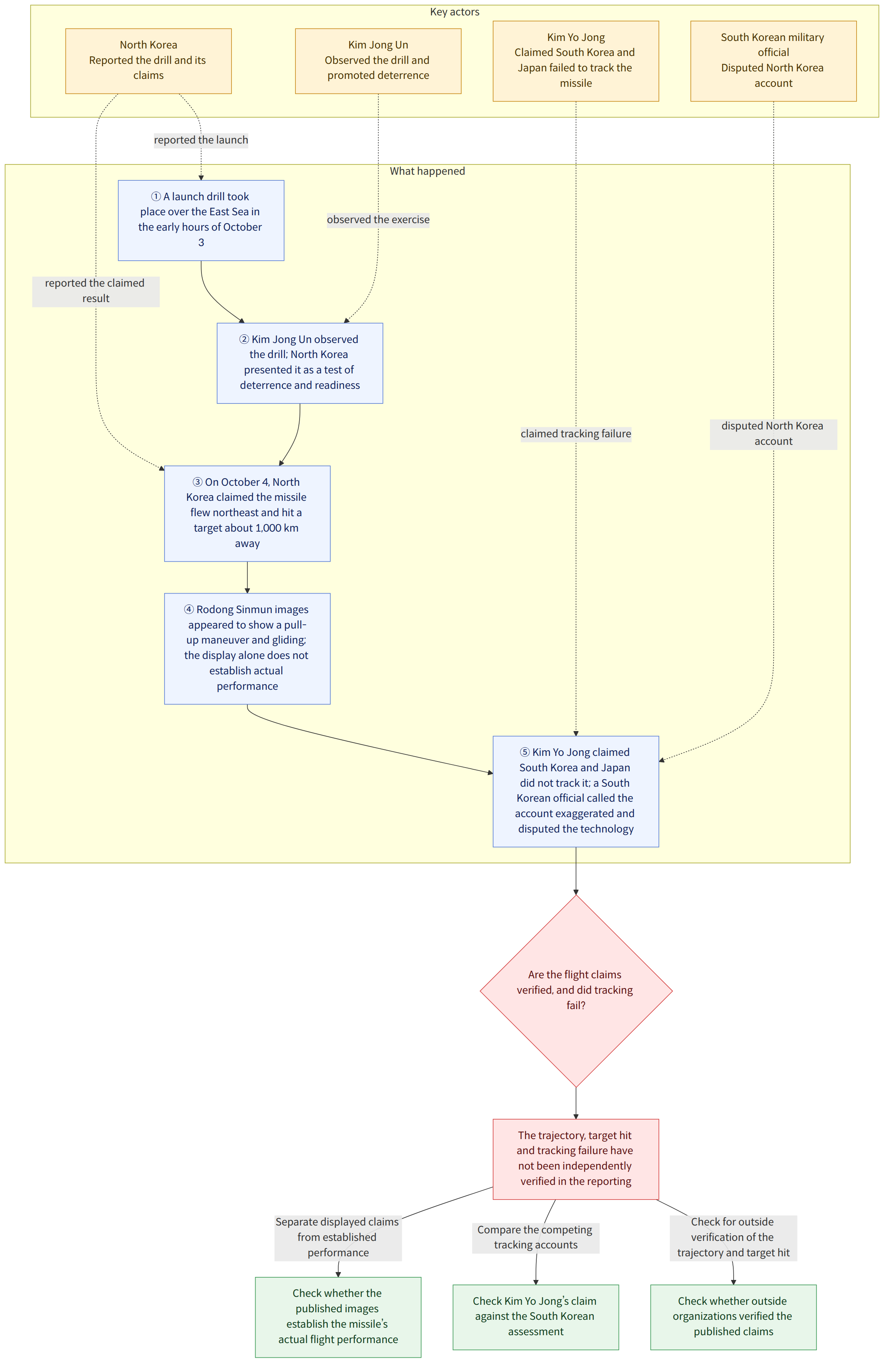
North Korea reported on October 4 that it had conducted a launch drill for an intermediate-range strategic missile over the East Sea in the early hours of October 3. Kim Jong Un, chairman of the State Affairs Commission, observed the drill, and Rodong Sinmun (노동신문) claimed the missile was launched northeast and hit a designated target about 1,000 km away over the East Sea. North Korea described the drill as part of efforts to hone its ability to operate a hypersonic strategic weapon system and assess its war deterrent, emphasizing the strengthening of its nuclear deterrent.
Background and context
Photographs released by Rodong Sinmun showed Kim Jong Un at the drill site with his daughter Ju Ae and wife Ri Sol Ju. Kim Jong Sik, first deputy department director of the Workers’ Party of Korea’s Department of Munitions Industry (노동당 군수공업부), and Missile General Bureau (미사일총국) Director Jang Chang Ha were also reported to have observed the drill. The published photographs and report showed not only the launch, but also the leadership watching the exercise.
North Korea said the drill was intended to hone missile troops’ ability to carry out firepower duties and assess the reliability, effectiveness, and operational readiness of its deterrent. Kim Jong Un reportedly said the strategic missile troops had demonstrated their ability to operate an important weapons system and their readiness to counterattack, bolstering confidence in the deterrent. He also said efforts to repeatedly impress upon adversaries the reliability and lethality of strategic strike capabilities should continue, calling this a form of exercising deterrence.
A display showing the trajectory in photographs published by Rodong Sinmun appeared to depict a “pull-up” maneuver—when a descending vehicle rises again—followed by a period of gliding, according to reports. However, the display in the photographs is material released by North Korea, and it cannot be concluded on that basis alone that the missile’s actual flight performance or full trajectory has been established.
What this news means
A key point in the announcement is that North Korea presented the launch as a message about strengthening its “nuclear war deterrent.” Kim Jong Un said the purpose of the drill was to further develop the nuclear war deterrent and use a powerful deterrent to control various threats. The disclosure can therefore be read both as a demonstration of weapons-operating capabilities and as a signal that North Korea is promoting the strengthening of its nuclear deterrent as a way to respond to security threats.
For the security authorities of South Korea and Japan, the claimed flight pattern and whether the missile went undetected are important issues. Kim Yo Jong, director of the Workers’ Party of Korea’s General Affairs Department (노동당 총무부), claimed on the day of the drill that the missile’s distinctive flight pattern had been verified and that the South Korean and Japanese militaries had failed to track it. By contrast, a South Korean military official cited in subsequent reports assessed that North Korea’s account involved deception and exaggeration, and that development of the gliding-flight technology central to hypersonic missiles remained insufficient. Since these are statements and assessments from different parties, it is difficult to treat North Korea’s account as objectively confirmed performance.
For example, if someone on the Korean Peninsula sees this announcement and worries that missile defenses have been rendered ineffective, they should first distinguish whether North Korea’s claim of a tracking failure is a verified fact and what the South Korean assessment says. Based on the reporting currently available, it is not known whether outside organizations have verified North Korea’s published trajectory and claim that the missile hit its target.
Points reported differently
Through a statement by Kim Yo Jong, North Korea claimed that the South Korean and Japanese militaries had been unable to track the missile. A second report, however, said a South Korean military official assessed North Korea’s announcement as involving “deception and exaggeration” and presented the view that North Korea’s gliding-flight technology remained insufficient. Rather than an independent confirmation of what actually happened during tracking, this reflects competing claims and assessments by different parties.
A report discussing the display published by Rodong Sinmun also said the trajectory appeared to resemble that of a hypersonic missile that glides after a pull-up maneuver. Another report, however, pointed out that key information, including speed and altitude during the gliding phase, is needed to assess a hypersonic missile’s performance. North Korea reportedly did not release that information in its report.
What is confirmed and what remains unknown
Confirmed facts
- North Korea reported on October 4 that it had conducted a launch drill for an intermediate-range strategic missile over the East Sea in the early hours of October 3.
- Kim Jong Un observed the drill, and photographs released by Rodong Sinmun showed Ju Ae and Ri Sol Ju at the site as well.
- North Korea claimed the missile was launched northeast and hit a designated target about 1,000 km away over the East Sea.
- Kim Yo Jong claimed the South Korean and Japanese militaries had failed to track the missile, while a South Korean military official assessed that North Korea’s announcement involved deception and exaggeration.
What remains unknown
- What exact model of missile was used in this launch?
- Have outside organizations verified the flight trajectory released by North Korea and its claim that the missile hit its target?
- Did the actual flight speed, altitude, and trajectory match North Korea’s account?
What readers should check
- In follow-up reporting, look at what South Korean authorities specifically confirm or dispute.
- Distinguish among North Korea’s claims, interpretations of the trajectory observed in published photographs, and verification by outside organizations.
- Do not draw conclusions about missile defense capabilities based on one party’s announcement alone; check whether additional detection or flight data are released.
References
- Other coverage consulted: hani.co.kr