
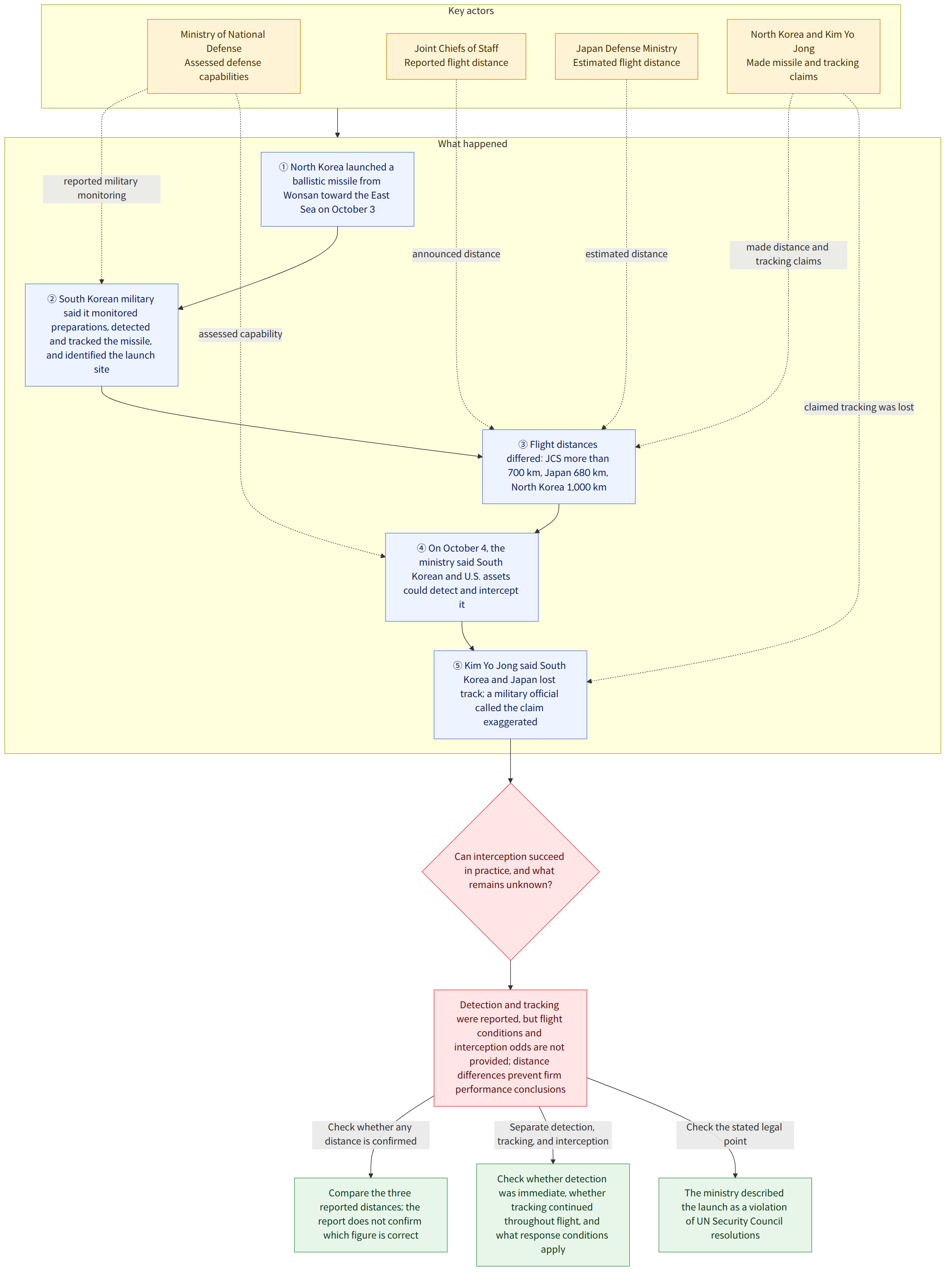
After North Korea launched one ballistic missile toward the East Sea from the Wonsan area at around 6:30 a.m. on October 3, the Ministry of National Defense assessed on October 4 that it was within the capabilities of South Korean and U.S. defense assets to detect and intercept. The Joint Chiefs of Staff announced that the missile had flown more than 700 km, while Japan’s Defense Ministry estimated its flight distance at 680 km. North Korea called it a “hypersonic intermediate-range strategic missile” and claimed it had flown 1,000 km.
Background and context
The Ministry of National Defense said the South Korean military had monitored preparations for the launch and, immediately after it occurred, detected and tracked the missile and identified its launch site. It also said that South Korea and the United States were maintaining a robust combined defense posture. The ministry described North Korea’s ballistic missile launch as a violation of United Nations Security Council resolutions and urged it to stop actions that raise tensions.
North Korea’s statements and the military’s assessment conflict over detection capabilities. Kim Yo Jong, director of the General Affairs Department of the Workers’ Party of Korea (조선로동당 총무부장), claimed that South Korea and Japan had lost track of the missile’s flight trajectory and that there was virtually no way to evade an attack. In response, a military official quoted in the report assessed that North Korea’s claim involved deception and exaggeration, and that its development of glide-flight technology—a key component of hypersonic missiles—remained inadequate.
The report described hypersonic missiles as rising like ballistic missiles, descending from a high point, and then changing direction while flying within the atmosphere. The ability to change course or move from side to side during the glide phase (when an aircraft flies by gliding on lift rather than relying primarily on propulsion) was presented as a feature that makes detection more difficult. However, the report said that whether a weapon qualifies as hypersonic depends in part on whether its speed during the glide phase exceeds Mach 5, and noted that Kim Yo Jong did not disclose the speed or the altitudes of the first and second peaks.
What this news means
The Ministry of National Defense’s assessment is the government’s judgment about detection and interception capabilities. But the assessment that the missile is “within the capabilities to detect and intercept” does not, by itself, tell us under what conditions a specific missile could be intercepted in an actual situation or how likely an interception would be to succeed. What is currently confirmed is the ministry’s account that the South Korean military detected and tracked the missile and identified its launch site immediately after launch, along with its assessment of South Korean and U.S. defense assets’ ability to respond.
The differences in reported distances also make it difficult to draw firm conclusions about the missile’s performance. The Joint Chiefs of Staff’s announcement, Japan’s Defense Ministry’s estimate and North Korea’s claim differ, but the report provided does not explain why. It is therefore difficult to treat any one figure as the confirmed flight distance or to draw conclusions about the missile’s performance or the possibility of defending against it based solely on the difference in distance.
For example, readers who come across a report about a similar missile launch can separate three distinct questions: whether the missile was detected immediately after launch, whether it was tracked throughout every stage of its flight, and whether it can actually be intercepted. The fact that detection and tracking took place does not prove that an interception would succeed, and the possibility of interception may depend on the missile’s flight conditions and the response circumstances. However, this report does not provide those specific conditions or the likelihood of success.
What different reports said
Reported flight distances for this launch differ by source. The Joint Chiefs of Staff announced a distance of more than 700 km, Japan’s Defense Ministry estimated 680 km, and North Korea claimed the missile had flown 1,000 km. It has not been confirmed whether the difference resulted from measurement methods or other factors.
There are also conflicting claims about whether the missile could be detected. The Ministry of National Defense assessed that South Korean and U.S. defense assets could sufficiently detect and intercept it, while Kim Yo Jong claimed that South Korea and Japan had lost track of its trajectory. A military official characterized North Korea’s claim as deceptive and exaggerated, but the information presented in the report is not enough to determine the actual conditions for interception or the probability of success.
What is confirmed and what remains unknown
Confirmed facts
- The Joint Chiefs of Staff announced that North Korea had launched one ballistic missile toward the East Sea from the Wonsan area at around 6:30 a.m. on October 3.
- The Ministry of National Defense assessed that South Korean and U.S. defense assets could sufficiently detect and intercept the missile, and said that a combined defense posture was being maintained.
- The reported flight distances differ: more than 700 km according to the Joint Chiefs of Staff, 680 km according to Japan’s Defense Ministry, and 1,000 km according to North Korea.
- The Korean Central News Agency (조선중앙통신) reported on October 4 that a launch drill for an intermediate-range strategic missile had been conducted in the presence of North Korean leader Kim Jong Un.
What remains unknown
- The report does not specify under what conditions South Korean and U.S. defense assets could detect and intercept the missile in an actual situation, or how likely an interception would be to succeed.
- The reason for the differences among the flight distances reported by the Joint Chiefs of Staff, Japan’s Defense Ministry and North Korea is not explained.
- The report alone does not make it possible to confirm whether North Korea’s claim that the trajectory went undetected is true, or what the missile’s speed and flight characteristics were during the glide phase.
What readers should check
- When reviewing follow-up announcements, distinguish among the fact of the launch, the flight distance, assessments of detection and tracking, and judgments about the possibility of interception.
- Check which source is reporting a flight-distance figure. When figures from the Joint Chiefs of Staff, Japan’s Defense Ministry and North Korea differ, as they do in this case, it is safer not to treat any one figure as definitive until the discrepancy is explained.
- For claims about hypersonic missiles, check whether information about speed and trajectory during the glide phase has been provided. This report said that this key information had not been made public.
References
- Other coverage consulted: hani.co.kr
- Other coverage consulted: en.yna.co.kr