

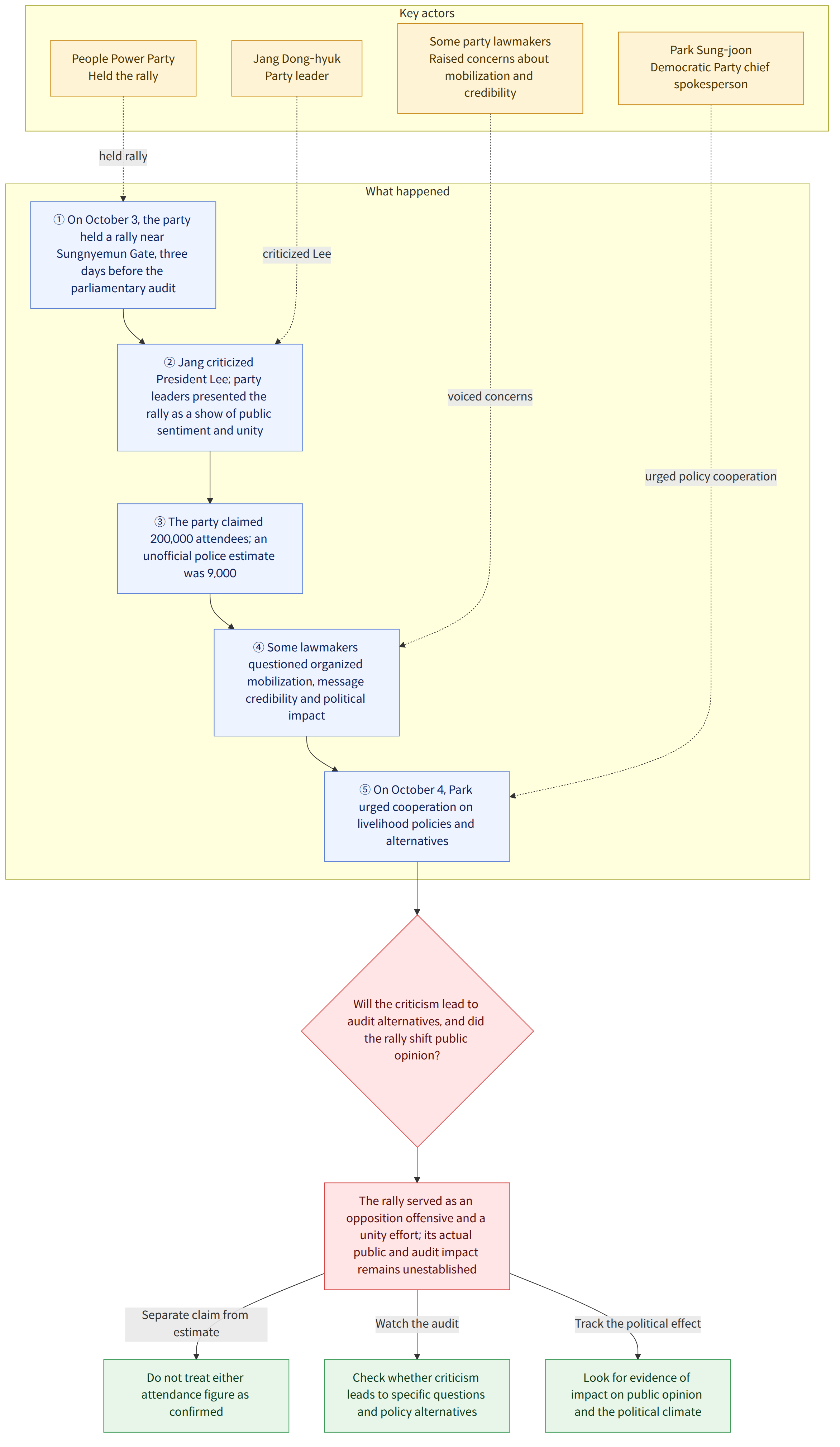
Three days before the National Assembly’s (국회) parliamentary audit (국정감사), on October 3, 2026, the People Power Party (국민의힘) held the “‘Judgment on the Lee Jae-myung Administration’ Livelihood Recovery and National Security Protection People’s Action Rally” (‘이재명 정권 심판’ 민생회복·안보수호 국민행동대회) near Sungnyemun Gate in Jung-gu, Seoul. Party leader Jang Dong-hyuk criticized President Lee Jae-myung, saying, “You have now become a land mine for South Korea’s national security.” Party leaders said the rally showed public sentiment rallying behind the party, but some party members argued that it relied on organized mobilization and that its message lacked credibility.
Background and context
The rally served both as an opposition offensive against the government ahead of the parliamentary audit and as an effort to unite the party. Party leaders emphasized the party’s ability to mobilize, noting that about 70 sitting lawmakers attended. Floor leader Chung Jeom-sik wrote on Facebook that he felt “the public’s seething anger toward the Lee Jae-myung administration rising like a wildfire.”
However, accounts of the rally’s size and significance differed. The People Power Party claimed that 200,000 people attended, while the article also cited an unofficial police estimate of 9,000. Both figures should be understood as a claim and an estimate regarding attendance; the article does not establish the actual number of attendees or explain the difference between the figures.
The criticism within the party went beyond the number of attendees. A second-term lawmaker said that most participants had been mobilized through the party’s organization and that the rally had no effect on changing the political situation. A first-term lawmaker said there were many issues on which to criticize the government, but that the party’s messengers did not seem to be trusted to the same extent. Flags reading “Yoon Suk Yeol was right” and “Martial law was justified” were also seen at the rally.
What this news means
The rally was an effort by the opposition to criticize the government in the streets ahead of the parliamentary audit and showcase the party’s unity. At the same time, lawmakers’ comments within the party raise the question of whether rally attendance alone can demonstrate public support or a shift in the political landscape. Party leaders praised the show of unity, while some lawmakers expressed skepticism, making it difficult to say that the rally was understood in the same way by people inside and outside the party.
What matters to readers is not just the slogans and attendance figures, but also what questions and policy alternatives the government criticism leads to during the parliamentary audit. For example, voters who agree with the criticism of the government can look at whether it leads to specific issues being raised and alternatives being proposed during the audit. However, the available evidence does not allow a judgment on the rally’s actual impact on public opinion or the parliamentary audit.
Confirmed facts and what remains unknown
Confirmed facts
- The People Power Party held the “‘Judgment on the Lee Jae-myung Administration’ Livelihood Recovery and National Security Protection People’s Action Rally” near Sungnyemun Gate in Jung-gu, Seoul, on October 3, 2026.
- At the rally, party leader Jang Dong-hyuk criticized President Lee Jae-myung as “a land mine for South Korea’s national security.”
- The People Power Party claimed that 200,000 people attended, while the article cited an unofficial police estimate of 9,000.
- Party leaders said that about 70 sitting lawmakers attended, while some lawmakers expressed concerns about organized mobilization and the credibility of the party’s message.
- Park Sung-joon, chief spokesperson for the Democratic Party of Korea (더불어민주당), said in a written briefing on October 4 that the People Power Party should cooperate in developing policies and alternatives to address people’s livelihoods.
What remains unknown
- How many people actually attended the rally, and why did the estimates differ?
- What impact did the rally have on public opinion or the political climate surrounding the parliamentary audit?
- How will the party leaders’ emphasis on unity and lawmakers’ concerns about credibility play out in the party’s political activity going forward?
What readers should watch for
- Distinguish the party’s claim about attendance from the unofficial police estimate, and do not treat either figure as the confirmed number of actual attendees.
- Watch whether the government criticism raised at the rally leads to specific questions and policy alternatives during the parliamentary audit.
- When assessing the rally’s political impact, consider the party leaders’ assessment separately from criticism within the party, and look for further evidence about public opinion or the outcome of the parliamentary audit.

















