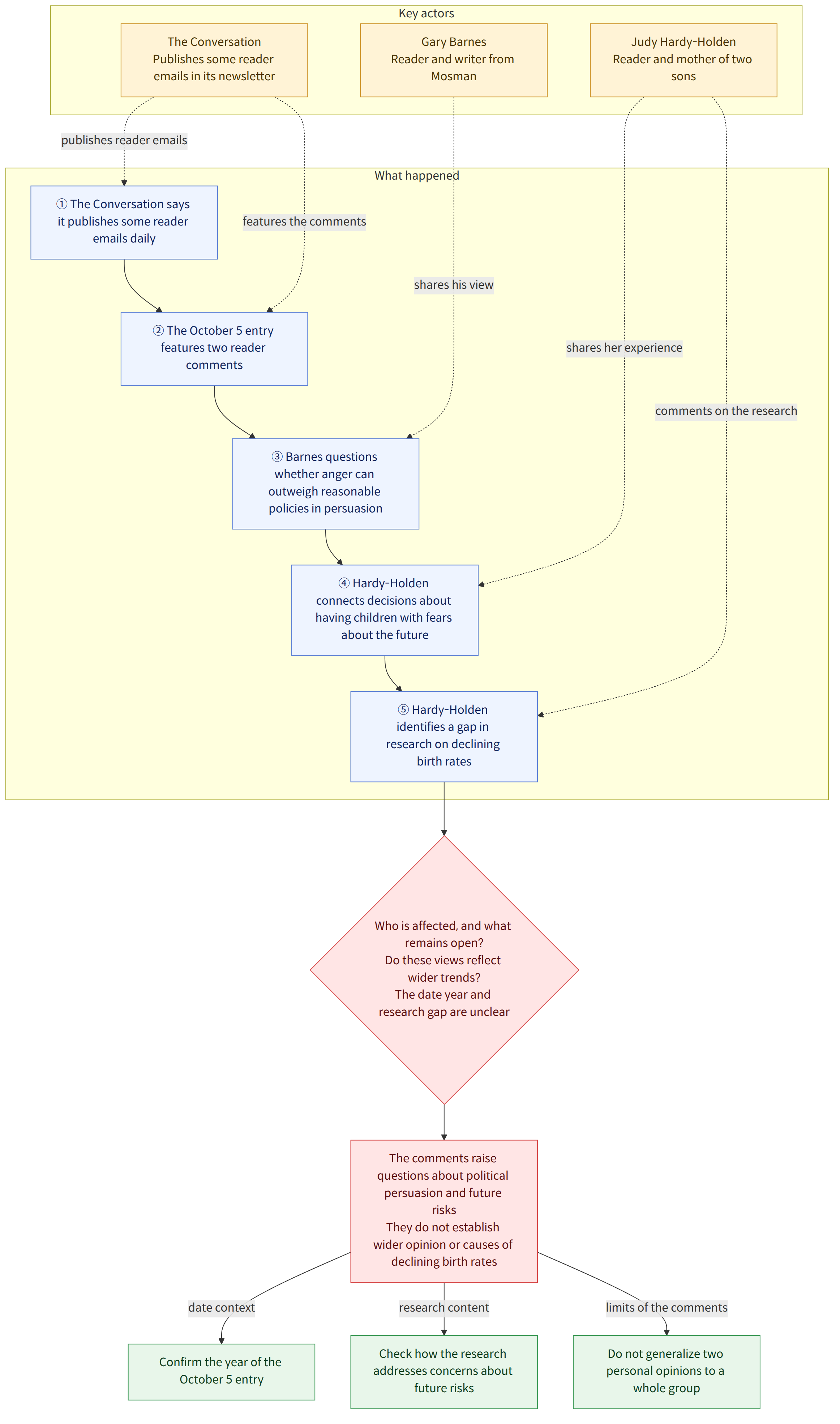
The Conversation said it publishes some of the emails it receives from readers in its newsletter every day. The reader comments for the week of October 5 included two pieces: one about the effect of political anger on persuasion, and another about how anxiety about the future informs concerns about having children. Readers were invited to send their comments by email to yoursay@theconversation.edu.au.
Background and context
The first writer, Gary Barnes, was identified as a resident of Mosman, New South Wales. He said the new Green Party (녹색당) leader appeared to have the momentum to take on Pauline Hanson and would offer more reasonable policies.
Barnes added, however, that reasonable policies alone might not be enough. In his view, if politicians appeal to anger itself and that appeal resonates with Australians’ anger, the reasonableness of their policies may not be enough to persuade voters. He also mentioned algorithm-fuelled anger as part of the backdrop, but the original does not explain the details of the political situation.
The second writer, Judy Hardy-Holden, described herself as 86 years old and the mother of two sons. Her sons were born in 1969 and 1970. She recalled that people worried about war at the time, but did not have to consider global warming or the potential risks of artificial intelligence (AI).
Hardy-Holden said she understood people today who decide not to have children because of frightening scenarios about the future. She also argued that there was a major gap in the part of Viva Hammer’s research on declining birth rates that addressed such reasons. The reader comment does not specify which reasons were omitted from the research or what data and methods the study used.
What this means
The two pieces show concerns surrounding different kinds of decisions. Barnes raises the question of whether emotions such as anger can affect political persuasion alongside policy content. Hardy-Holden’s experience and interpretation suggest that personal decisions about having children may be connected to concerns about the future.
For example, a reader looking at research on declining birth rates might take Hardy-Holden’s comment as a prompt to examine how concerns about future risks are addressed in that research. However, the opinions of these two people cannot establish the feelings of Australian voters as a whole or the common reasons people delay having children.
What is confirmed and what remains unknown
What is confirmed
- The Conversation said it publishes some reader emails in its newsletter every day.
- The October 5 entry included opinions from Gary Barnes and Judy Hardy-Holden.
- Barnes spoke positively about the new Green Party leader’s momentum and policies, while writing that reasonable policies alone might not be enough if anger became a political appeal.
- Hardy-Holden said her two sons were born in 1969 and 1970, and that she understood people who decide not to have children because of frightening scenarios about the future.
What remains unknown
- The original does not say which year the October 5 date mentioned in the headline refers to.
- The specific context of the political situation Barnes mentioned, and the nature of the gap Hardy-Holden identified in the research, have not been established.
- It is not known how much the two opinions reflect broader voter sentiment or trends in decisions about having children.
What readers should check
- When citing this piece in other material, it is best to first confirm the year of the relevant week so the date can be specified.
- Anyone reviewing research on declining birth rates can check how concerns about future risks are addressed in the research and how the gap Hardy-Holden mentioned relates to the actual content of the study.
- Political claims and opinions about having children should not be generalized as the views of an entire group; readers should distinguish personal opinions from established research findings.