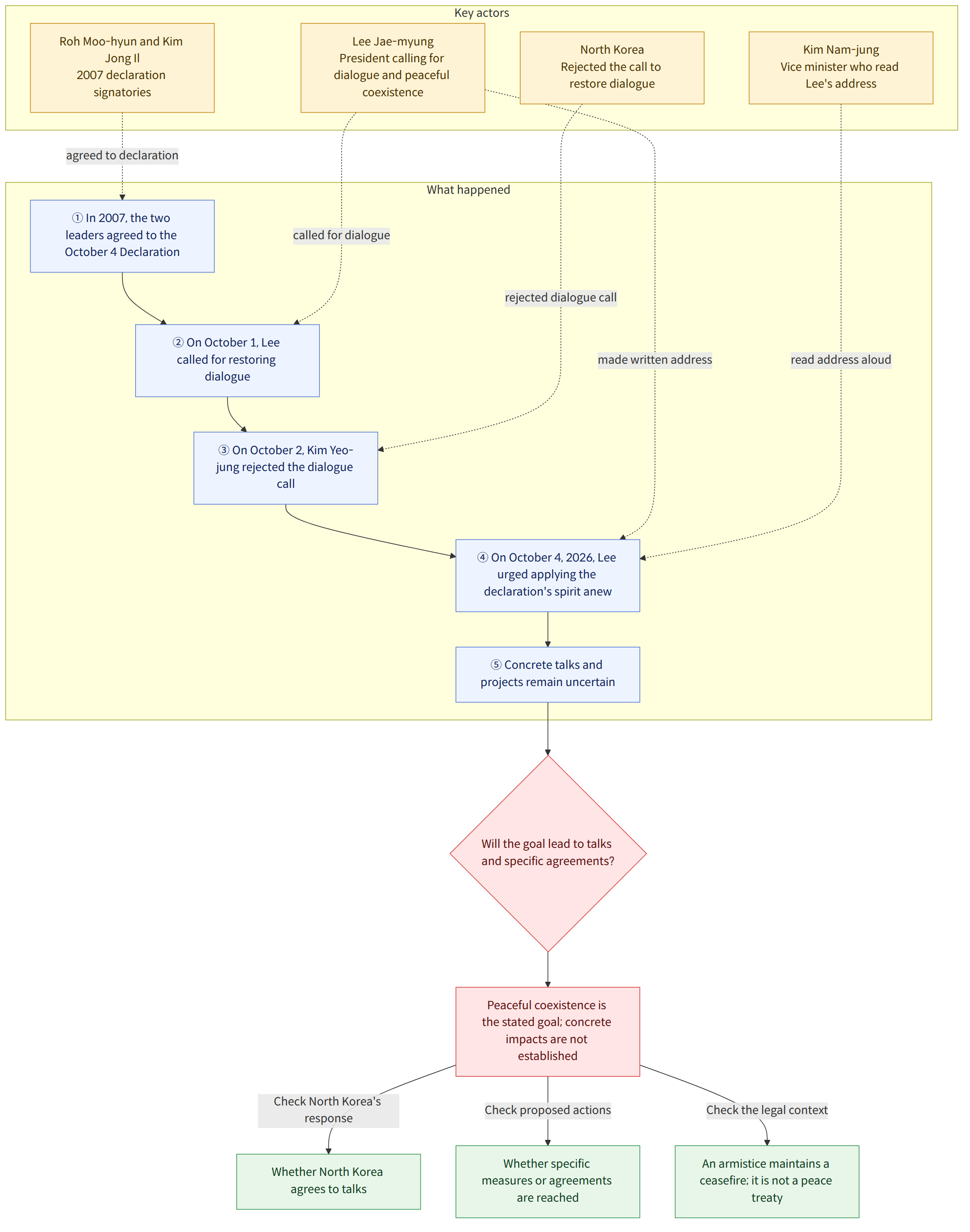
In a written address for a ceremony on October 4, 2026, marking the 19th anniversary of the October 4 Inter-Korean Summit Declaration (10·4 남북정상선언), President Lee Jae-myung emphasized the importance of peaceful coexistence between the two Koreas. In the address, read aloud by Vice Minister Kim Nam-jung of the Ministry of Unification (통일부), Lee said that breaking the cycle of hostility and confrontation was necessary to create a virtuous cycle of peace and prosperity. But North Korea rejected Lee’s call to restore dialogue, leaving a gap between the government’s stated direction toward peaceful coexistence and the current state of inter-Korean relations.
Background and context
The October 4 Declaration is the Declaration on the Development of Inter-Korean Relations and Peace and Prosperity (남북관계 발전과 평화번영을 위한 선언), agreed to in Pyongyang on October 4, 2007, by President Roh Moo-hyun and National Defense Commission Chairman Kim Jong Il. It called for carrying out specific projects in keeping with the spirit of the June 15 North-South Joint Declaration (6·15 남북공동선언) of 2000. Its provisions included a shared understanding of the need to end military hostilities and establish a peace regime, cooperation on pursuing a declaration to end the war, and economic cooperation projects.
Lee described the October 4 Declaration as a historic agreement to transform inter-Korean relations into a relationship of mutual respect and trust, end military hostility, and work together to build a lasting peace regime beyond the armistice system. An armistice system maintains a ceasefire; it is not a peace treaty that formally ends a war. The declaration’s significance, therefore, lies not only in its symbolic message of support for improving relations, but also in its effort to address military de-escalation, a peace regime and economic cooperation together.
The ceremony also revisited former President Roh’s 2007 visit to Pyongyang, when he crossed the Military Demarcation Line by land. Lee said the words Roh left at the last gateway to the North—“A path that strengthens peace, a path that leads to prosperity”—clearly expressed the declaration’s meaning. He added that the journey to resolve issues on the Korean Peninsula and strengthen peace was difficult, but that the path to take was clear.
What this news means
The address’s central message was that the spirit of the past agreement should be applied anew to current inter-Korean relations, rather than simply commemorated. Recalling a remark by former President Roh about reciprocity, Lee said, in effect, that reciprocity could bring only recurring crises and confrontation. In this context, “peaceful coexistence” refers to an approach aimed at changing relations through mutual respect and trust rather than repeating hostility and confrontation.
However, emphasizing the spirit of the declaration and actually reaching agreements or establishing exchanges between the two Koreas are separate steps. In his October 1 Armed Forces Day (국군의날) address, Lee offered condolences to soldiers injured in landmine explosions in the Demilitarized Zone (DMZ; 비무장지대), an area established around the inter-Korean Military Demarcation Line, and called for restoring dialogue with North Korea. The next day, Kim Yeo-jung, director of the General Affairs Department of the Workers’ Party of Korea, described the call in a statement as “the climax of a farce” and rejected dialogue.
Discussion of peaceful coexistence is drawing attention because it could affect both military tensions and economic cooperation. One of the reports relayed Lee’s argument that hostility and confrontation cause material and human losses, hinder the economy and could be misused as grounds for threatening democracy. This is the president’s assessment; it does not mean that the specific scale of any losses or the effects of future policies have been established by this commemorative address alone.
For example, hypothetically, if the two Koreas resumed talks and discussed economic cooperation projects, people or businesses connected to those projects might be interested in the possibility of cooperation. But the fact that the declaration included economic cooperation projects does not mean that projects will soon go ahead or that opportunities to take part will arise. The actual impact will depend on what measures the government proposes, whether North Korea agrees to talks and whether specific agreements are reached.
Differences in how reports covered the story
Both reports said Lee called for returning to the spirit of the October 4 Declaration and emphasized mutual respect, trust and peaceful coexistence. One report, however, explained the declaration’s provisions on military affairs, a peace regime and economic cooperation, and also covered the Armed Forces Day address and North Korea’s rejection of dialogue. The other introduced Lee’s assessment of the potential effects of hostility and confrontation on the economy and democracy, as well as three aspects of his vision: inclusive, stable and responsible peaceful coexistence.
The reports also differed in how they described the date of former President Roh’s visit to the North. One said he crossed the Military Demarcation Line by land in 2007, while the other specified that he set out on his overland trip to the North on October 2, 2007. Both reports agreed that the October 4 Declaration was reached on October 4, 2007.
What is confirmed and what remains unknown
Confirmed facts
- In a written address at a ceremony on October 4, 2026, marking the 19th anniversary of the October 4 Declaration, Lee emphasized peaceful coexistence and ending the cycle of hostility and confrontation.
- The October 4 Declaration was agreed to in Pyongyang on October 4, 2007, by President Roh Moo-hyun and National Defense Commission Chairman Kim Jong Il.
- The declaration included ending military hostilities, a shared understanding of the need to establish a peace regime, cooperation on pursuing a declaration to end the war, and economic cooperation projects.
- Lee called for restoring dialogue with North Korea on October 1, and Kim Yeo-jung rejected the call in a statement on October 2.
What remains unknown
- The publicly available information does not say what specific measures the government will pursue to realize the spirit of the October 4 Declaration.
- It has not been established whether North Korea will respond to future proposals for inter-Korean dialogue or whether talks will resume.
- No details have yet been presented on how the declaration’s ideas for a peace regime or economic cooperation might be pursued today.
What readers should watch
- Whether the government turns its vision of peaceful coexistence into concrete policies or proposals to North Korea.
- How North Korea responds to calls for dialogue, and whether its position changes after its rejection.
- Whether specific agreements on economic cooperation or easing military tensions are announced. A commemorative address alone is not enough to conclude that projects will proceed or dialogue will resume.
References
- Other coverage consulted: chosun.com