
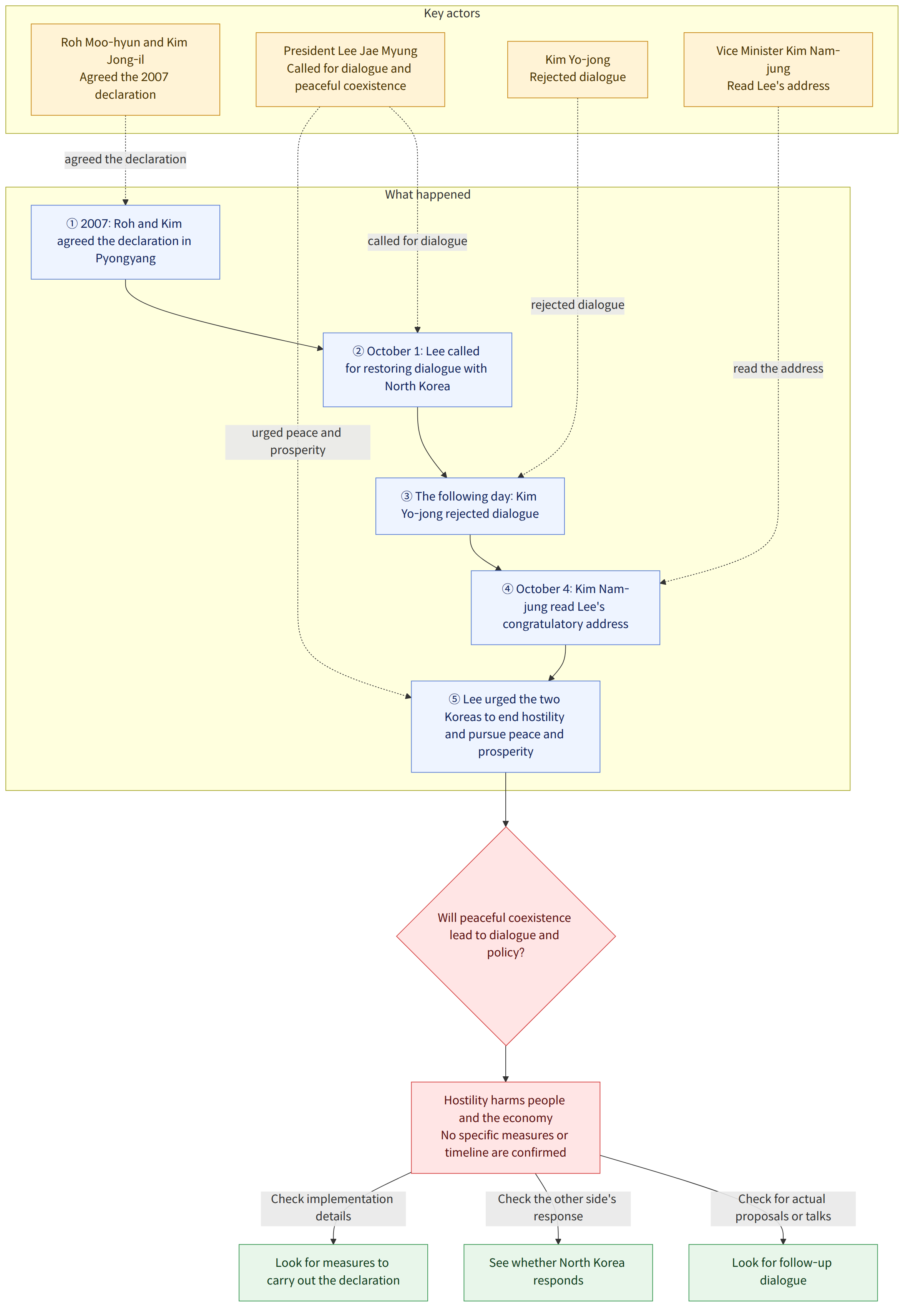
On October 4, 2026, President Lee Jae Myung urged the two Koreas to break the vicious cycle of hostility and confrontation and create a virtuous cycle of peace and prosperity, marking the 19th anniversary of the October 4 North-South Korea Joint Declaration (10·4 남북정상선언). Other reports said Vice Minister of Unification Kim Nam-jung read the congratulatory address on the president’s behalf.
Background and context
The October 4 North-South Korea Joint Declaration was an agreement reached in Pyongyang on October 4, 2007, by President Roh Moo-hyun and National Defense Commission Chairman Kim Jong-il. Reports describe the declaration’s aim as transforming inter-Korean relations into a relationship of mutual respect and trust, ending military hostilities, and working together to establish a permanent peace regime beyond the armistice system. The reports also said the declaration included economic cooperation projects.
Reports said President Lee called for a return to the spirit of the declaration and said that, although the path to resolving issues on the Korean Peninsula and establishing peace would not be easy, it was one that must be taken. He also noted that hostility and confrontation cause human and material harm, obstruct the economy, and can be exploited as a pretext to threaten democracy. This framed peace not only as a diplomatic and security issue but also in terms of its effects on society and the economy.
The reports also described a context in which the atmosphere for inter-Korean dialogue has not been smooth. According to one report, President Lee called for the restoration of dialogue with North Korea in his October 1 Armed Forces Day address, and Kim Yo-jong, vice department director of North Korea’s Workers’ Party (북한 노동당), rejected dialogue in a statement the following day. In light of this sequence, the latest remarks reiterated the need for peaceful coexistence, but whether the spirit of the declaration can be translated into actual dialogue or policy remains a separate question.
What this news means
For readers interested in inter-Korean relations and policy on the Korean Peninsula, the key is to distinguish between the goals the president emphasized and whether any implementation plans to support those goals have been made public. President Lee stressed the need to reduce mutual hostility and confrontation and pursue peace and prosperity. A Chosun Ilbo report also outlined three visions for peaceful coexistence: inclusive peaceful coexistence based on mutual respect, stable peaceful coexistence in which there is no need to fight, and responsible peaceful coexistence that contributes to world peace.
These principles explain the direction of policy, but do not in themselves mean that specific measures have been taken or an agreement has been reached. The reported information does not establish what dialogue process will be pursued, whether the other side will respond, or how the declaration’s agreed points will be implemented. Readers should therefore consider the symbolic significance of the message separately from evidence of actual policy changes.
For example, readers interested in restoring inter-Korean dialogue could check whether future statements lead to actual proposals or talks. This is a hypothetical way to assess developments; the current reports do not show that follow-up talks have begun.
Points reported differently
The three reports agree on the central point that the president stressed the need to break the vicious cycle of hostility and confrontation and pursue peace and prosperity. One report focused on the substance of his remarks, while others provided more detail about the reading of a written congratulatory address at the ceremony marking the 19th anniversary of the October 4 declaration and the declaration’s background. One report also outlined three visions for peaceful coexistence.
So whether these remarks should be viewed as a simple slogan or as containing a concrete policy vision depends on the scope of what was reported. The information made public sets out a direction and principles, but does not include detailed implementation procedures or a timeline.
What is confirmed and what remains unknown
Confirmed facts
- On October 4, 2026, President Lee Jae Myung urged the two Koreas to break the vicious cycle of hostility and confrontation, marking the 19th anniversary of the October 4 North-South Korea Joint Declaration.
- Multiple reports said Vice Minister of Unification (통일부) Kim Nam-jung read the president’s written congratulatory address at the ceremony.
- The October 4 declaration was described as an agreement reached in 2007 by President Roh Moo-hyun and National Defense Commission Chairman Kim Jong-il.
- Reports said the declaration covered mutual respect and trust, an end to military hostilities, a permanent peace regime, and economic cooperation.
What remains unknown
- What specific measures and timeline will the government pursue to break the vicious cycle?
- How will North Korea respond to these remarks or the vision of peaceful coexistence?
- Has a specific plan been drawn up to connect the spirit of the declaration to actual inter-Korean dialogue or implementation of agreements?
What readers can watch for
- Readers can look for whether the vision of peaceful coexistence takes shape as actual policy proposals or talks between the two Koreas.
- They can distinguish North Korea’s response to calls to restore dialogue from any subsequent developments in inter-Korean relations.
- It is important not to confuse references to the spirit of the declaration with confirmed implementation of past agreements or the reaching of new agreements.
References
- Other coverage consulted: hani.co.kr
- Other coverage consulted: chosun.com