
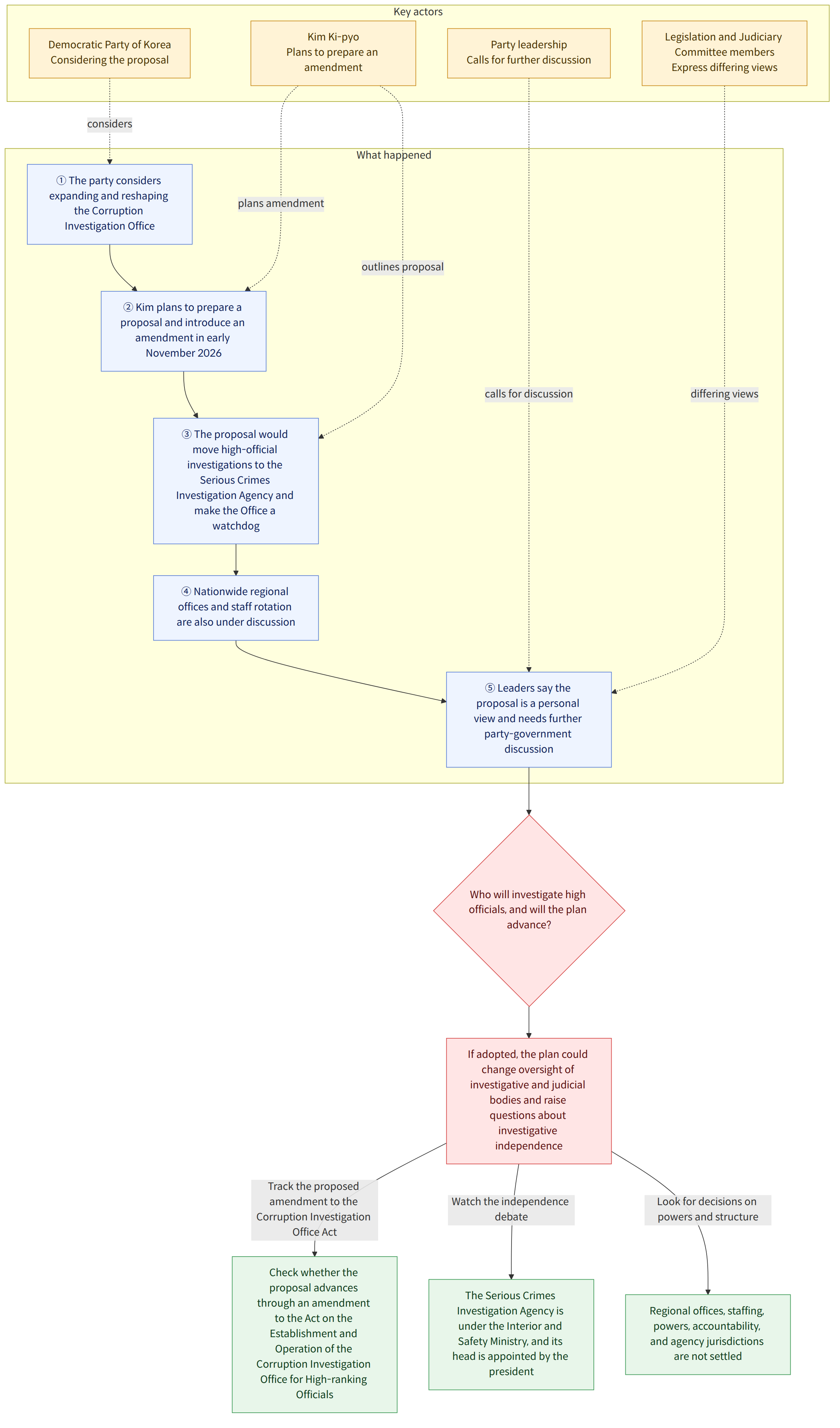
The Democratic Party of Korea (더불어민주당) is considering expanding the Corruption Investigation Office for High-ranking Officials (고위공직자범죄수사처, 공수처) into a nationwide organization with regional offices and revamping it into an agency that monitors and investigates misconduct by employees of investigative and judicial institutions, including judges, prosecutors and police. According to reports, Democratic Party lawmaker Kim Ki-pyo (김기표) said he plans to prepare the proposal and introduce an amendment to the Act on the Establishment and Operation of the Corruption Investigation Office for High-ranking Officials (고위공직자범죄수사처법) in early November 2026. However, a party leadership official said the proposal still reflects Kim’s personal position and that further views need to be gathered in discussions between the party and government.
Background and context
The core of the proposal is to redistribute the Corruption Investigation Office’s role. According to reports, one proposal being discussed within the Democratic Party is to assign investigations of high-ranking officials, including the president and lawmakers, to the Serious Crimes Investigation Agency (중대범죄수사청, 중수청), and to turn the Corruption Investigation Office into an oversight body that checks the Serious Crimes Investigation Agency, the Prosecution Office (공소청), which handles indictments, and the courts.
Lawmaker Kim Ki-pyo said the ideal arrangement would be for the Serious Crimes Investigation Agency, the Prosecution Office and the courts to perform their respective roles, while the Corruption Investigation Office monitors and investigates their officials. Reports say a proposal is also under discussion to give the Corruption Investigation Office regional offices, like the former prosecutors’ district offices or district courts, and have employees rotate between central and regional offices to investigate corruption across the police, prosecution and judiciary nationwide.
These discussions are linked to assessments of the Corruption Investigation Office. It was established in 2021 under the leadership of the Democratic Party, but some within the party have previously called for its abolition, citing limited investigative results. The report also recounts that former National Assembly Legislation and Judiciary Committee chair Jeong Cheong-rae (정청래) criticized the head of the Corruption Investigation Office after the attempted execution of an arrest warrant for former President Yoon Suk Yeol (윤석열) failed in January 2025.
What this news means
If the Corruption Investigation Office becomes an oversight agency with offices nationwide, the scope and methods of oversight of investigative and judicial institutions could change. This could affect not only the Office’s role, but also which agency handles investigations of high-ranking officials and how that agency’s independence is secured.
In particular, the report says the Serious Crimes Investigation Agency is under the Ministry of the Interior and Safety (행정안전부), and its head is appointed by the president. The article notes that assigning investigations of the president and lawmakers to the Serious Crimes Investigation Agency, rather than to the independent Corruption Investigation Office, could prompt debate over investigative independence. Conversely, the broader the Corruption Investigation Office’s oversight remit becomes, the more important it may be to determine its own staffing, powers and accountability.
For example, if allegations of misconduct by police or investigative agency employees arise in a particular region, regional offices could take on an oversight and investigative role under the proposed nationwide structure. This is an illustration based on the possibility that the proposal could be adopted as an actual system; it does not mean that the establishment of such offices or their jurisdictions has been decided.
The nationwide expansion and role changes are not finalized policy. According to reports, party leaders said further discussions between the party and government were needed, and Democratic Party members of the Legislation and Judiciary Committee also voiced support for abolition and opposition to expansion.
Related systems and support information
The proposal was reported as being planned through an amendment to the Act on the Establishment and Operation of the Corruption Investigation Office for High-ranking Officials (고위공직자범죄수사처법). Therefore, regional offices, staffing adjustments and the allocation of investigative powers among agencies should be understood as proposals under discussion, not as a system currently in effect.
The issues fall into two broad areas. One is the scope and methods for the Corruption Investigation Office to monitor and investigate employees of investigative and judicial institutions, including judges, prosecutors, police officers and investigators. The other is how to ensure independence if investigations of high-ranking officials, including the president and lawmakers, are assigned to the Serious Crimes Investigation Agency. According to reports, the head of the Serious Crimes Investigation Agency is appointed by the president, so how this allocation of powers is reflected in any actual bill is something to watch.
What is confirmed and what is still unknown
Confirmed
- It has been reported that the Democratic Party is considering expanding the Corruption Investigation Office into a nationwide organization.
- The proposal under discussion includes assigning investigations of high-ranking officials to the Serious Crimes Investigation Agency and having the Corruption Investigation Office monitor and investigate employees of investigative and judicial institutions.
- Lawmaker Kim Ki-pyo said he plans to introduce an amendment to the Act on the Establishment and Operation of the Corruption Investigation Office for High-ranking Officials in early November 2026.
- Democratic Party members of the Legislation and Judiciary Committee are scheduled to hold a forum at the National Assembly (국회) on October 7, 2026, on a comprehensive overhaul of the Corruption Investigation Office’s functions.
- A party leadership official said the proposal still reflects Kim’s personal position and that further discussions between the party and government are needed.
Still unknown
- The available information does not show how many regional offices there would be, where they would be located, or what the Corruption Investigation Office’s staffing and budget would be.
- The specific contents of the amendment and the schedule for its introduction and passage have not been finalized.
- It is not yet known whether the proposal to expand the organization nationwide will ultimately be adopted after discussions between the party and government.
- No specific measures have been proposed for strengthening the independence of investigations into high-ranking officials.
What readers should check
- Readers should check whether the amendment to the Act on the Establishment and Operation of the Corruption Investigation Office for High-ranking Officials is actually introduced, and how it defines regional offices and the Corruption Investigation Office’s oversight and investigative remit.
- If the bill assigns investigations of high-ranking officials to the Serious Crimes Investigation Agency, readers can examine how its provisions address investigative independence and the appointment process for the agency’s head.
- Readers should check whether differences within the party narrow at the October 7, 2026, forum and in subsequent discussions between the party and government.