

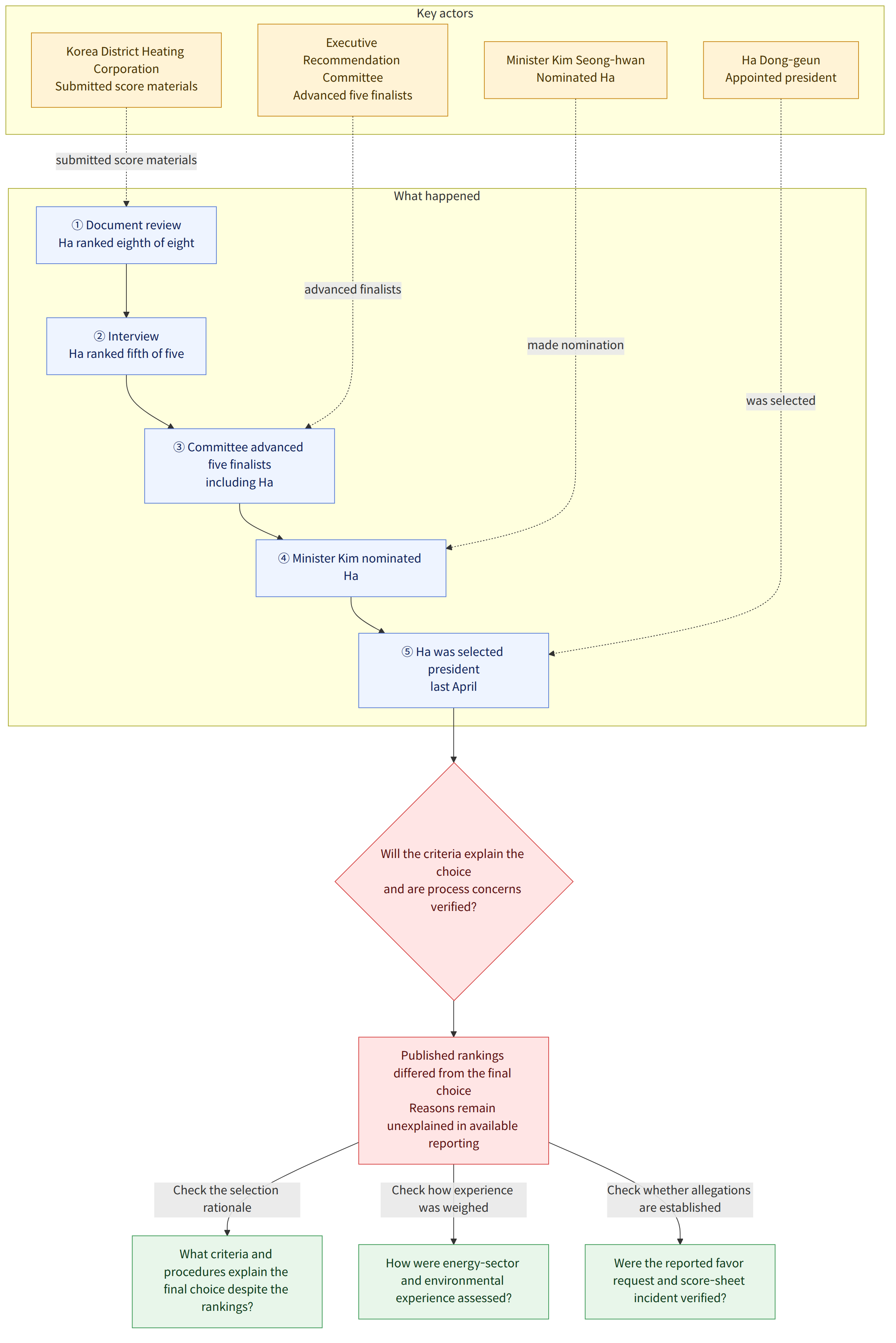
Reports say Ha Dong-geun was appointed president of the Korea District Heating Corporation despite receiving scores near the bottom in both the document review and interview. According to materials the corporation submitted to the office of Na Kyung-won, a lawmaker from the People Power Party (국민의힘), Ha scored 85.8 points, ranking eighth out of eight, in the document review, and 81.42 points, ranking fifth out of five, in the interview. The Executive Recommendation Committee (임원추천위원회) advanced five finalists, including Ha, and Ha was selected last April after a nomination by Kim Seong-hwan, minister of the Ministry of Climate, Energy and Environment (기후에너지환경부).
The central issue is not simply that Ha received low scores. What matters is whether the evaluation criteria and procedures explaining why the review rankings differed from the final appointment are public. The reporting available so far does not explain the specific reasons for choosing Ha or how the review results factored into the final decision.
Background and context
According to the reports, Ha was a civic and environmental activist whose work included a campaign to establish Seongnam Medical Center (성남의료원) and the Seongnam Federation for Environmental Movement (성남환경운동연합). He had no background in the energy sector. The Korea District Heating Corporation supplies heating to 1.9 million households nationwide, and its headquarters are in Bundang-gu, Seongnam, Gyeonggi Province. Reports put the president’s salary at 243 million won, including performance-based pay.
At a parliamentary audit, Minister Kim said the Korea District Heating Corporation’s role required it to consider not only energy but also environmental and ecological factors. This offers context for considering whether candidates for the presidency should be assessed solely on their energy-sector experience and how experience in environmental fields was taken into account. The minister’s remarks alone, however, do not establish how much weight Ha’s background actually received in the evaluation.
The reports said Ha had worked alongside President Lee Jae-myung and Kim Hyun-ji, the senior secretary for the Blue House’s First Office (청와대 제1부속실장), when they were involved in civic group activities in Seongnam, and that Ha officiated at Kim’s wedding. These connections were cited as a reason to question the fairness of the appointment process. However, the existence of a connection and the claim that it affected the review outcome should be distinguished. The relationships described in the reports alone do not establish that there was improper interference.
A person involved in the review at the time, quoted in the article, alleged that a corporation executive contacted them in a way that amounted to asking them to favor Ha. The person also said that on the day of the interview, one panelist came in after handling a submitted score sheet, causing a disturbance. These are accounts by people involved in the process as reported in the article; it does not establish whether the score sheet was actually changed or whether an official investigation took place.
What this news means
The appointment of a public corporation president is connected not only to the operation of that institution but also to public trust in appointments to public bodies. In this case, the striking point is that the published rankings from the document review and interview differed from the final selection. The available information does not establish that the rankings had to determine the appointment, but explaining the criteria used to compare candidates when a different choice was made could make the process easier to understand.
The experience and criteria used to select the head of an institution may be relevant to confidence in the decisions of an organization that provides public services. For example, households that receive district heating can look at whether the institution explains the review criteria and procedures it used, rather than treating the appointment controversy as a sign that service will be interrupted.
The reports also said that Nam Kwang-woo, appointed around the same time as president of the Korea Environmental Industry & Technology Institute (한국환경산업기술원), scored 89 points and ranked third in the document review, and scored 84 points and ranked second in the interview. Nam was selected over the applicant who ranked first in both the document review and interview, and was described as the inaugural secretary-general of the Seongnam Citizens’ Group (성남시민모임), where President Lee Jae-myung and Kim Hyun-ji had been active. Coverage of the two cases together may increase attention to appointment processes overall, but no evidence was presented that the two institutions had the same review criteria or circumstances.
Na Kyung-won said that Kim’s role as the officiant at a wedding had effectively overturned the document-review and interview scores, and called for an investigation into whether there had been pressure from the Blue House. This is the lawmaker’s claim. The account of someone handling a score sheet and reports of personal connections may provide grounds for raising questions, but they do not mean that pressure or improper interference has been confirmed.
What is confirmed and what remains unknown
The following summarizes the materials and statements presented in the reports. Allegations of interference in the review, which were claims by people quoted in the reports, should be distinguished from confirmed findings of an investigation.
Confirmed facts
- In the materials the corporation submitted to the lawmaker’s office, Ha scored 85.8 points and ranked eighth out of eight in the document review, and scored 81.42 points and ranked fifth out of five in the interview.
- The Executive Recommendation Committee advanced five finalists, including Ha, and Ha was selected last April after a nomination by Minister Kim Seong-hwan.
- The corporation supplies heating to 1.9 million households nationwide, and reports put the president’s salary at 243 million won, including performance-based pay.
- The reports described Ha’s civic and environmental activism, noted his lack of experience in the energy sector, and reported past connections with the president and the senior secretary for the Blue House’s First Office.
What remains unknown
- The materials presented do not establish whether an official investigation was conducted into the claim that someone handled the score sheet or whether the score sheet was actually changed.
- The published article does not identify the specific evaluation criteria and reasons for recommending Ha as a finalist and selecting him.
- It is also unknown how the panelists weighed the candidates’ backgrounds and scores, or how much weight each stage of the evaluation carried in the final decision.
What readers can check
- Follow-up reporting or official announcements may indicate whether the claims about the score sheet were investigated and whether the findings were made public.
- Checking whether the evaluation criteria and reasons for recommending finalists and making the appointment are disclosed can help readers assess the difference between the low rankings and the final selection.
- When comparing the case of President Nam Kwang-woo, readers should also bear in mind that there is no confirmation that the two institutions used the same review criteria and procedures.

















