

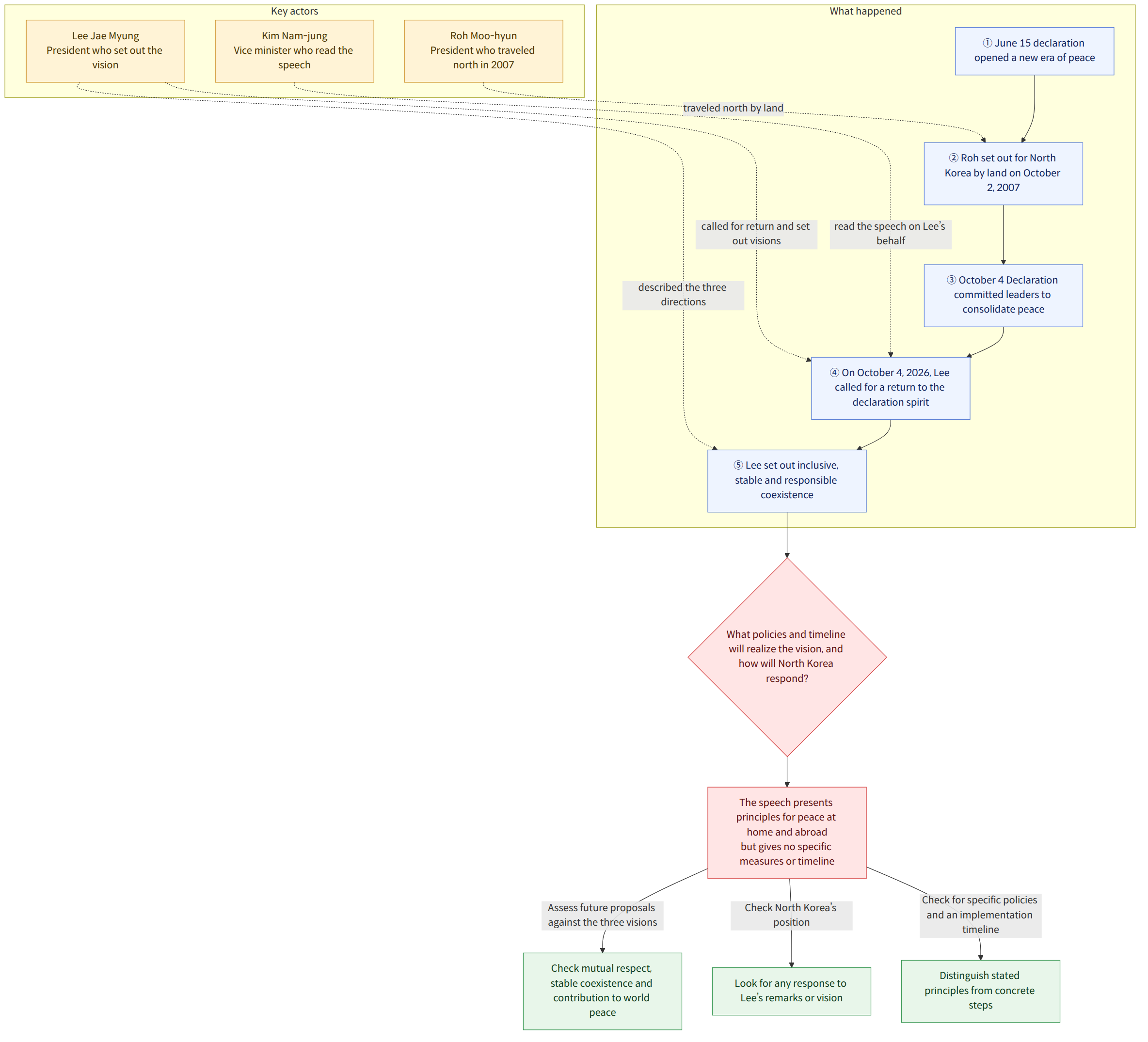
In a speech at a commemorative event on October 4, 2026, the 19th anniversary of the October 4 Inter-Korean Summit Declaration (10·4 남북정상선언), President Lee Jae Myung said, “We must return to the spirit of the ‘October 4 Inter-Korean Summit Declaration.’” Vice Minister of Unification Kim Nam-jung read the speech on the president’s behalf. Lee said he had set out three visions based on the spirit of the declaration: inclusive peaceful coexistence, in which the two sides respect one another; stable peaceful coexistence, in which there is no need to fight; and responsible peaceful coexistence, which contributes to world peace.
Background and context
Lee explained how the October 4 Declaration differed from the June 15 Inter-Korean Joint Declaration (6·15 남북공동선언). If the June 15 declaration opened a new era of peace, he said, the October 4 Declaration was a commitment by the leaders of the two Koreas to consolidate that peace. He said the October 4 Declaration was a historic agreement to transform inter-Korean relations into a relationship of mutual respect and trust, end military hostility and build a permanent peace regime together.
The speech also evoked a moment from the past that has come to symbolize the declaration. Lee noted that on October 2, 2007, President Roh Moo-hyun set out for North Korea by land. The words Roh left at the last gateway on the way north—“The road to consolidating peace, the road to prosperity”—clearly conveyed the meaning of the October 4 Declaration, Lee said.
The gap between promises and reality is the problem Lee identified today. He said promises of peace and prosperity had gone unfulfilled, giving way to hostility and confrontation. He also said hostility and confrontation had caused material and human losses, become an obstacle to the economy, and at times been exploited as a pretext to threaten democracy. This framed the issue of peace as connected not only to inter-Korean relations, but also to the economy and democracy.
What this news means
One notable feature of the speech is that it set out three directions for peaceful coexistence. “Inclusive” conveys the principle of mutual respect, while “stable” expresses the goal of reaching a state in which there is no need to fight. “Responsible” peaceful coexistence points to an international orientation: contributing to world peace. Lee said this vision was a blueprint for peace and prosperity that put the spirit of the October 4 Declaration into today’s language.
Because this vision was presented to the public and the international community, it shows what principles of peaceful coexistence the president is putting forward both at home and abroad. However, the three terms describe a vision set out in a speech; they do not in themselves amount to specific measures or a timeline for implementation. The speech reflected Lee’s view that breaking the cycle of hostility and confrontation is necessary to create a virtuous cycle of peace and prosperity, but it did not explain what steps would bring about that shift.
For example, if proposals are made in the future, readers can assess them against the three visions by asking whether they embody mutual respect, are consistent with stable coexistence, and align with the goal of contributing to world peace. This is not a prediction about the content of any proposals, but one way to assess the vision the president has set out.
What is confirmed and what remains unknown
Confirmed facts
- In his speech at the October 4, 2026, event marking the 19th anniversary of the October 4 Inter-Korean Summit Declaration, Lee said the two Koreas should return to the spirit of the declaration.
- Vice Minister of Unification (통일부) Kim Nam-jung read the speech on the president’s behalf.
- Lee described the October 4 Declaration as an agreement to build mutual respect and trust, end military hostility and establish a permanent peace regime together.
- Lee said he had set out three visions for inclusive, stable and responsible peaceful coexistence.
What remains unknown
- What specific policies and timeline will be used to realize the three visions for peaceful coexistence?
- What position has North Korea expressed on Lee’s remarks or his vision for peaceful coexistence?
What readers should look for
- If further announcements are made, it will be important to distinguish the principles in the three visions from specific policies or timelines.
- When considering subsequent positions related to inter-Korean relations, readers can look separately at what Lee said in his speech and what North Korea officially said.

















