
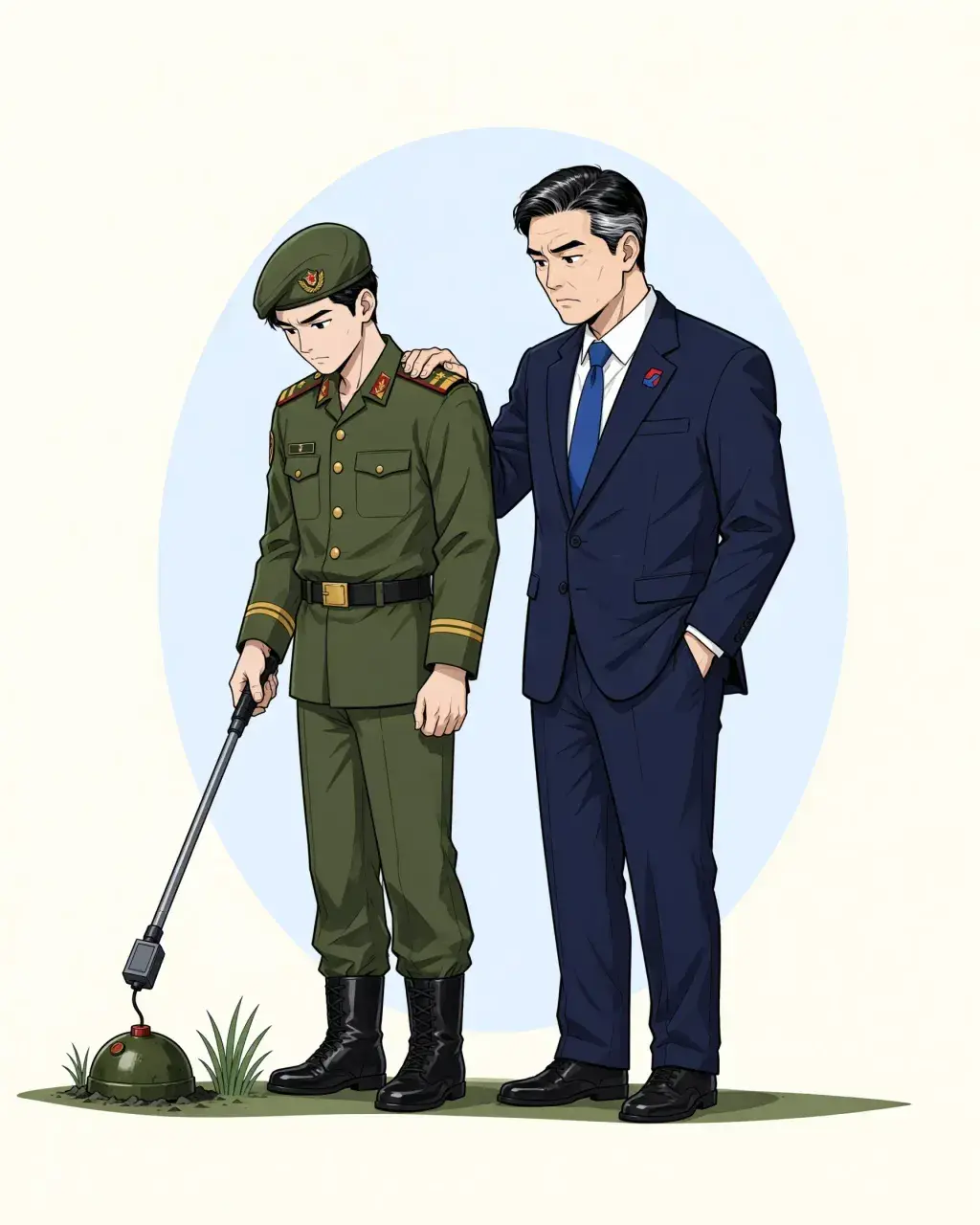
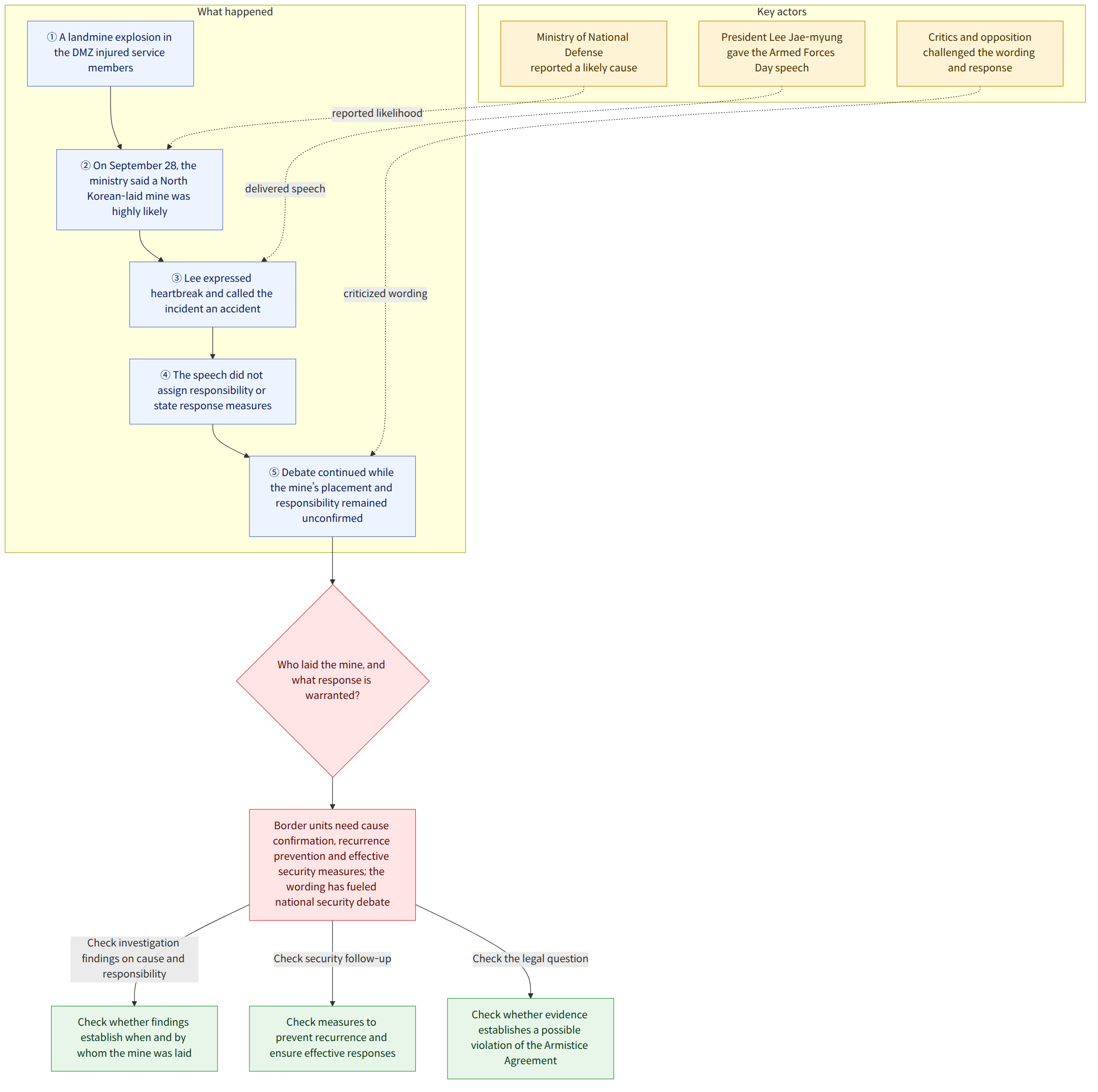
In his Armed Forces Day (국군의 날) speech, President Lee Jae-myung said he was “heartbroken” about service members injured in the Demilitarized Zone (DMZ; the area of military confrontation between North and South Korea). However, reports said the speech included no message about North Korea’s responsibility, the possibility of a violation of the Armistice Agreement (정전협정), or response measures. One report also said it was highly likely that the mine was laid by North Korean troops, but no investigation findings supporting that account of how it was laid or who was responsible were presented.
Background and context
The controversy focused less on the expression of sympathy for the injured service members than on how the president characterized the incident and what follow-up message he delivered. According to reports, the president called it an “accident,” and did not mention a warning or condemnation of North Korea, or any response measures. Critics reportedly said the speech “fell short of expectations for an Armed Forces Day address” and “appeared to be watching North Korea’s reactions.”
However, the fact that the wording has become controversial is separate from whether it has been confirmed who laid the mine. One report said the Ministry of National Defense (국방부) had stated on September 28 that it was highly likely that the incident was caused by a mine laid by North Korean troops. Even so, the articles provided contain no investigation findings establishing when the mine was laid at the site, the specific circumstances, or who was responsible.
The debate was also linked to wording used under previous administrations. One article reported that foreign affairs and security ministers under the Moon Jae-in administration (문재인 정부) described the sinking of the Cheonan and North Korea’s shelling of Yeonpyeong Island as “accidental incidents,” and called the Battle of Yeonpyeong an “unfortunate clash between the two Koreas.” The article criticized such language for obscuring North Korea’s intentions or responsibility and situated the president’s remarks in the same debate.
The article also summarized how phrases such as “resolve it through dialogue” and “win without fighting” have repeatedly been used in connection with North Korea-related incidents. The articles alone do not establish how these phrases changed actual policy or responses. The central issue in this controversy is that language describing an event as an “accident,” as opposed to language assigning responsibility, invites political interpretations of the direction of North Korea policy.
What this news means
The president’s remarks were intended to offer comfort to the service members, but the fact that he did not explicitly assign responsibility to North Korea or state a response policy prompted debate over whether the national security message was sufficient. In particular, an Armed Forces Day speech can be read as a message to the military and the public, so how an event is characterized may be interpreted as a clue to the government’s view of North Korea and its willingness to assign responsibility. This is a matter of interpretation; the remarks alone do not establish that the government took no action.
For service members and units stationed near the border, confirming the cause of the incident, preventing a recurrence, and ensuring the effectiveness of security and response measures are immediate concerns. A second report said an active-duty officer, speaking anonymously, testified to witnessing North Korean troops cross south of the Military Demarcation Line and carry a box believed to contain a mine. This was presented as the officer’s testimony and should be distinguished from independently confirmed facts or official investigation findings.
Political disputes over the government’s wording and response may continue. One article summarized that the longer the response to the mine is delayed, the more the opposition attacks the government over “remittances to North Korea.” This is a political forecast or interpretation presented by that article, not a confirmed outcome of the response. For example, if a follow-up investigation confirms that North Korea laid the mine, questions about what measures the government took could develop into a more specific dispute over responsibility. Conversely, before the cause and circumstances are established, it is important to distinguish political claims from confirmed investigation findings.
What is confirmed and what remains unknown
Confirmed facts
- In his Armed Forces Day speech, the president mentioned service members injured in the Demilitarized Zone and said he was heartbroken.
- According to reports, the president did not mention a warning or condemnation of North Korea, or response measures, in the speech.
- One report said the Ministry of National Defense stated on September 28 that it was highly likely that the incident was caused by a mine laid by North Korean troops.
- Reports on the incident described criticism and debate over North Korea policy concerning the president’s wording and response message.
What remains unknown
- What do investigation findings say about the specific circumstances of the explosion and whether North Korea laid the mine?
- What response measures did the government consider or implement in connection with the incident involving the injured service members?
- What final determination did military authorities make about when the mine was laid and who was responsible for the incident?
What readers should check
- Check how follow-up investigations report the type of mine, how it was laid, and whether North Korea laid it, and distinguish interim assessments from final findings.
- Check whether the government and military have announced any response measures concerning the incident involving the injured service members, and what grounds and objectives those measures have.
- When following political disputes, it is useful to distinguish evaluations of remarks, testimony from anonymous sources, and official investigation findings as different kinds of evidence.
References
- Other coverage consulted: chosun.com

















