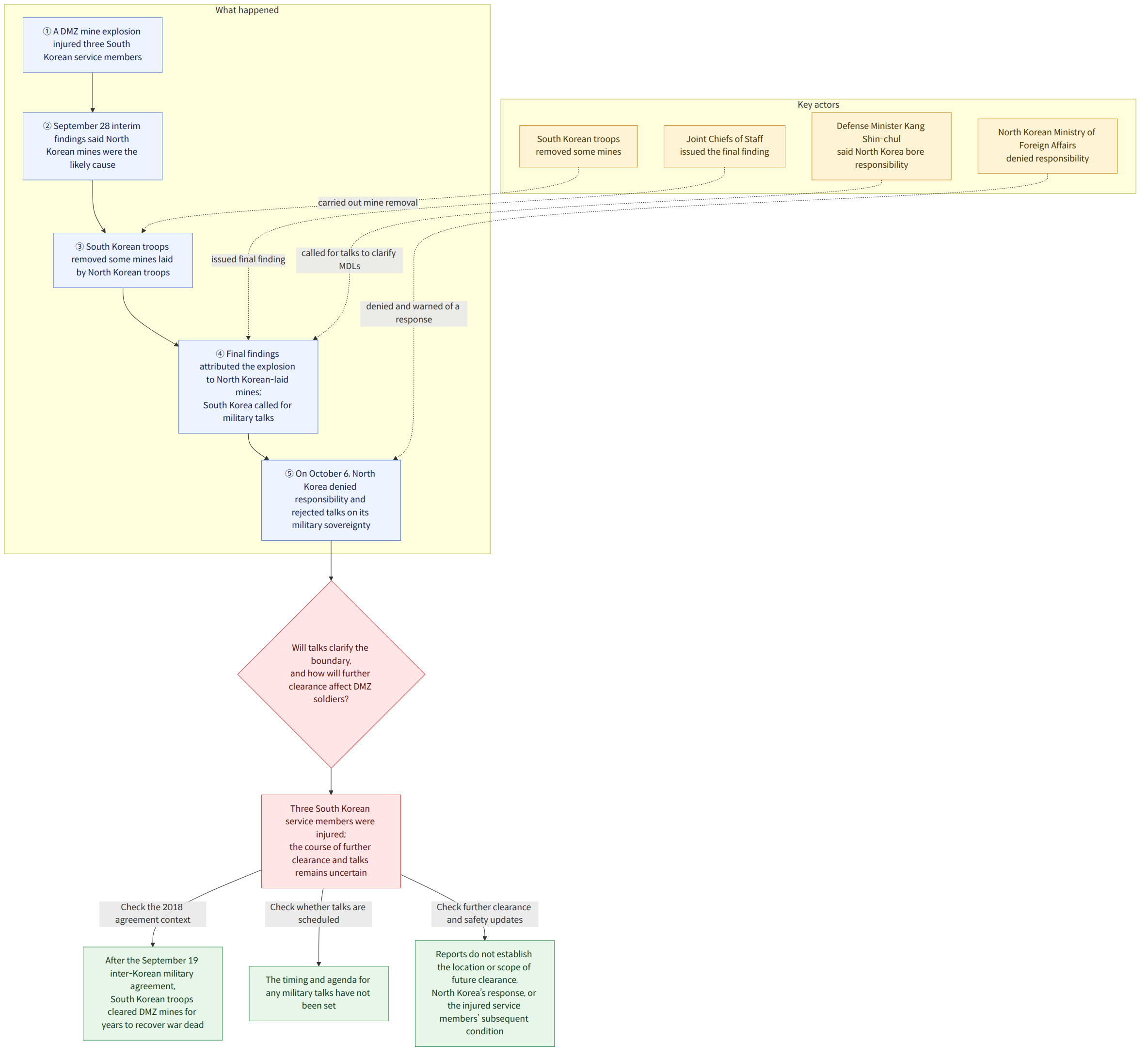
Claims by the two Koreas directly clashed over an incident last month in which a mine exploded in the Demilitarized Zone (DMZ), injuring three South Korean service members. The Joint Chiefs of Staff issued its final investigation finding that the explosion was caused by a minefield laid by North Korean troops, and Defense Minister Kang Shin-chul said North Korea bore all responsibility. North Korea’s Ministry of Foreign Affairs (북한 외무성), by contrast, denied the incident, calling it a fabrication by South Korea, and said it would respond forcefully if South Korean troops intruded even 1 mm into North Korean territory.
Background and context
Before the Joint Chiefs of Staff announced its final findings, the interim findings issued on September 28 concluded that North Korean mines were the likely cause. According to the article, President Lee Jae-myung chaired a Cabinet meeting on October 6 but did not mention the incident.
The incident is not just a dispute over who is responsible for the explosion. Defense Minister Kang said there are multiple Military Demarcation Lines (MDLs; 군사분계선) and that North Korea should come to the table for talks so the two sides can confirm them. Woo Kyung-seok, a policy planning director at the Ministry of National Defense, also said military talks were necessary, adding that their timing would be decided after a comprehensive assessment.
Minister Kang described the South Korean military’s removal the previous day of some mines laid by North Korean troops as the first such action in the history of the DMZ and called it a firm response. However, reports say that after the September 19 inter-Korean military agreement (9·19 남북 군사합의) in 2018, South Korean troops also cleared mines in the DMZ for several years to recover the remains of Korean War dead. The description of this action as the “first,” then, can be understood as referring not to the first mine clearance of any kind, but to an operation to remove mines laid by North Korean troops in response to this incident.
In a statement issued on the evening of October 6, North Korea’s Ministry of Foreign Affairs said it would not discuss the exercise of its military sovereignty with an adversary country. Alongside its claim that the mine explosion was a “self-staged farce” by South Korea, it also said that even if a similar incident occurred on South Korean soil in the future, responsibility would lie with the side involved in the accident, not with North Korea. On the same day South Korea’s Ministry of National Defense called for military talks, North Korea said it would not discuss its military sovereignty through negotiations.
What this news means
The first issue is that mine clearance can be both a safety measure and a military signal between the two Koreas. Minister Kang described it as a firm response, while North Korea warned of a forceful response based on whether its territory was violated. If the two sides dispute not only responsibility for the incident but also which boundaries each side should use as a reference, they may interpret the significance of actions on the ground differently as well.
The second issue is the gap between the need for dialogue and the possibility of actually holding it. South Korea said military talks were needed to clarify differences in how the two sides understand the MDL, but North Korea said it would not discuss its military sovereignty. The fact that talks have been proposed does not mean they will take place or that differences over the boundary will be resolved. The timing and agenda for any talks have not yet been set, according to the information available.
The issue is also directly linked to the safety of soldiers deployed in the DMZ. For example, if mine-clearing work continues, its location and scope, as well as how the other side interprets it, could affect both safety measures and tension management. However, current reports do not establish how any further clearance work will proceed or what North Korea will do.
Details reported differently
Reports differ in how much detail they provide about the injured service members’ condition. One report said three service members were injured, while another specified that two were seriously injured and one sustained minor injuries. This does not mean the reports give different totals; they differ in how much detail they provide about the severity of the injuries. The available information does not establish the service members’ subsequent condition.
Reports also rendered the wording of North Korea’s statement differently, using phrases such as “self-staged farce” and “self-fabricated plot.” The common point is that North Korea denied South Korea’s allegations of responsibility and the investigation’s findings, and said it would respond if South Korean troops violated its territory. The core of North Korea’s stated position should be distinguished from differences in the wording of quoted phrases.
What is confirmed and what remains unknown
Confirmed facts
- Three South Korean service members were injured in a mine explosion in the DMZ.
- The Joint Chiefs of Staff announced its final investigation finding that a minefield laid by North Korean troops caused the explosion.
- Defense Minister Kang Shin-chul said North Korea bore all responsibility and described the mine clearance as a firm response.
- A Ministry of National Defense official said inter-Korean military talks were necessary but did not give a specific timeline for pursuing them.
- North Korea’s Ministry of Foreign Affairs denied responsibility and said it would respond forcefully if South Korean troops violated its territory.
What remains unknown
- The current condition and recovery of the three injured service members have not been confirmed.
- Reports do not specify the number of mines cleared by the South Korean military or the precise location of the work.
- It has not been decided whether military talks will actually be pursued or, if they are held, when they will take place and what their agenda will be.
- The specific actions meant by North Korea’s warning have not been confirmed.
What readers should check
- Check updates on the injured service members and follow-up statements from the Joint Chiefs of Staff to see whether anything has changed since the initial reports.
- Watch for further mine-clearance work and official announcements about its scope to better understand the significance of the actions on the ground.
- Follow both the Ministry of National Defense’s updates on whether and when military talks will be pursued and North Korea’s official response to distinguish the prospects for dialogue from changes in tensions.
References
- Other coverage consulted: en.yna.co.kr
- Other coverage consulted: hani.co.kr