

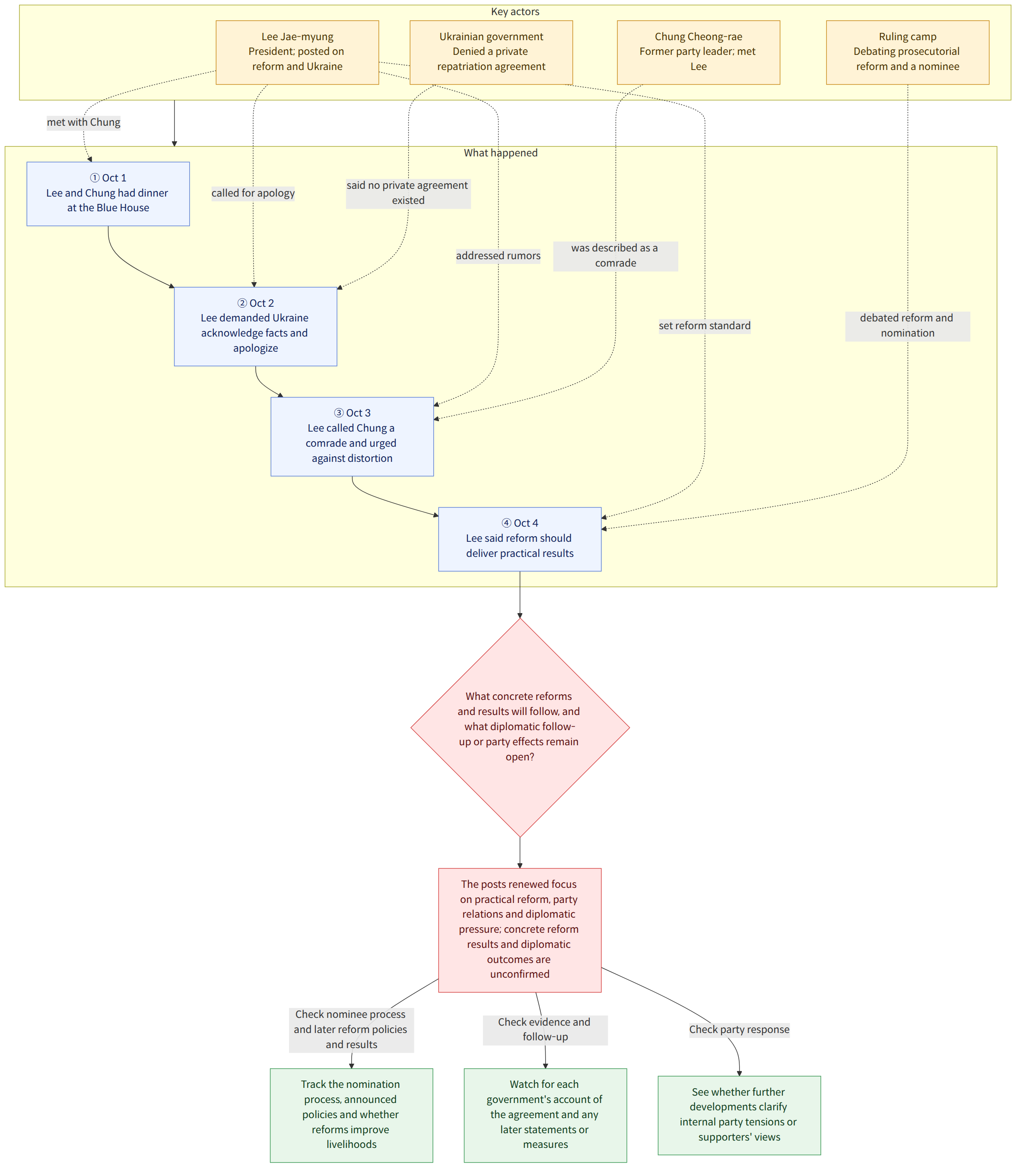
On October 4, 2026, President Lee Jae-myung posted on X that reform is for the people and the country and should not be used as a means of attacking anyone. He also said he would press ahead without wavering with practical reforms that deliver results by improving people’s livelihoods and contributing to national development. The post also brought renewed attention to his denial of rumors of a rift with former Democratic Party of Korea (더불어민주당) leader Chung Cheong-rae, and to his demand that the Ukrainian government acknowledge the facts and issue a public apology over the issue of a private agreement concerning the repatriation of North Korean prisoners of war to South Korea.
Background and context
The remarks on reform came amid internal debate in the ruling camp over the nomination of a candidate to head the Serious Crimes Investigation Agency (중대범죄수사청). According to reports, some questioned the government’s commitment to prosecutorial reform in connection with the nomination of Kim Ji-yong, and Lee’s post was interpreted as a response. Other reports described it as a warning to hardliners within the ruling party.
The standard Lee set is results, rather than how prominently reform is presented. His argument is that reform should improve people’s lives, not stop at attracting attention or attacking someone. However, the post alone does not reveal what policies will be pursued, how they will be implemented, or how their results will be assessed.
Lee’s post about his relationship with former leader Chung addressed interpretations that emerged after their dinner became public. The two had dinner at the Blue House (청와대) on October 1, and the meeting was later made public. After some supporters criticized Lee for using Chung, Lee wrote on October 3 that the two were comrades who had weathered difficult times together and urged people not to misunderstand or distort the situation.
The issue involving Ukraine is a diplomatic matter separate from domestic politics. On October 2, Lee called on the Ukrainian government to acknowledge the facts and issue a public apology after it claimed there had been no private agreement concerning the repatriation of North Korean prisoners of war to South Korea. He said further action would follow if the government refused. However, the reports do not make clear what action he meant or what evidence each country has cited in explaining whether an agreement existed.
What this means
In the ruling camp’s debate over reform, a key question may be whether the “practicality” emphasized by the president leads to concrete policies and results. His remarks describe the direction of reform, but they do not resolve disagreements over the nominee or establish specific measures for prosecutorial reform. Readers should therefore look separately at actual institutional changes and their results, rather than at political rhetoric alone.
The public explanation of his relationship with former leader Chung can be read as a message aimed at quelling rumors of discord between party figures. But since both the president’s explanation and criticism from some supporters have been reported, it is difficult to conclude that one post settled either internal party tensions or supporters’ views.
Lee’s demand of the Ukrainian government amounts to public diplomatic pressure. Having called for an acknowledgment of the facts and an apology, he also raised the possibility of further action. Attention will therefore focus on how subsequent statements or measures affect relations between the two countries. This is an analysis of possible future developments, not confirmation that any diplomatic outcome has occurred.
For example, a citizen seeking to assess the government’s direction on prosecutorial reform could look beyond the president’s social media post and consider the process related to the nominee, policies announced later, and results in improving people’s livelihoods. The important distinction in this case is that the intention to pursue reform and the concrete results of reform are at different stages.
Differences in how reports framed the remarks
Reports differed in how they explained the background to the remarks on reform. One interpreted them as a response to doubts within the ruling camp about commitment to prosecutorial reform following the nomination of Kim Ji-yong; another described them as a warning to hardliners within the ruling party. The two interpretations emphasize different political contexts for the remarks. The central point of the post itself was that reform should be tied to tangible results.
What is confirmed and what remains unknown
Confirmed facts
- On October 4, Lee wrote on X that reform is for the people and the country and should lead to tangible results.
- It was reported that doubts were raised within the ruling camp about commitment to prosecutorial reform over the nomination of Kim Ji-yong as a candidate to head the Serious Crimes Investigation Agency.
- Lee and former leader Chung Cheong-rae had dinner at the Blue House on October 1, and the meeting was later made public.
- On October 3, Lee posted a message denying rumors of a rift with Chung.
- On October 2, Lee called on the Ukrainian government to acknowledge the facts and issue a public apology, and said further action would follow if it refused.
What remains unknown
- What specific policies and criteria for success does the government have in mind for practical reform?
- What further action did Lee say he would take if the Ukrainian government refused?
- What evidence have the South Korean and Ukrainian governments each presented regarding whether a private agreement existed on the repatriation of North Korean prisoners of war to South Korea?
- Did Lee’s explanation of his relationship with Chung actually resolve the internal party controversy or criticism from some supporters?
What readers should check
- When assessing remarks about reform, distinguish the debate over the nominee from the substance of actual policies and any subsequent results in improving people’s livelihoods.
- On the Ukraine issue, check whether the government releases further explanations or takes action, and whether the two countries present evidence regarding the existence of an agreement.
- Regarding Lee’s relationship with Chung, it is useful to consider the dinner, the president’s explanation, and subsequent reactions within the party separately.
References
- Other coverage consulted: hani.co.kr
- Other coverage consulted: chosun.com

















