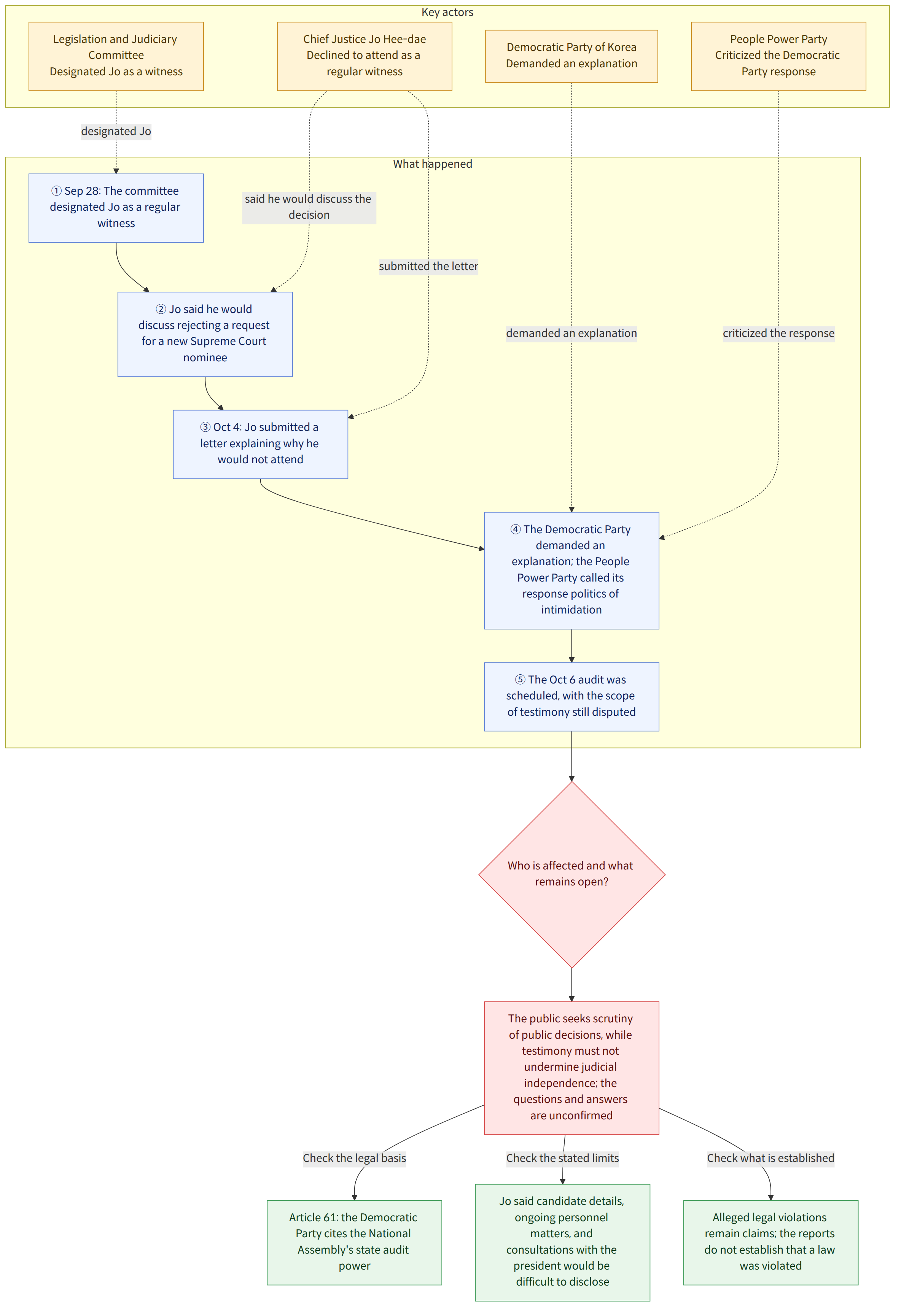
Chief Justice Jo Hee-dae submitted a letter explaining why he would not attend as a regular witness the National Assembly’s audit of the Supreme Court (대법원), scheduled for October 6 before the Legislation and Judiciary Committee. Jo said that testimony about his exercise of the authority to nominate candidates for the Supreme Court could run counter to the separation of powers and judicial independence, and that it would also be difficult to disclose details of ongoing personnel matters or consultations with the president. The Democratic Party of Korea criticized his decision as a refusal to comply with the National Assembly’s legitimate oversight request, while the People Power Party countered by calling the Democratic Party’s response “politics of intimidation.”
Background and context
On September 28, the Legislation and Judiciary Committee, led by the Democratic Party, designated Chief Justice Jo as a regular witness for the state audit. That same day, as he arrived at work, Jo said he would discuss during the audit his decision to reject the Blue House’s (청와대) request to nominate a new candidate for Supreme Court justice. Democratic Party floor coordinator Kim Eui-kyeom said Jo had submitted a letter explaining his absence on October 4, and criticized him for changing his position from what he had said earlier.
The reasons stated in the letter were reported by the media. Jo argued that the chief justice’s nomination authority is a constitutionally independent power and that requiring him to testify about it would run counter to the purpose of the separation of powers and the independence of judicial authority. He also said it would be inappropriate to disclose details about candidates’ personal information, ongoing personnel matters or consultations with the president, and raised the possibility of an investigation related to his exercise of the nomination authority.
The Democratic Party countered that the state audit is a power of the National Assembly under Article 61 of the Constitution (헌법 제61조). Kim argued that allowing an official to stay away merely because an investigation is possible could set a precedent enabling public officials who have been accused of wrongdoing to avoid state audits. The Democratic Party believes that rejecting the request to nominate a new candidate infringed on the public’s right to a trial, and that there are grounds to suspect violations of the Constitution and laws, including convening a meeting of senior officials during the Dec. 3 emergency martial law. These are the Democratic Party’s allegations; the reports provided do not establish that any law was violated.
What this news means
This dispute lies at the intersection of the National Assembly’s authority to scrutinize the activities of public officials and institutions through state audits and the principle of protecting judicial independence. The points at issue include how far the National Assembly can go in demanding answers about the chief justice’s exercise of his nomination authority, and how sensitive personnel information or details of consultations with the president should be handled. Since both sides invoke different constitutional values, the demand that Jo appear does not, by itself, establish that either side is right.
The issue matters to the public as well. Testimony from public officials during a state audit can help people understand how public decisions were made, but it also raises the question of how to define the scope and manner of testimony so as not to undermine judicial independence. For example, if the National Assembly asks about the course of the nomination process, readers can distinguish between information that could be made public in an answer and the candidate details and consultation information that Jo said would be difficult to disclose. The questions and answers themselves have not yet been confirmed.
What differed across reports
The reports differed in their focus. One covered Representative Park Jie-won’s call for Jo to attend, saying, “He should just show up,” as well as examples of former chief justices appearing at state audits. Another reported both the Democratic Party’s and the People Power Party’s opposing responses. A report focused on the contents of the letter provided details of Jo’s stated reasons, including his nomination authority, judicial independence and the possibility of an investigation.
Representative Park claimed that former Chief Justices Min Bok-ki and Cho Jin-man appeared as witnesses and answered questions at state audits in the 1960s and 1970s, and that Kim Byeong-ro, the first chief justice, also complied with a same-day request from the National Assembly to appear. Urging Jo to attend, Park said that state audits, plenary sessions and standing committee meetings were held even while people were evacuating during the war. He also argued that the re-nomination dispute, the meeting of senior officials on the night of the Dec. 3 martial law and insurrection, and the alleged “splitting” of the Supreme Court’s corporate card transactions were unrelated to individual trials and were matters that only Chief Justice Jo could answer. These points were reported as Park’s claims.
What is confirmed and what remains unknown
Confirmed facts
- On September 28, the Legislation and Judiciary Committee, led by the Democratic Party, designated Chief Justice Jo as a regular witness for the state audit.
- Jo submitted a letter explaining his absence on October 4 and said it would be difficult for him to attend the audit on October 6.
- The letter cited the exercise of his nomination authority and judicial independence, disclosure of sensitive personnel and consultation information, and the possibility of an investigation as reasons for his absence.
- The Democratic Party called for him to attend, citing the National Assembly’s oversight authority and Jo’s earlier remarks; the People Power Party criticized the Democratic Party’s pressure.
What remains unknown
- The reports provided do not say whether Chief Justice Jo subsequently attended the state audit.
- The reports alone do not establish what process will be used to assess the allegations raised by the Democratic Party or what the outcome will be.
What readers should look for
- It is worth checking whether Chief Justice Jo attended the October 6 state audit and how the Legislation and Judiciary Committee actually questioned him.
- Follow-up reports that distinguish the claims in the letter from the National Assembly’s rebuttal may make it clearer whether the dispute is about attendance itself or the scope of testimony concerning the nomination authority.
- The alleged violations of the Constitution and laws raised by the Democratic Party should be assessed by distinguishing the party’s claims from any findings that have been confirmed.
References
- Other coverage consulted: hani.co.kr
- Other coverage consulted: hani.co.kr