
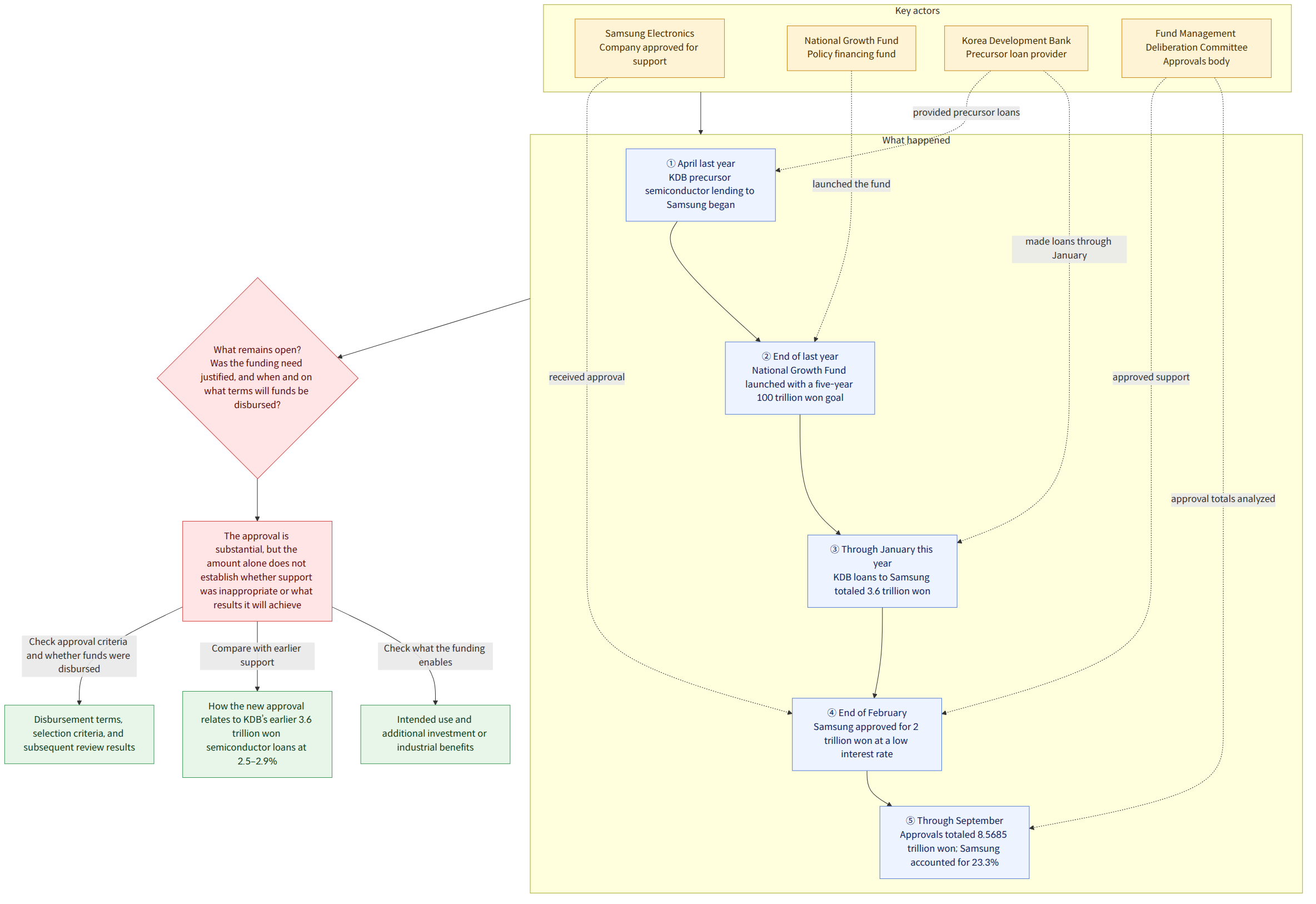
Samsung Electronics was approved for 2 trillion won from the National Growth Fund’s Advanced Strategic Industries Fund. An analysis by the Hankyoreh (한겨레) of approvals by the Fund Management Deliberation Committee (기금운용심의회) found that approvals for support, excluding indirect investments, totaled 8.5685 trillion won through September this year. According to the article, the funds approved for Samsung Electronics accounted for 23.3% of the total approved through this month.
Background and context
The Advanced Strategic Industries Fund is a source of policy financing made up of funds raised through government-guaranteed bonds and contributions from the Korea Development Bank (산업은행), among other sources. Launched at the end of last year, the National Growth Fund aims to provide 100 trillion won from this fund over five years. The approved amount refers to the scale of support that has been approved; the article does not say when or on what terms the approved funds will actually be disbursed.
By sector, semiconductors received the most, at 3.3985 trillion won, or 39.7% of the approved amount. Artificial intelligence (AI) received 1.578 trillion won (18.4%), infrastructure 1.44 trillion won, displays 1.3 trillion won, secondary batteries 770 billion won, biotechnology 335 billion won, and vaccines 250 billion won. Because some funds were counted in more than one sector, the sector totals should not simply be added up and compared with the total approved amount.
By company, LG Display was approved for 1.3 trillion won (15.2%), followed by Doosan Tesna, which was approved for 560 billion won (6.5%). Samsung Electronics’ support was reported to have been approved at the end of February this year. The article said Samsung Electronics would receive the 2 trillion won loan at a low interest rate comparable to that on government bonds, but did not provide the specific interest rate or repayment terms.
What this news means
Policy financing can be used to support companies or industries that have difficulty obtaining the funding they need from private sources. Assessing whether a company receiving a large amount of support lacks access to funding, and whether policy financing supplements investments or industrial capabilities that would be difficult to secure with private funding alone, is therefore a way to judge whether the allocation is justified. The approval amount alone is not enough to conclude that support for Samsung Electronics was inappropriate, but that is why it is important to explain the need for the funding and the selection criteria.
According to the article, Samsung Electronics’ free cash flow in the first half of this year—the cash generated from operations minus capital expenditures—was 112 trillion won, and its cash holdings at the end of the first half were 190 trillion won. Its cash holdings were reported to have nearly doubled from a year earlier. The article also reported that, from April last year through January this year, the Korea Development Bank lent Samsung Electronics 3.6 trillion won under a semiconductor loan program that served as a precursor to the National Growth Fund, at a fixed annual interest rate of 2.5–2.9%, with maturities from 2030 to 2035. These facts are relevant when explaining the need for the newly approved 2 trillion won and how it relates to existing support. However, the article does not say how the previous loan and the current approval are connected.
For example, if a company being considered for support has substantial cash and existing low-interest loans, readers may ask what additional investment or industrial benefits the support would make possible. Conversely, the approval amount alone cannot establish how the funds will actually be used or what results they will achieve. The approval criteria, intended use of the funds, whether they were disbursed, and the results of subsequent reviews must also be disclosed to assess what needs the policy financing addressed.
Related programs and support information
The “2027 Super-Gap Startup Project: Recruitment of Lead Organizations for Technology Commercialization and Investment Attraction” (2027년 초격차 스타트업 프로젝트 기술사업화 및 투자유치 주관기관 모집), posted on Bizinfo (기업마당), is a separate program from the National Growth Fund loan discussed in the article. It is a project for technologies in six strategic industries and 12 new industries, and companies that have been in operation for no more than 10 years. It recruits specialist lead organizations to support technology commercialization or investment attraction. The application deadline stated in the notice is October 11, 2026.
Support includes funding for technology commercialization and specialized programs, public procurement, open innovation (OI—collaboration between companies and external organizations), investment attraction, and links to research and development, policy financing, guarantees, and exports. However, this notice is not an application channel for the loan approved for Samsung Electronics, nor should it be viewed as a program that all companies can apply to directly. Interested companies or organizations should check the notice to confirm whether they are eligible and review the details of the support.
Confirmed facts and what remains unknown
Confirmed facts
- Cumulative approvals from the Advanced Strategic Industries Fund, excluding indirect investments, totaled 8.5685 trillion won through September this year.
- Semiconductor approvals totaled 3.3985 trillion won (39.7%); some funds were counted in more than one sector.
- Samsung Electronics was approved for a 2 trillion won loan, and 23.3% of the approved funding reported in the article is set to go to the company.
- Samsung Electronics’ free cash flow in the first half was reported at 112 trillion won, and its cash holdings at the end of the first half at 190 trillion won.
- The Korea Development Bank previously lent Samsung Electronics 3.6 trillion won under a semiconductor loan program.
What remains unknown
- When will the approved 2 trillion won loan actually be disbursed, and at what interest rate and on what repayment terms?
- What projects or equipment does Samsung Electronics plan to use the funds for?
- Which other companies have received support from the National Growth Fund, and in what amounts, and what criteria were used to select them?
- How is the current approval related to the previous semiconductor loan, and how will the results of the support be evaluated?
What readers should check
- Distinguish between the approved amount and the amount actually disbursed as a loan, and watch for disclosure of the interest rate, maturity, and intended use of Samsung Electronics’ loan.
- Keep in mind that sector totals include double counting, and check whether company-by-company approval details and selection criteria are disclosed later.
- If you are interested in the Super-Gap Startup Project, first check the October 11, 2026 application deadline stated in the notice and whether the applicant is supposed to be a company or a lead organization.