

A nomination enters the Assembly’s review process
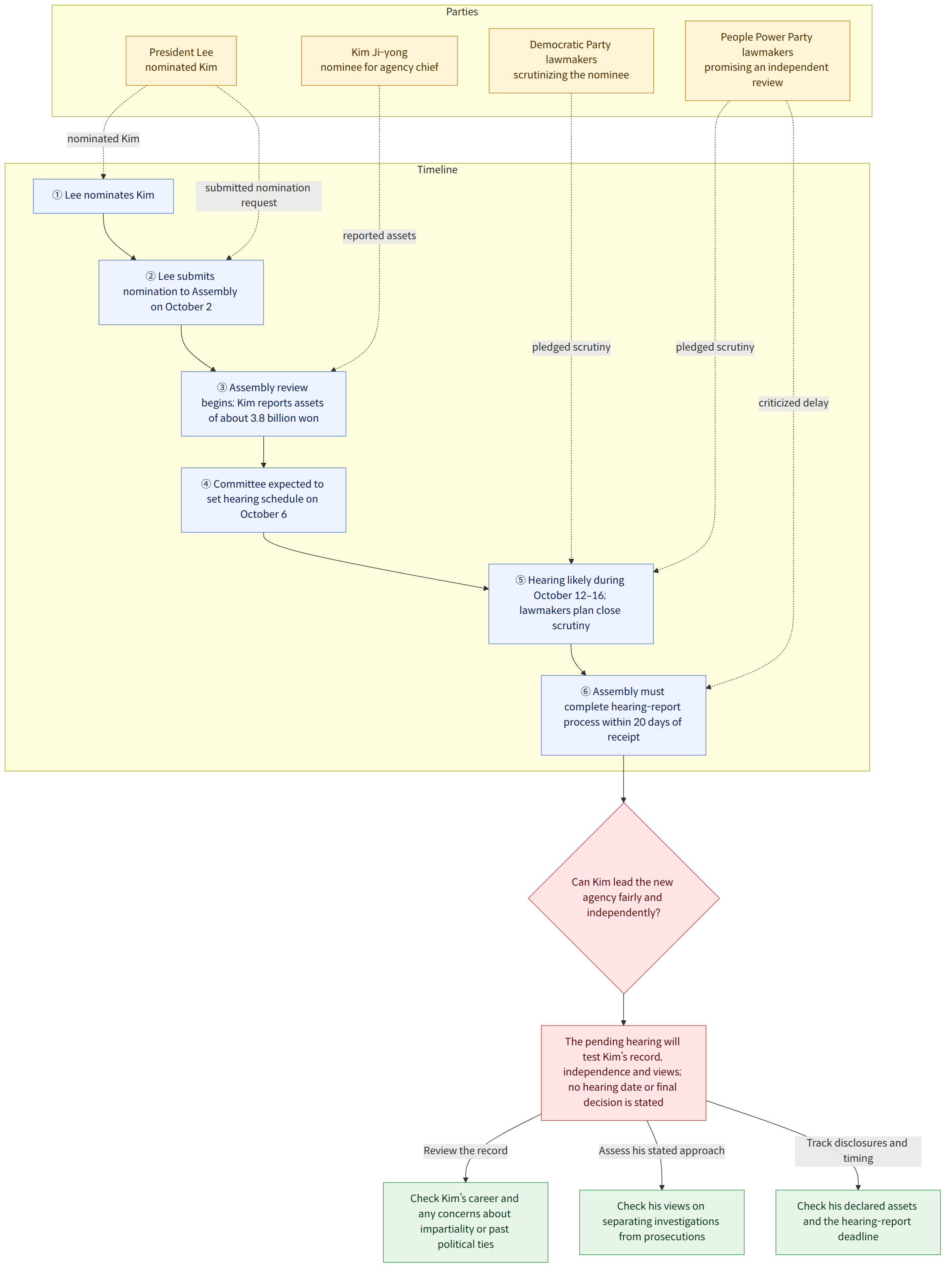
President Lee Jae-myung submitted Kim Ji-yong’s nomination for chief of the newly established Serious Crimes Investigation Agency to the National Assembly on October 2. The submission begins the parliamentary review process for the agency’s first chief.
The proposed agency is expected to handle investigations into serious crimes. Its leadership will therefore help shape how the new organization builds its investigative capacity and earns public trust.
The central question for lawmakers will be whether Kim can lead the new agency fairly and independently. Both the governing Democratic Party and the opposition People Power Party have pledged close scrutiny.
The president’s case for Kim
In the nomination request, Lee said Kim had the qualities needed to lead the new agency, bring its investigative abilities together and help establish a criminal justice system that the public can trust. That assessment will now be tested by lawmakers during the confirmation process.
Kim reported assets of about 3.8 billion won for himself, his spouse and their two children. The declared holdings include two apartments in Bundang, Seongnam, a city south of Seoul.
Why the first appointment matters
As the agency’s first chief, Kim would oversee its initial leadership and organizational direction. The job involves more than managing individual investigations: the person in charge will also need to establish working practices and public confidence in an institution that is still taking shape.
In practical terms, the distinction between investigating a case and deciding whether to prosecute it can affect who gathers evidence, who evaluates it and how decisions are checked. Lawmakers are expected to examine how Kim understands those responsibilities and how he would protect the agency from improper influence.
A hearing date is still being arranged
The National Assembly’s Public Administration and Security Committee is expected to set the hearing schedule at a full committee meeting on October 6. The committee’s ruling- and opposition-party floor leaders are coordinating the timetable.
A ruling-party committee member said the hearing process requires at least five days of preparation. With parliamentary audits scheduled for October 6 and 7 and a public holiday on October 9, the hearing is considered likely to take place during the week of October 12–16.
The 20-day review deadline
Under South Korea’s confirmation-hearing law, the Assembly must complete the process for adopting a hearing report within 20 days of receiving a nomination request. A hearing report records the committee’s review and conclusions; the deadline puts a time limit on the legislature’s examination.
The schedule has also drawn criticism from the opposition. People Power Party lawmaker Kang Myung-gu said the nomination request was sent to the Assembly three weeks after Kim was nominated and called for a formal protest over the delay.
Scrutiny within the ruling party, too
Some Democratic Party lawmakers have signaled that support for the president’s nominee will not prevent them from questioning his record. Park Ju-min, a member of the committee, said the principle of separating investigations from prosecutions should be a core belief for the agency’s chief.
Park added that the first chief should lead the organization in a fair and independent manner. He said he would speak up if the hearing showed that Kim did not meet those standards.
“The first chief must lead this organization in a very fair and independent way,” Park said, describing the standards he believes the hearing should apply.
Yoon Geon-young, another Democratic Party committee member, said he intends to examine Kim’s career in detail rather than treat the president’s endorsement as the final word. He argued that lawmakers should conduct a more thorough review so the public can see the evidence and the president can also consider the findings.
Questions about past political ties
The scrutiny includes claims that Kim was a “pro-Yoon” prosecutor, a description referring to perceived closeness to former President Yoon Suk Yeol. Some Democratic lawmakers have previously raised the issue, while Lee has said it is difficult to label Kim that way and urged the public to wait for the hearing.
The claim is a subject for examination, not an established finding. The hearing may give Kim an opportunity to respond and allow lawmakers to assess whether his past conduct raises concerns about impartiality.
The opposition promises an independent review
The People Power Party says it will conduct its own rigorous examination, regardless of the questions raised by members of the governing party. Kang Myung-gu, the opposition’s committee floor leader, said the opposition would not go easy on Kim simply because some ruling-party lawmakers were also calling for close scrutiny.
The opposition’s objections include both the timing of the nomination request and the questions surrounding Kim’s background. Its review is expected to focus on whether he is suitable to lead the agency and whether his approach would protect its independence.
- The ruling party’s stated focus: Kim’s record, his commitment to separating investigations from prosecutions, and his ability to lead independently.
- The opposition’s stated focus: A thorough assessment of his suitability, alongside a protest over the delay in sending the nomination request.
- The broader issue: Whether the new agency can build credibility across political lines.
What the hearing could determine
The confirmation hearing will not only assess Kim as an individual candidate. It will also offer lawmakers an early chance to question how the new agency should operate and what safeguards its chief should follow.
For the public, the practical stakes include whether investigations are conducted impartially and whether decisions are made free from political pressure. These are especially important questions for a new institution, whose early leadership can help establish expectations for how it functions.
What to watch next
The immediate next step is the committee’s decision on the hearing date. Once the schedule is confirmed, lawmakers will question Kim and review the information submitted with his nomination before the Assembly completes its review within the statutory timeframe.
The key test will be whether Kim can answer concerns about his record and independence with enough clarity to convince lawmakers—and the public—that he can lead the agency fairly. The hearing’s outcome may shape confidence in both his appointment and the institution he is being asked to build.

















