
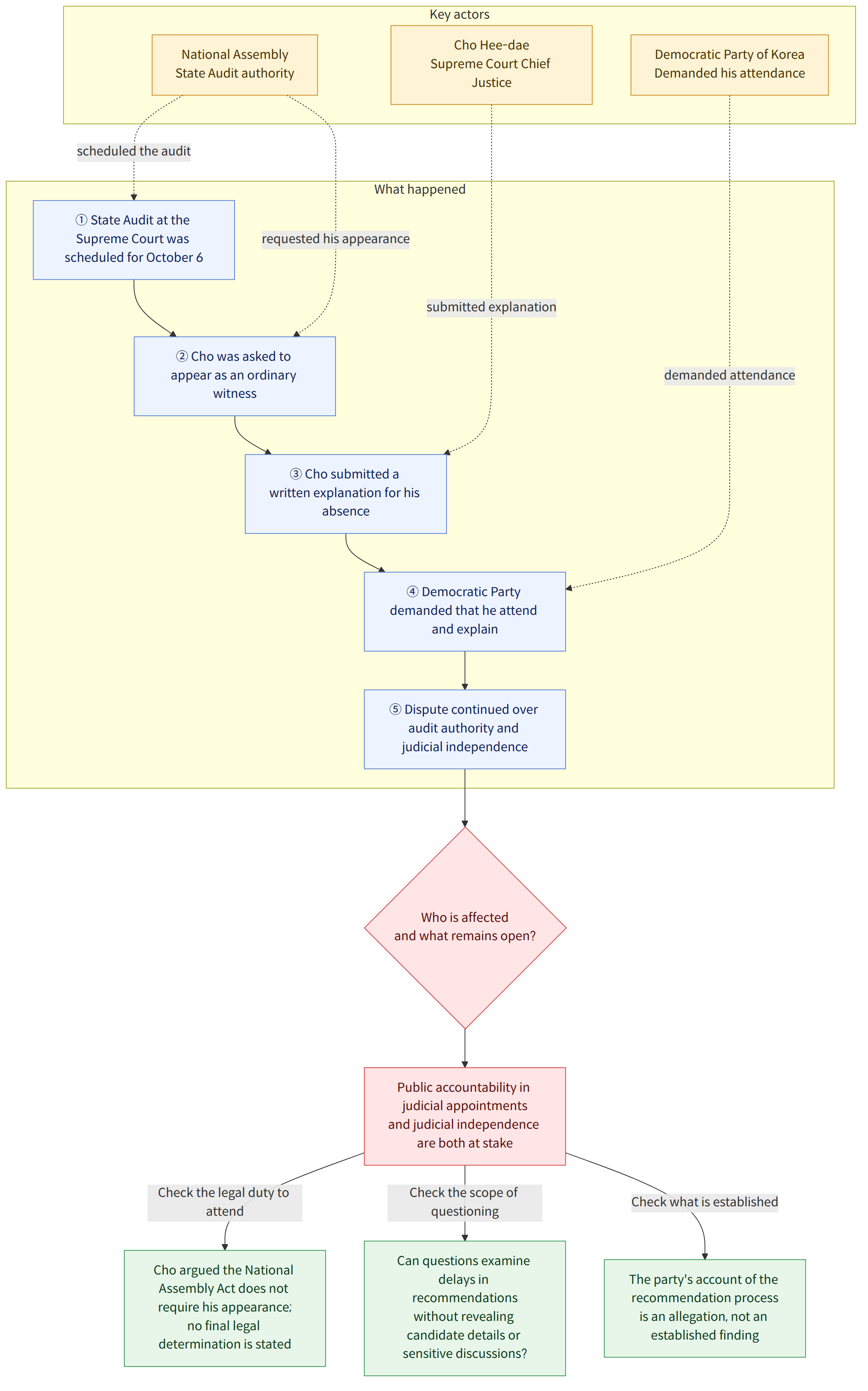
Supreme Court Chief Justice Cho Hee-dae submitted a written explanation for his absence in response to a request that he appear as an ordinary witness at the Supreme Court’s State Audit scheduled for October 6. The Democratic Party of Korea demanded that he attend the audit and explain himself, and pressed him to resign if he had no intention of appearing. At the center of the dispute is whether the National Assembly can examine, through witness questioning, matters of judicial administration concerning recommendations for Supreme Court justices, and whether doing so would infringe on judicial independence.
Background and context
The key issue in the written explanation submitted by Chief Justice Cho is the nature and scope of disclosure of the recommendation authority—the power to propose candidates for Supreme Court justice. Chief Justice Cho argued that, because the recommendation authority is an independent constitutional power of the Chief Justice, requiring testimony about it before the National Assembly could run counter to the principles of separation of powers and judicial independence. He also said this would be inconsistent with the intent of the National Assembly Act (국회법), which does not impose an obligation on the Chief Justice to appear before and answer to the National Assembly.
He stated that it would be inappropriate to disclose in detail information about Supreme Court justice candidates, sensitive matters concerning ongoing appointments, or discussions related to the President’s constitutional powers. The written explanation also said it could not rule out the possibility that a complaint concerning the exercise of the recommendation authority could lead to a future investigation. These are the reasons Chief Justice Cho gave for his absence; they do not mean that a legal determination has been made that he has no obligation to attend.
The Democratic Party says the subject of this witness questioning is not a particular trial, but a state of unconstitutionality that it believes arose because recommendations for Supreme Court justices had not been made for an extended period—in other words, a matter of judicial administration. Spokesperson Lee Yong-woo said the public wants to know whether the Court Administration Office (법원행정처) gave its view that the candidates should be recommended again, but Chief Justice Cho rejected that view and directed that the position be framed as a refusal. This is the party’s allegation; the circumstances or whether the situation was unconstitutional have not been established by the contents of the written explanation and news reports alone.
What this news means
This confrontation is a case in which two principles collide: the reach of the National Assembly’s authority to conduct State Audits and the point at which the judiciary’s independent powers must be protected. The Democratic Party argues that the National Assembly can require testimony to hold judicial administration accountable, while Chief Justice Cho argues that demanding disclosure of the Chief Justice’s recommendation authority and related discussions could exceed the limits imposed by the separation of powers. Neither side’s position has been established as the final interpretation of the law.
For the public, both accountability in the process of recommending Supreme Court justice candidates and the protection of judicial independence are at stake. If the National Assembly cannot question the process, the avenues for demanding explanations about appointments may be limited. Conversely, if a demand for testimony leads to disclosure of candidates’ personal information or sensitive discussions, concerns about the independence of judicial powers could grow. For example, if the National Assembly seeks to establish why recommendations were delayed, a key issue may be whether questions about the recommendation process can be distinguished from information about candidates and discussions that may be difficult to disclose.
The Democratic Party says attendance is obligatory, while Chief Justice Cho submitted a written explanation for his absence, citing judicial independence and the recommendation authority. This dispute alone does not establish that the Chief Justice is obligated to attend.
Points reported differently by different outlets
Reports share the facts that an appearance was requested and a written explanation for absence was submitted, but differ in the issues they cover. One report focused on Democratic Party spokesperson Lee Yong-woo’s call for the Chief Justice to resign and the claim that he was obligated to attend under Article 2 of the Act on Testimony, Appraisal, etc. before the National Assembly (국회증언감정법). Another covered Chief Justice Cho’s reasons for not attending, as well as a rebuttal by lawmaker Kim Eui-gyeom and the background to the selection of witnesses for the State Audit.
Another report said that National Assembly Legislation and Judiciary Committee Chair Seo Young-kyo cited Article 129 of the National Assembly Act, Article 10 of the Act on the Inspection and Investigation of State Administration (국정감사 및 조사에 관한 법률), and Article 5 of the Act on Testimony, Appraisal, etc. before the National Assembly as the legal basis for the request that the Chief Justice appear. Chair Seo argued that if he appeared, he would also have to take the witness oath and testify, and said that legal measures could be taken if he failed to appear without a legitimate reason. These are the National Assembly side’s claims and explanations; they are not a final determination of the legal effect of the written explanation or whether attendance is obligatory.
What is confirmed and what remains unknown
Confirmed facts
- Supreme Court Chief Justice Cho Hee-dae submitted a written explanation for his absence in response to a request that he appear as a witness at the Supreme Court’s State Audit on October 6.
- The written explanation cited the independence of the recommendation authority, the sensitive nature of candidates’ personal information and ongoing appointments, and concerns about disclosing discussions with the President.
- Chief Justice Cho also cited a complaint concerning the exercise of the recommendation authority and the possibility of a future investigation as reasons for his absence.
- The Democratic Party demanded that he attend the State Audit and explain himself, arguing that the Chief Justice is not exempt from the obligation to appear as a witness.
What remains unknown
- Whether Chief Justice Cho will actually attend the State Audit on October 6
- How the National Assembly will respond to the written explanation for his absence
- The specific details of the complaint concerning the recommendation or renewed recommendation of Supreme Court justice candidates, and whether an investigation will proceed
- A final legal determination on whether the Chief Justice is obligated to appear as a witness at this State Audit
What readers should check
- It is necessary to check whether Chief Justice Cho actually appears on the day of the State Audit and how the National Assembly responds to his written explanation.
- It is important to assess the Democratic Party’s and Chief Justice Cho’s positions separately, and to check which legal provisions and constitutional principles each side cites as the basis for its position on the attendance obligation.
- Before the complaint concerning the recommendation or renewed recommendation process, or the progress of any investigation, is confirmed, it should not be treated as an established violation of the law.
References
- Other coverage consulted: hani.co.kr
- Other coverage consulted: chosun.com

















