
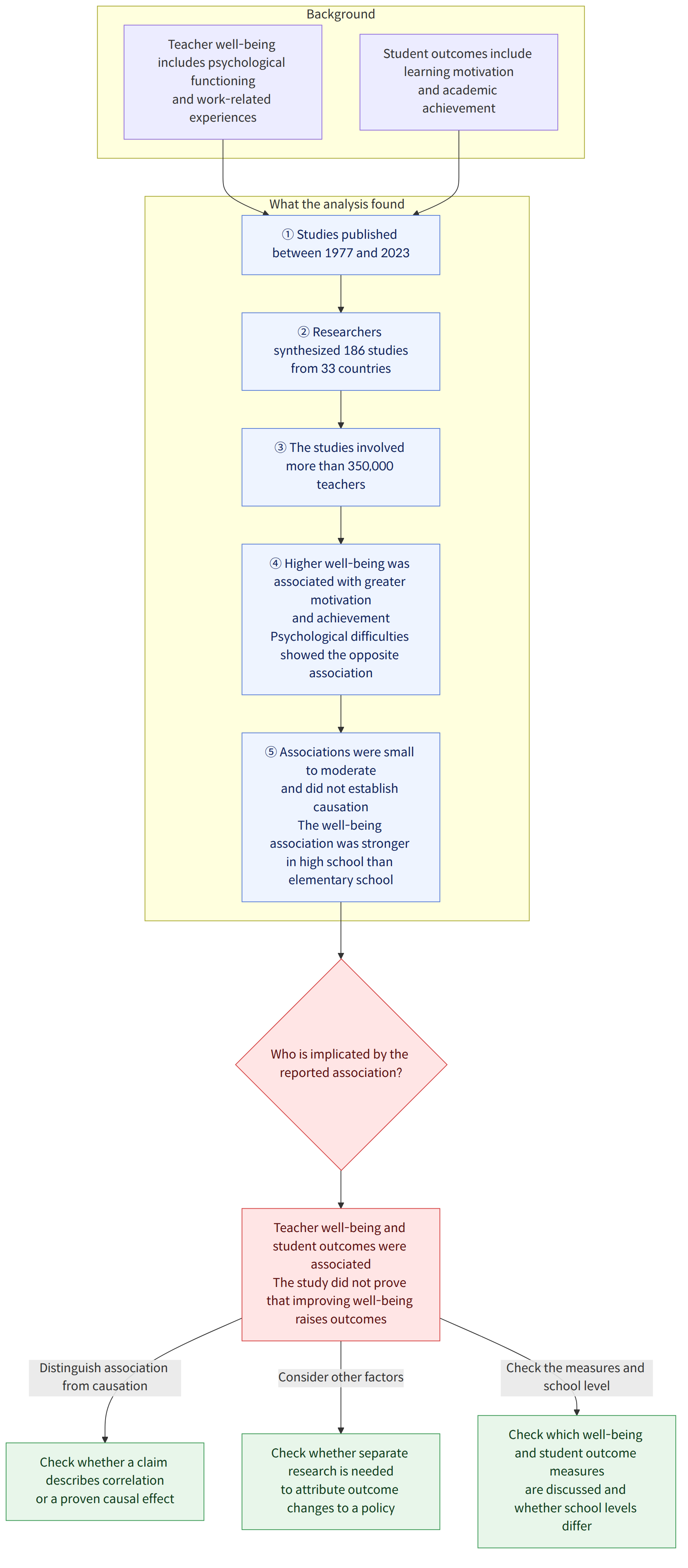
A study has found that teacher well-being may be associated not only with teachers’ own working conditions but also with students’ learning motivation and academic achievement. Teresa Dicke and her fellow researchers synthesized data from 186 studies published between 1977 and 2023 in 33 countries, involving more than 350,000 teachers worldwide. According to the article, this is the largest analysis to date of evidence on the relationship between teacher well-being and student outcomes.
The analysis consistently found that higher teacher well-being tended to be associated with greater student motivation and academic achievement. Conversely, psychological difficulties such as burnout, stress, depression, and anxiety were associated with student outcomes in the opposite direction, and this association was slightly weaker than the relationship between well-being and student outcomes.
Background and context
The researchers did not limit teacher well-being to mood in the narrow sense. They included psychological functioning such as self-efficacy (the belief that one can do one’s job), job satisfaction and engagement, work motivation, positive mood, and the ability to cope with job demands. Psychological difficulties, by contrast, included not only burnout and stress but also signs of psychological strain such as depression and anxiety.
Student outcomes, too, meant more than test scores. Along with academic achievement, such as grades and test scores, the analysis examined learning motivation, including interest in learning, goals students set, and their beliefs about their own abilities. The findings therefore indicate a broad association between teachers’ state of well-being and students’ learning outcomes; they do not mean that any one specific measure of academic performance improved.
Job satisfaction, work motivation, and overall psychological functioning each showed associations with improved student outcomes of similar magnitude. The relationship between teacher well-being and student outcomes was stronger in high school than in elementary school. However, no equivalent difference by school level was found for teachers’ psychological difficulties, and the study did not explain why.
What this news means
These findings are noteworthy because they suggest that the case for improving teachers’ working conditions may extend beyond teachers’ personal welfare and retention in the profession. If teachers who struggle with their workload or face substantial psychological strain tend to have students with poorer outcomes, the school working environment may also be connected to the conditions in which students learn. However, this is a possible interpretation of the findings, not a confirmed conclusion that a particular policy will improve student outcomes.
The researchers offered possible explanations: when teachers’ needs for autonomy, competence, and relatedness are met, they may be able to teach in ways that support students’ autonomy and motivation; and teachers who are psychologically well may be better positioned to manage classrooms and build relationships with students. However, the study did not directly test either explanation. These pathways remain possible interpretations.
The study found a tendency for teacher well-being and student outcomes to change together. It did not establish a causal relationship showing that improving teacher well-being raises student outcomes.
The researchers said the associations were small to moderate in size. Other factors may also be related to student outcomes, and this analysis alone cannot distinguish the effects of each factor. For example, if a school introduces a policy to reduce teachers’ workloads and student outcomes change, separate research would be needed to determine whether this was due to improved teacher well-being or occurred alongside other changes.
What is established and what remains unknown
What is established
- The analysis synthesized 186 studies covering elementary schools, secondary schools, and combined schools in 33 countries.
- The data included more than 350,000 teachers worldwide, and the studies were published between 1977 and 2023.
- Teacher well-being was associated with higher student motivation and academic achievement, while psychological difficulties were associated with student outcomes in the opposite direction.
- The association between well-being and student outcomes was stronger in high school than in elementary school, but the same pattern by school level did not appear for psychological difficulties.
- The findings are correlational, and the associations were described as small to moderate in size.
What remains unknown
- The analysis does not establish the specific effect sizes of the associations.
- The analysis did not determine whether policies to improve teacher well-being actually raise student outcomes.
- The reason no differences by school level were found in the relationship between psychological difficulties and student outcomes is also unknown.
What readers should check
- When examining well-being measures at schools or in education policy, readers can check how workloads are actually adjusted and whether support for school leadership and collegial relationships is included. The article on the research recommends investing in manageable workloads, supportive school leadership, and collegial relationships.
- When evaluating teacher support policies, it is important to distinguish changes in teacher satisfaction or psychological well-being from changes in student outcomes. Even if both change together, that alone does not establish causation.
- Rather than applying the findings directly to an individual school or specific class, readers should bear in mind that the analysis synthesized studies from multiple countries and school levels and found an association.