The Ritual of Loyalty: Celebrating the Founder to Empower the Successor
North Korea has officially marked the 114th birth anniversary of its state founder, Kim Il-sung. While the day is nominally dedicated to the grandfather of the current regime, the primary objective of the celebrations is to reinforce the absolute authority of Kim Jong-un.
Through state-controlled media, the regime is calling upon all party members and citizens to demonstrate increased loyalty. This strategic move ensures that the historical legitimacy of the founder is used as a bridge to solidify the current leader's grip on power.
The 'People-Centered' Philosophy: A Political Tool
Central to this year's anniversary is the concept of people-centered policies. The Rodong Sinmun, the official newspaper of the ruling Workers' Party of Korea, highlighted that the founder's philosophy of treating the people as "the sky" (meaning the highest priority) continues under Kim Jong-un's leadership.
In practical terms, a people-centered approach (a political strategy where the state claims to prioritize the welfare of the masses to maintain stability) is presented as a "perpetual political philosophy." By framing the current leadership as the rightful heir to this legacy, the regime attempts to justify its rule through a narrative of benevolence.
"With unwavering loyalty, (we) should uphold the ideology and leadership of respected general secretary Kim Jong-un, who carries forward the sacred history of supreme leader Kim Il-sung's people-centered policy."
The Evolution of the 'Day of the Sun'
Historically, the birth anniversary of Kim Il-sung has been known as the Day of the Sun, one of the most significant national holidays in North Korea. However, observers have noted a subtle but critical shift in terminology in recent years.
The Shift in Honorifics
- The regime has gradually refrained from using the term "Day of the Sun" in official capacities.
- This change is interpreted as a deliberate effort to shift the focus of loyalty from the deceased founder to the living leader.
- By toning down the glorification of the past, the state creates more space for the cult of personality surrounding Kim Jong-un.
This transition is a classic example of political succession management, where the prestige of a predecessor is utilized to legitimize the successor before eventually being eclipsed by the new leader's own image.
Mass Mobilization and Social Control
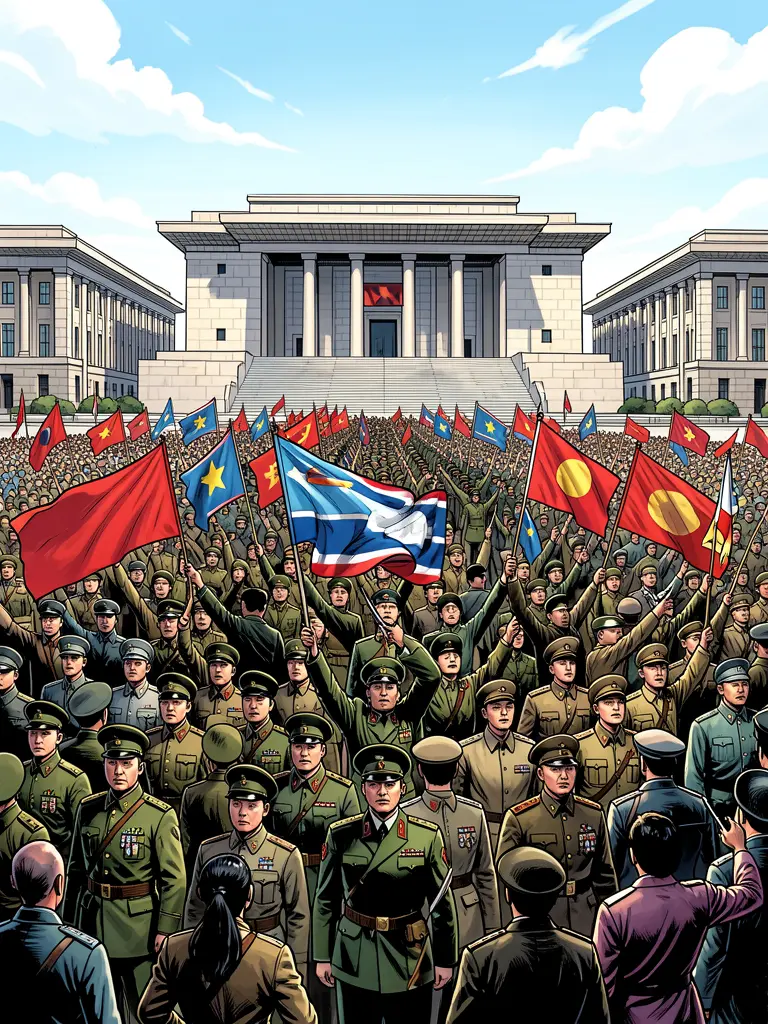
To demonstrate national unity, the regime has organized a series of large-scale events involving various social organizations. These activities serve as a public pledge of allegiance to the current leadership.
Key participating groups include:
- The Socialist Women's Union of Korea: Organizing events to align female citizens with state goals.
- The Union of Agricultural Workers of Korea: Ensuring the loyalty of the rural population, which is critical for food security.
- Youths and Students: Holding massive outdoor rallies at Kim Il Sung Square in Pyongyang to project an image of youthful vigor and devotion.
These rallies are not merely celebrations but are forms of social synchronization (the process of ensuring all members of a society think and act in unison), which discourages dissent and reinforces the state's omnipresence.
Future Outlook: The Consolidation of the Kim Dynasty
As North Korea continues to navigate economic hardships and international sanctions, the emphasis on people's welfare mentioned in state media is seen as a strategic attempt to quell internal dissatisfaction. The regime claims that improving the lives of citizens is its "top priority," though actual implementation remains opaque.
Looking forward, the regime is likely to continue blending the legacy of Kim Il-sung with the current directives of Kim Jong-un. This dynastic continuity is essential for the regime's survival, as it presents the leadership not as a political choice, but as an inevitable historical destiny.
By linking the current leader to the "sacred history" of the founder, the Workers' Party of Korea aims to ensure that any challenge to Kim Jong-un is viewed as a betrayal of the state's very foundation.