
An October 4 column on divisions within the Democratic Party (민주당) focused on three sets of photos released at different times: a dinner photo taken just after the party convention in August, photos of former party leader Jeong Cheong-rae in the hospital in September, and a photo of Jeong having dinner with President Lee Jae-myung in October. The photos themselves do not prove the causes of the conflict, but who released each scene and the interpretations that followed offer clues to distrust and tension within the party.
Background and context
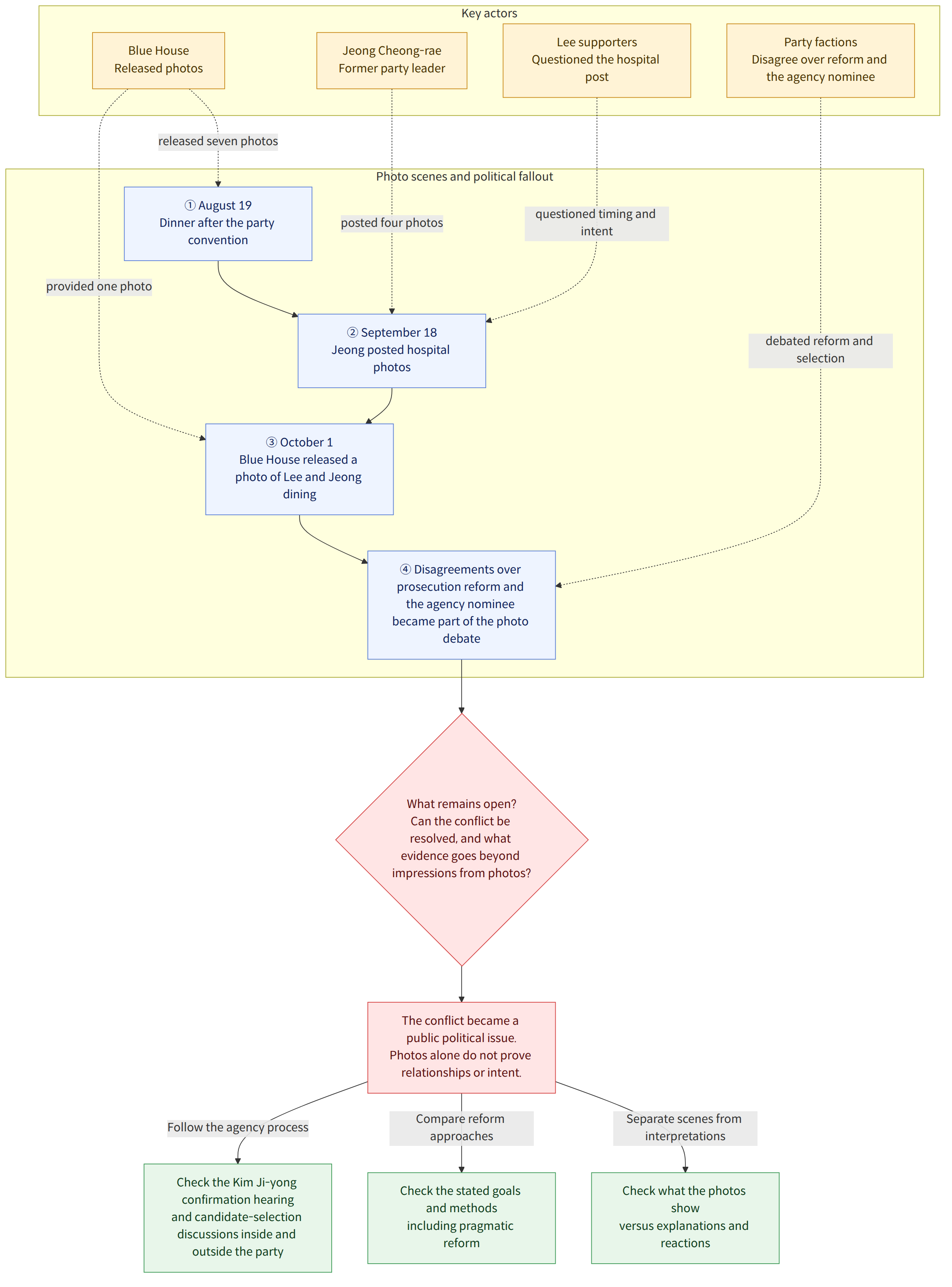
The first scene was a “dinner meeting with the party leader and candidates” held just after the Democratic Party convention on August 19. The Blue House (청와대) released seven photos, which showed party leader Kim Min-seok, then-candidates for party leader Jeong Cheong-rae and Rep. Song Young-gil, floor leader Han Byeong-do, Presidential Chief of Staff Kang Hoon-sik, Senior Secretary for Political Affairs Hong Ik-pyo, and others. The column reported that Jeong was smiling in only three of the seven photos.
An aide to Jeong said that the photos looked more like a celebration of victory than a scene of consolation for the convention’s defeated candidate and efforts to foster unity. This does not mean the participants’ actual feelings can be confirmed from the photos alone; it shows that the same scene was perceived differently depending on people’s positions and experiences within the party.
The second was a photo Jeong posted on Facebook on September 18. He said he had been hospitalized for three days with chills and a fever, and posted four photos of himself lying in a hospital bed in a patient gown. His side explained that he released them because there had been much discussion about his not attending the previous day’s plenary session. Supporters of Lee raised questions about the timing and intent of the post. The episode shows how a photo can serve to convey information about someone’s health while also being interpreted as a political message.
The third was a photo provided by the Blue House on October 1. The Blue House gave reporters one photo of Lee and Jeong sitting side by side, saying they had dined together for four hours. It also announced that they had spoken frankly about state affairs and party matters and developed a deep consensus. However, neither the column nor related reports gave details of their actual conversation.
What this news means
A photo shows the composition of a particular moment and the people in it. Interpreting that scene as “consolation,” “celebration,” “unity” or “discord,” by contrast, depends on explanations and reactions from those who released the photo and those who viewed it. Losing sight of this distinction can lead people to treat the impressions conveyed by a photo as conclusive evidence of the individuals’ relationships or intentions.
That does not mean the debate over the photos is meaningless. Party members and supporters have assigned different meanings to the released scenes, and even the president responded to rumors of discord online. These facts show that the conflict has become a public political issue rather than remaining confined to the party. October 1 was also the day before the Serious Crimes Investigation Agency (중대범죄수사청) was due to be launched, and the day the Blue House announced that it would proceed with the confirmation hearing for Kim Ji-yong, its first candidate to lead the agency.
At the heart of the conflict are disagreements over how to pursue prosecution reform. The column says one side argues that reform must be carried out properly to prevent a repeat of the tragedy of prosecutorial abuse of power, while the other believes it should reduce suffering and resistance while delivering effective results. According to related reports, Lee said he would pursue “pragmatic reform,” stressing that reform should lead to results that improve people’s lives rather than serve as a means of achieving political gains or attracting attention.
This dispute is intertwined with the debate over the selection of a candidate to lead the Serious Crimes Investigation Agency. The issues going forward, then, are not limited to who was photographed with whom. How the goals and methods of reform are explained, and what processes and discussions the candidate selection undergoes both inside and outside the party, may provide more direct grounds for assessing whether the conflict can be resolved.
Public political disputes can also affect trust in the government’s performance and in the party. The column said that public approval of the president’s job performance had not rebounded significantly after the president’s “reflection” press conference, and that support for the Democratic Party had also fallen. It interpreted this as a reflection of public fatigue and cynicism. However, it did not give figures for how much either rating changed. What readers can confirm is the column’s statement that ratings fell—not the size of the decline or its cause as a matter of numerical fact.
For example, if a voter sees a photo and concludes that the relationship between the president and the party leadership has been repaired, they should also consider whether the explanations after the dinner are followed by actual policy decisions and party discussions. A photo can serve as a political signal, but it cannot stand in for proof of the substance of a policy or whether a conflict has been resolved.
Confirmed facts and what remains unknown
Confirmed facts
- The Blue House released seven photos of a dinner held just after the party convention on August 19, and the column reported that Jeong was smiling in three of them.
- On September 18, Jeong posted four hospital photos on Facebook, saying he was hospitalized; his side and supporters of Lee offered different interpretations of why they were released.
- On October 1, the Blue House provided one photo along with details of a four-hour dinner between Lee and Jeong, and announced that they had developed a consensus on state affairs and party matters.
- The column reported continuing disputes over the direction of prosecution reform and the selection of Kim Ji-yong as a candidate to lead the Serious Crimes Investigation Agency.
What remains unknown
- Reports do not say what specific issues Lee and Jeong discussed at their October 1 dinner or whether they reached any agreements.
- The column does not give the scale of the changes it mentions in the president’s job-approval rating or the Democratic Party’s support rating.
- It is difficult to determine from these reports alone whether the release of the photos eased tensions within the party or made them worse.
What readers should look for
- Distinguish interpretations attached to the photos from explanations actually given by the people involved and their political factions. In particular, Jeong’s side and supporters of Lee differed over why the September photos were released.
- Check how follow-up announcements on prosecution reform and the selection of a candidate to lead the Serious Crimes Investigation Agency explain the specific policy details and confirmation-hearing process.
- When assessing the reported decline in approval ratings, distinguish the column’s account from actual poll figures and the dates the polls were conducted. The column provided does not state the scale of the changes.
References
- Other coverage consulted: hani.co.kr

















