
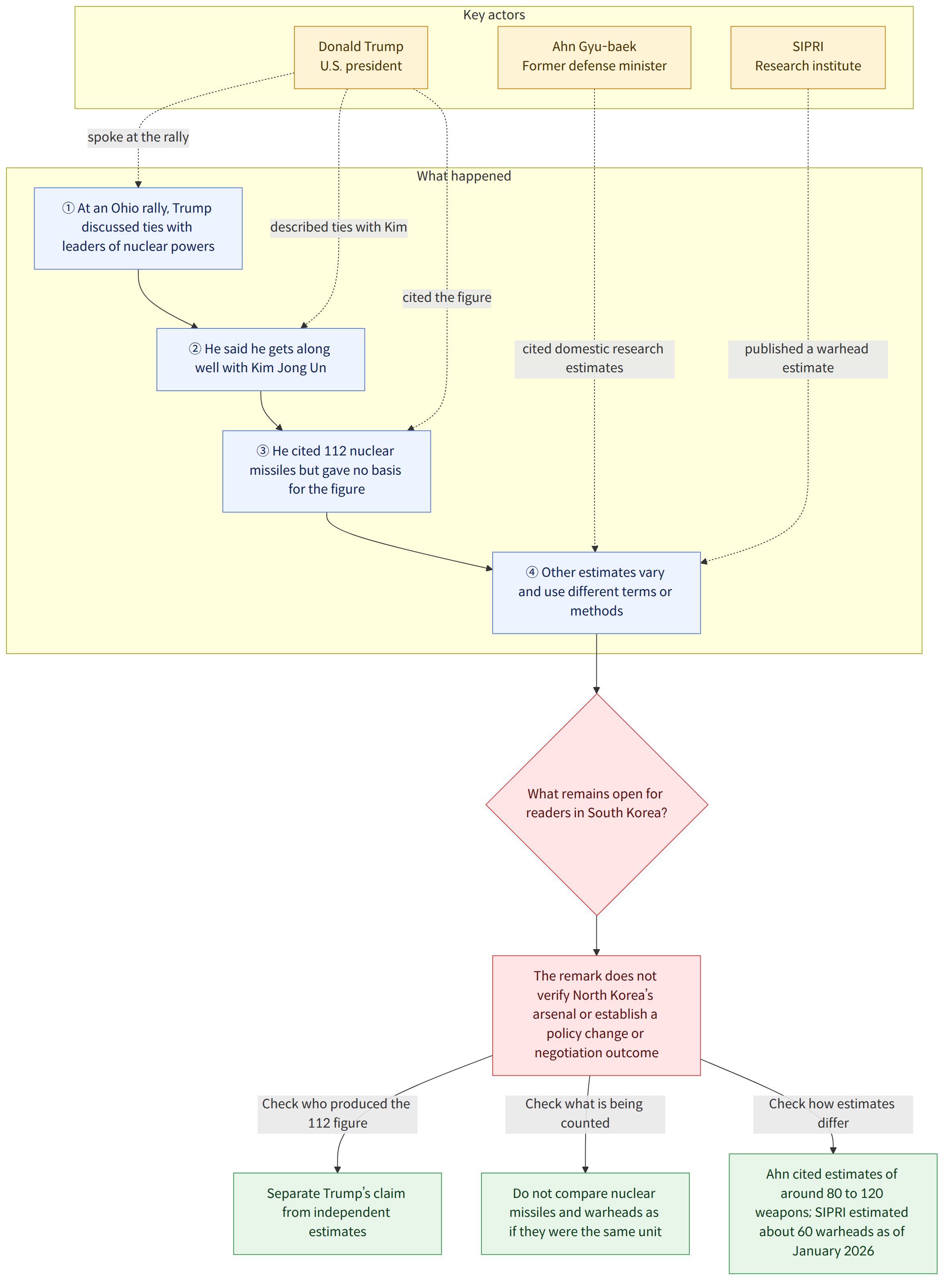
U.S. President Donald Trump said he “gets along very well” with North Korean leader Kim Jong Un at a midterm election rally in Ohio. While discussing his relationship with Chinese President Xi Jinping, he said that it was important to maintain good relations with leaders of countries that possess nuclear weapons. According to another news report, after mentioning Kim, Trump added, “When somebody has 112 nuclear missiles, it’s good to get along.”
The key point of the remark is not just that Trump mentioned his relationship with Kim Jong Un. In defending his relationships with leaders of major powers, Trump emphasized the importance of maintaining cordial ties with leaders of countries that possess nuclear weapons. However, this remark alone does not establish how U.S. policy toward North Korea or the actual relationship between the two sides has changed.
Background and context
The first report said that Trump told a rally on Saturday that he gets along well with Kim Jong Un and emphasized the importance of maintaining good relations with leaders of countries that possess nuclear weapons. The quotation that followed ended with the phrase, “Isn’t it good to get along?” Another report included more information about where the remark was made, its surrounding context, and the nuclear-missile figure.
According to that report, the remark was made at a rally in Ohio on October 3 local time. Explaining why he maintains good relations with Xi Jinping, Trump asked whether it would not be better to maintain good relations with the leaders of major nuclear powers. Immediately after mentioning Kim Jong Un, he also cited “112 nuclear missiles,” but did not explain what information the figure was based on.
Therefore, “112” should be treated not as a confirmed count of North Korea’s nuclear weapons, but as a figure Trump cited at the rally. The report noted that the phrase could be interpreted as referring to North Korea’s nuclear-missile capabilities, while also pointing out that the basis for the figure had not been made public. Nuclear missiles and nuclear warheads are different terms, so figures using different units should not be compared directly as if they were measured on the same basis.
What this news means
The remark shows that Trump is invoking his personal rapport with Kim Jong Un when discussing relations with North Korea. According to reports, Trump has recently also called Kim “my friend” and said, in effect, that he is almost the only person Kim likes. These remarks offer a glimpse of how Trump describes diplomatic relationships, but the fact that he emphasized a personal relationship does not, on its own, establish that a policy change or agreement has taken place.
For readers in South Korea, the important point is to distinguish the rhetoric of the remark from verified assessments of North Korea’s nuclear capabilities. For example, if someone cites “112 nuclear missiles” to describe North Korea’s arsenal, it is worth first checking whether the figure is Trump’s claim or an estimate from a separate analytical institution. Even if the remark draws attention as a diplomatic message, it does not in itself verify a nuclear-weapons figure or indicate a specific negotiation outcome.
The other figures cited in the reports are not a single, definitive figure calculated in the same way. Former Defense Minister Ahn Gyu-baek said, citing analysis by domestic research institutions, that North Korea is generally believed to have around 80 to 120 nuclear weapons, but that it is extremely difficult to state an exact figure. The Stockholm International Peace Research Institute (스톡홀름국제평화연구소; SIPRI) estimated in its 2026 yearbook that North Korea had about 60 nuclear warheads as of January 2026, a figure reported to be 10 higher than the previous year.
The report said that when Trump previously claimed in August that Kim Jong Un had “57 very powerful nuclear weapons,” he did not make public the basis for that figure either. Trump’s claim of 112, his earlier claim of 57, and estimates by research institutions and others come from different sources and use different terms, so they should not be grouped together as though they were a single confirmed figure. It is also important to bear in mind that estimates of the number of nuclear weapons vary among institutions.
Where the reports differed
The two reports agree on the central points: Trump said that he gets along well with Kim Jong Un and emphasized his relationships with leaders of countries that possess nuclear weapons. However, the first report’s quotation ends with “Isn’t it good to get along?” and does not mention a nuclear-missile figure. The other report adds Trump’s reference to “112” and notes that the basis for the figure was not made public, as well as providing several estimates of the size of North Korea’s nuclear arsenal.
What is confirmed and what remains unknown
Confirmed facts
- At a midterm election rally in Ohio, Trump said he “gets along very well” with Kim Jong Un.
- While discussing his relationship with Xi Jinping, he emphasized the importance of maintaining good relations with leaders of countries that possess nuclear weapons.
- According to another report, after mentioning Kim Jong Un, he cited “112 nuclear missiles,” but did not explain the basis for the figure.
- The reports also included different estimates of the size of North Korea’s nuclear arsenal and Trump’s past remarks.
What remains unknown
- It has not been confirmed what information or method of calculation Trump relied on when he cited “112.”
- The reports do not say what specific meeting or conversation Trump was referring to when he spoke about his relationship with Kim Jong Un.
- It has not been confirmed whether the remark led to a specific change in policy toward North Korea or an agreement between the two sides.
What readers should check
- When you encounter figures about North Korea’s nuclear capabilities, check who made the statement, its source, and the basis of the estimate; distinguish between terms with different units, such as nuclear missiles and nuclear warheads.
- Consider Trump’s remarks about personal relationships separately from information about actual policy or agreements. These reports alone do not confirm any specific agreement or follow-up action.
- Check whether subsequent reports provide new information about the basis for the figure or relevant conversations, but do not fill in the gaps in unverified remarks with speculation.
References
- Other coverage consulted: hani.co.kr