

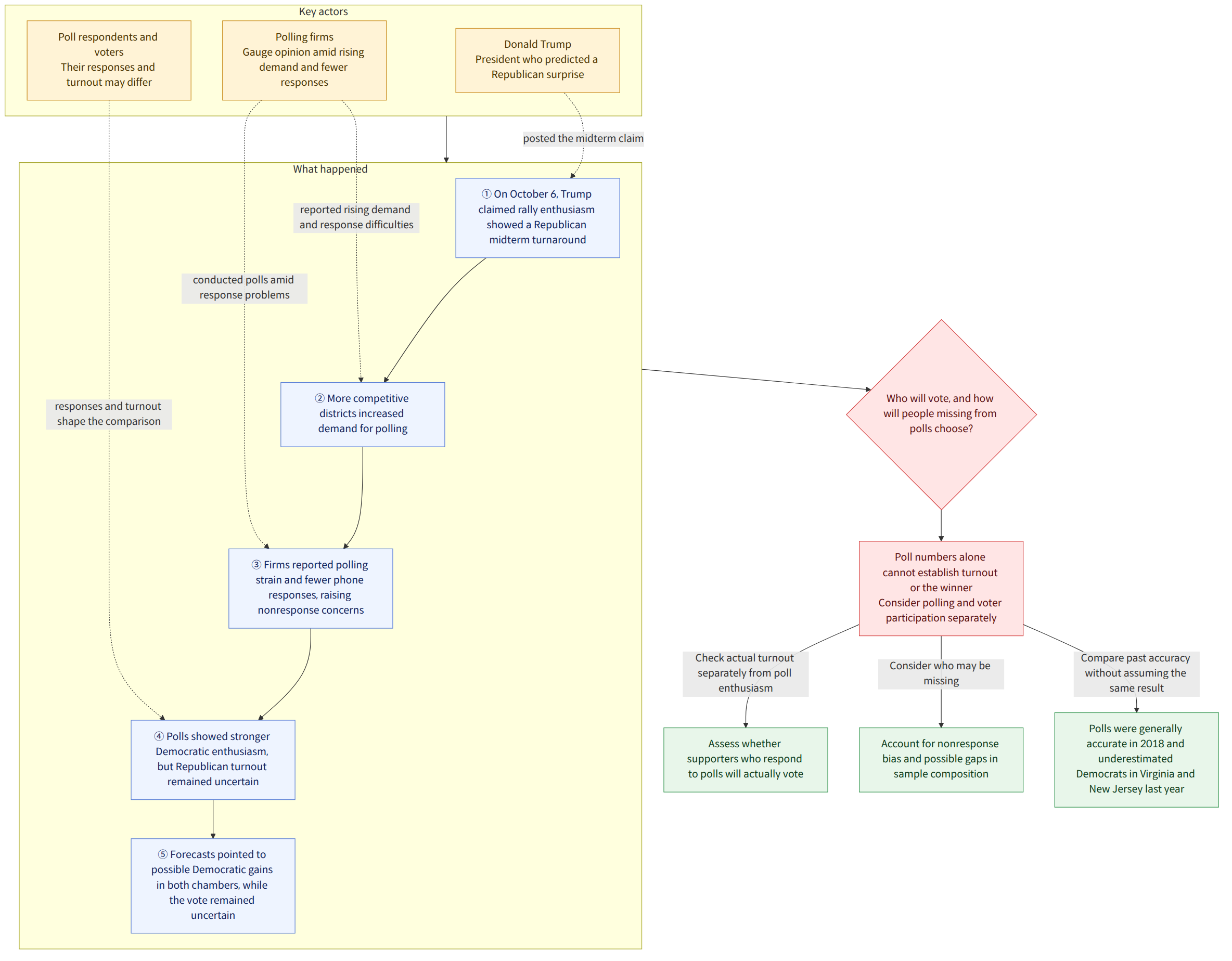
U.S. President Donald Trump has predicted a Republican “midterm surprise.” However, various polls and election forecasts point to the possibility that Democrats could retake not only the House of Representatives but also the Senate. At the same time, the expansion of competitive districts and declining response rates are making it harder for polling firms to gauge public opinion, leaving it uncertain how closely current poll results will match the actual vote.
On October 6 (local time), President Trump wrote on Truth Social that the crowds and enthusiasm at rallies were “incredible” and that “we’re turning the tide all over the place.” He also said the media were failing to report the changes and urged people to “watch for the ‘Midterm Surprise.’” But it is unclear whether this claim reflects an actual shift in the state of the race.
Background and context
Election polls use the views of respondents to estimate public opinion as a whole. As a result, poll results can differ from election outcomes depending on who responds and whether those respondents actually vote. This time, the number of competitive districts has grown more than expected, leading to a surge in demand for polling, and reports say polling firms are finding it harder to gauge public opinion.
Landon Wall of GrayHouse, a Republican polling firm, described the current situation as “like doomsday.” He said the firm rotates between three call centers to handle its polling workload. Brent Buchanan, CEO of another Republican polling firm, Signal, said that even after expanding its capacity, the firm gets fewer responses per hour of phone polling than it did two years ago.
These difficulties vary in severity by location. Reports say response-rate problems are more pronounced in Alaska, where the population is widely dispersed, and in South Texas, where turnout is low. This is why “nonresponse bias”—the possibility that the makeup of people who respond to polls differs from that of actual voters—is seen as a factor.
Recent polls reflect stronger enthusiasm among Democrats and weaker turnout among Republicans. But it is not known whether Republicans who are less inclined to respond to polls will also stay away from the polls on Election Day. In other words, differences in poll responses should not be read as direct evidence of differences in voting results.
Concerns about sample composition also remain. There are warnings that polls may again fail to adequately capture white voters without college degrees in Nebraska, Iowa and Kansas. Republican polling expert Patrick Ruffini said that state-level shifts in support seen recently would not necessarily carry over into the actual election, adding, “The fundamentals are going to matter a lot more than we think right now.”
Still, the fact that polls are uncertain does not mean Republicans are favored. Polls were generally accurate in the 2018 midterm elections, and in last year’s elections in Virginia and New Jersey, they underestimated support for Democrats. Past examples do not guarantee the outcome of this election, but it is also difficult to conclude in advance that polls will err in favor of one side.
What this news means
The key point for readers is to consider poll numbers and actual voter participation as separate pieces of information. Even if polls show strong enthusiasm among one party’s supporters, it is necessary to separately assess whether those respondents will actually vote and how voters who did not participate in the polls will choose. Conversely, low response rates alone are not enough to conclude that a particular party’s supporters will not vote.
Republicans are focusing on the turnout battle during the remaining campaign period. As President Trump travels to key areas to rally his supporters, outside political groups have also invested heavily in advertising. According to AdImpact, outside political groups supporting President Trump spent about $96.6 million after Labor Day and had secured an additional $89 million in advertising spending through Election Day. President Trump’s “surprise” message can be seen as part of a strategy to get Republican supporters to the polls.
For example, even if a poll shows strong enthusiasm among Democratic supporters and fewer responses from Republican supporters, that poll alone cannot establish actual turnout or determine the winner. The choices of voters who did not respond and actual voter participation must be known before it is possible to judge how closely the poll results matched the election outcome.
What is known and what is still unknown
What is known
- On October 6, President Trump predicted a Republican “midterm surprise” on Truth Social.
- Various polls and forecasts point to the possibility that Democrats could retake the House and Senate, but it is unclear whether President Trump’s claim reflects the actual state of the race.
- Concerns have been raised about declining response rates and nonresponse bias as the number of competitive districts and demand for polling have increased.
- Polls in the 2018 midterm elections were generally accurate, while polls in last year’s Virginia and New Jersey elections underestimated support for Democrats.
- Outside political groups supporting President Trump spent about $96.6 million after Labor Day and secured an additional $89 million in advertising spending through Election Day.
What is still unknown
- It is not known which party will actually control the House and Senate after the midterm elections.
- It has not yet been established how large the polling errors in this election will be compared with those in past elections.
- It is not known whether Republicans who are less inclined to respond to polls will actually vote.
What readers should check
- When looking at poll results, check whether response rates and the composition of respondents are provided alongside the figures for voter support.
- Poll results and actual voter participation can differ, so also check information about supporters’ enthusiasm and turnout.
- Rather than declaring a winner based on a single poll, compare the forecasts with the results once multiple polls and election results are available.

















